Sermon: Knowledge, Faith, and Love

Solomon is certain he has built a place worthy of being God’s dwelling place forever.  … Forever is a long time: building a permanent dwelling place for God strikes me as an attempt to create boundaries for God that work for us, but perhaps not for God.  God’s former home was that tent made out of cloth, and skins, not stone.  It was not a permanent dwelling.  And so I think of that tent as representing how our Faith is a journey, not an endpoint; a path we must walk.  We might stop occasionally to dwell for a time, but we always move on.  A tent is not a monument.

Lord God, may your peace and Holy Spirit fill this place. Open your scripture to us, and may I clearly communicate that which you intend us to receive. May your Word take root and flourish within each and every one of us; and through it may we be strengthened and transformed by your unconditional, living, and limitless love for us and all of your Creation. 

In Jesus Name, Amen.

Tom texted me yesterday and asked if I would fill in for him this morning.  I immediately said yes, certain I had a sermon somewhere in my archive that would provide a good starting point for a meditation on this morning’s scripture.  Oops.  It took a lot more work than I thought; which is probably a good thing, actually: because if it wasn’t a journey to write this sermon and prepare for this service, then it probably wasn’t worth doing.

This morning’s reading is about Israel redefining its relationship with God in the time of Solomon the Wise.  The old tent that long housed the Ark of the Covenant no longer seemed fitting to them, for their prosperous and peaceful Kingdom.  

At the end of our reading, Solomon is certain he has built a place worthy of being God’s dwelling place forever.  …Forever is a long time: building a permanent dwelling place for God strikes me as an attempt to create boundaries for God that work for us, but perhaps not for God.  God’s former home was that tent made out of cloth, and skins, not stone.  It was not a permanent dwelling.  And so I think of that tent as representing how our Faith is a journey, not an endpoint; a path we must walk.  We might stop occasionally to dwell for a time, but we always move on.  A tent is not a monument.

Also, for a while now, I’ve been pondering how Faith operates in and through us on our journey through life.

For example, we saw Faith at work last week here, at our Special Congregational Meeting  – a major stepping stone in a long period of our congregation evaluating what works, what doesn’t, what’s broken, and what needs to be replaced or rethought.  We were asked to commit ourselves to the next step in that journey in the form of a Capital Campaign, to prepare our church’s infrastructure for the future. 

That meeting, just like this worship service, and so many other things that we do – either individually or jointly – are all expressions of faith.

Continue reading “Sermon: Knowledge, Faith, and Love”

Thoughts on Gaza and the Israel/Palestine Conflict

Jesus taught that we must love The Other – no prerequisites, no limitations, no exceptions. That’s a very, very hard thing to do – especially in times like this. Yet, we must.

I have Jewish friends whom I deeply value and respect, just as I have Palestinian friends whom I equally value and respect. Many of these folks are friends and co-workers with each other, deeply committed to affirming the value of all human beings; regardless of nationality, race, creed, or political convictions.

The events of the past several months have been deeply troubling to my friends, as they have been to me.

They are appalled and deeply troubled by Hamas’s slaughter of innocent Jews and Palestinians in the October 7th attacks. Many of the dead, wounded, and missing are their own friends, families, and co-workers. People they knew. People they loved across the divisions and strife their own leaders and governments continue to nurture in the name of maintaining and expanding their own power.

But equally, they are angered by the Jewish Government & IDF’s response to that attack. Few deny that Israel has the right to defend itself, and that a forceful response to the Hamas attack is reasonable. But many question, as do I, the ferocity and breadth of that response. They are angered, as am I, by Israel’s willingness to sacrifice tens of thousands of innocent lives in its campaign to extinguish Hamas. …A fruitless and self-defeating endeavor I might add, as such violence and contempt will create more new militants and new enemies than it kills. People who will dedicate their lives to making Israel pay for what it has done, just as Israel is punishing all Palestinians for what Hamas has done.

The grievances and pain both sides have experienced both before and since October 7th is real and cannot be denied. I know people on both sides of that fence. They are deeply wounded by the decades of conflicts and injustice they’ve suffered, wounds they will never fully be healed-of.

Continue reading “Thoughts on Gaza and the Israel/Palestine Conflict”

Sermon: Who We Are

Paul had to address problems that we still face today. People still talk at each other rather than with each other. People still seem unable to appreciate their neighbor’s points of view. Many don’t give credence to others’ perspectives including our own – if they hear us at all. So, What does Paul do?

Please join me in prayer…  

Lord God, may your peace and Holy Spirit fill this place. Open your scriptures to us, and may I clearly communicate that which you intend us to receive. May your Word take root and flourish within each and every one of us. Through it may we be strengthened and transformed by your unconditional, living, and limitless love for all of your Creation. In Jesus Name, Amen.

I’ve been thinking a lot about community recently. Especially communities of faith – such as ours, here at MCC. In our reading, Paul talks about what a community of faith is, and how to make it work.

In Paul’s time, Corinth was a young city of several hundred thousand inhabitants, rebuilt long after Rome destroyed the original city and all of its people.

Everyone was an immigrant, or descended from immigrants. The social hierarchy was still fluid and evolving. So, improving one’s social status was possible, unlike most Roman cities. This may be why many came to Corinth in the first place. But even so, there were great disparities in wealth, power, and privilege. Most of the population were slaves and freedman, and very poor. Some were newly wealthy, but often had a low social status due to their own humble origins. 

Back then, Christians were seen as slightly bonkers (we still are). But we worship together regardless of class, which was very odd to folks back then, because it challenged the social norms of the time.

In Corinth at this time, there were perhaps 200 Christians over all, meeting in tiny house churches scattered around the city. Their members are known to include Jews, longtime Gentile believers, new converts, slaves, the wealthy, and perhaps a few soldiers and Roman officials as well. It was a tiny and diverse but fragmented, community of faith. They worshiped together, but their divergent perspectives and lives created friction.

Paul had to address problems that we still face today. People still talk at each other rather than with each other. People still seem unable to appreciate their neighbor’s points of view. Many don’t give credence to others’ perspectives including our own – if they hear us at all.

Continue reading “Sermon: Who We Are”

A Prayer of Invocation Inspired by Ecclesiastes 3

Lord God, Creator of all Space and of all Time, the God who is and who was and who ever shall be, the Great I Am: changeless and yet everchanging.

God of Faith, we are thankful for your presence here with us today: You are always at our side, always believing in us, even when we fail to believe in ourselves.  You are always seeking to fill us with your peace and your strength and your love: helping us face the unending challenges of this world, weeping when we are hurting and broken, rejoicing to see us grow and prosper, helping us follow the path you intend for us as we journey through this life.

God of Hope, we gather here today, seeking refuge and rest; renewing our strength so that we may continue bringing your Gospel to a world that is not what it once was.  It is a new season, and all is changing.  We are tired, and we ourselves are not what we once were.  We seek to better know who we are, and better know who you are, that we may know who our neighbor is, and so that we may learn how to love them for who they are, as they are.

God of Love, help us to never fear nor fail to embrace those who are other, even those who reject us.  Help us love those who seem unlovable.  Help us see them with your eyes.  And, help us to love ourselves, for only with the love you have planted and are nurturing within us can we minister out of that love to our neighbors.

In the name of Jesus, whom you gave to this World out of your boundless love for all of your Creation, and your desire that all be healed, including us; Amen.


Delivered at Memorial Congregational Church UCC in Sudbury MA, September 18, 2022.

Copyright 2022, Allen Vander Meulen III, all rights reserved.

This work is licensed under a Creative Commons Attribution-NonCommercial 4.0 International License.

Sermon: “The Ocean of Memory”

“…nothing we own, nothing we value, nothing we think we control in this life, will last.  Once we are gone, we cannot enjoy any amount of wealth, cannot use anything we once had to return us into present life.  We remain there forever – lost in that ocean of memory with none of the riches we once treasured.  We will not even have control over our own memory: everything will be in the hands of those we leave behind.”

This weekend, of course, is Memorial Day weekend.  It started as a sort of groundswell movement all over the North and South during and shortly after the Civil War: a day to place flowers on the graves of those who died in battle; a day to remember those we’d lost because of that war: It has grown to become a day of Remembrance for all who died in any of the wars our nation has fought.

Now I am not going to speak about the Civil War, or how it is still being fought today in so many ways, nor even about war in general.  But, I think the themes of Memorial Day’s narrative are reflected in this morning’s scripture readings – the themes of loss, and of the Love of God; and how that shapes our relationships with others, and even within ourselves.

Every death, whether expected or understandable – such as from old age, or perhaps in battle; or not understandable – such as from COVID, or a shooting in a classroom; is a loss.  The uniqueness of those who died, and all the richness and beauty and potential of their lives dies with them.  They are lost from the present, never to return; living on only in our memories.  But, human memory inevitably fades with time, and it vanishes entirely when those who knew that person pass on themselves.  I visualize this as a sort of tide, a tide of memory slowly receding from the shores of the present.  Yet, in reality it is the present that is advancing.  We are leaving that tide behind.

I grieve even when those who have been a royal pain to me or to those I whom love pass away – although I’ll admit, perhaps I don’t grieve quite as much. 

Even so, our lack of fond memories of them does not mean they were not loved by others, nor that they did not have value as human beings.  If nothing else, they were loved and valued by God.  And if God loves and values them, how can we not do the same?  To me, the question seems to be not whether we should love those who are in our past, but how to do so in our present.

Continue reading “Sermon: “The Ocean of Memory””

“Approve of Him”?

I’ve recently seen a spate of Facebook posts, political emails and opinion columns saying the writer can’t (and we shouldn’t) “approve of the President.”  I would suggest this is a fundamentally flawed approach…

Saying this suggests we should hate or dismiss the man for what and who he is.

Really?

And yet, as a minister, I and many of my peers constantly preach and demonstrate we love all of our neighbors no matter who they are or what they believe.  No matter what their race, income, nationality, immigration status, marital status, sexual orientation, or gender identity.  Jesus taught that we are to love each other without judgment, without preconditions.

That includes the President, too.

So, I cannot approve of him, nor disapprove of him.

Continue reading ““Approve of Him”?”

Lost But Not Forgotten

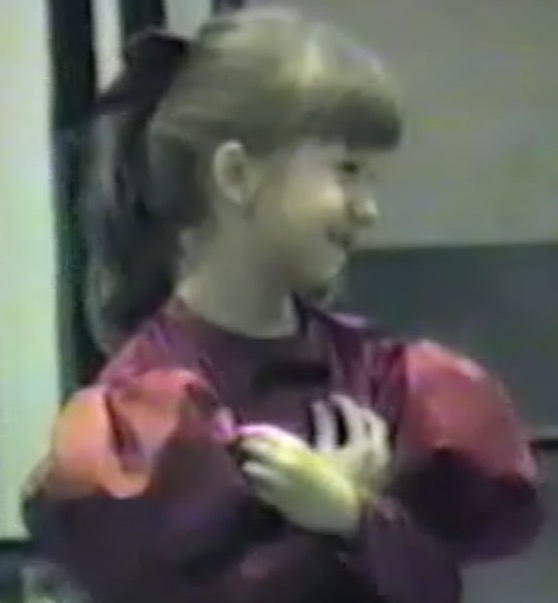
This image is of my daughter taking a bow after dancing to the song “I Will Follow Him” in a talent show at our church in October of 1995.  I pulled this from one frame of a shaky and out of focus video of the performance, shot by a very poor videographer (me), using a video camera that was old and tired even then. The video’s quality has not been helped by its later conversion from VHS to DVD and then (recently) to MP4.

Despite the faded and poor quality imagery, my memory of her performance that day is sharp and clear, and always will be.   She was only six years old at the time.  She selected the song by herself and used what she’d learned in her Ballet lessons to choreograph the dance on her own.  And, she selected her outfit for the performance – a red “twirly hoop dress” – all by herself, too.

She did a fabulous job, and kept her composure even when an excited toddler ran on to the stage during the dance.  The congregation let her know their appreciation with a rousing ovation and cheers.  She did great.  I was a very, very proud father that day.

But, it is also a memory tinged with sadness.  A few years later, our relationship was destroyed in the death of my first marriage: I was shut out of her life without any choice or voice in the matter, and know almost nothing of her life since.  I doubt that this rupture will ever be healed.

Continue reading “Lost But Not Forgotten”

A Benediction: The Word Became Flesh

This Benediction is based on the well known “The Word Became Flesh” passage at the start of the Gospel of John (John 1:1-14).  I wrote it for use on Christmas Day in year “A” of the Revised Common Lectionary. 


In the beginning was the Word, and the Word was with God, and the Word was God.   This Word became flesh and lived among us, and we have seen its glory, full of grace and truth. And, all who receive the Word are children of God, born of God.

The Word is the light of all people. It shines in the darkness, and the darkness cannot overcome it. And, so that all might believe, we are called to testify to this light.

So, go forth!  Rejoice in the Love of God made manifest through the Child of God. Go forth, testify to that Love and share it with all of God’s Creation, just as God shares it with each and every one of us.

Amen.


Copyright (c) 2016, Allen Vander Meulen III, all rights reserved.  I’m happy to share my writings with you, as long as proper credit for my authorship is given. (e.g., via a credit that gives my full name and/or provides a link back to this site – or just email me and ask!)

Fuzzball’s Run

This is a true story from my own life that I’ve used a couple of times for Sermon illustrations.  Here it is presented as a longish “Message for All Ages”, but would also be suitable for a  youth group session, or a Bible Study.  The scripture reading is 1 Kings 19:1-15a, which is about Elijah’s fleeing Jezebel’s wrath and then being confronted by God while hiding in the cave on Mt. Horeb.

A helpful prop for this story would be a 6 foot tall aluminum stepladder, or perhaps a good sized photo of one.


I once had a home with a huge backyard.  Since I didn’t want to spend all my time mowing the fenced back yard (and couldn’t afford a bigger mower), I bought some sheep to eat the grass.  The male of the three was named Fuzzball by my daughter.

One Sunday, I decided to trim the some dead branches on trees near the house; but quickly realized that my ladder [just like this one] was far too short for the job. It was getting late, so I left the ladder leaning against a tree and went in for the night.

The next morning I opened my bedroom window a bit as I got ready for work, I liked hearing the sheep bleating to each other as they grazed on the grass.

Suddenly, a rather surprised bleat sounded through the window.  No big deal – I figured one of them had gotten themselves in trouble again, which they always seemed to be doing. I figured I’d check into it when I fed them before leaving for work, and so kept tying my tie.

Then came a tremendous clatter.  Running to the window, I looked out just in time to see Fuzzball running at top speed from the near corner of the yard, where the trees were, to the far corner, where his shed was.

Continue reading “Fuzzball’s Run”

Blame

You know – with regards to the recent massacre in Orlando, we are sliding back into the same old same old set of accusations and counter-accusations we see every time: “Who’s fault is it?”

Is it the Muslims?

The Gays?

Bigots?

Obama?

The GOP?

The NRA? (Well …)

Trump?

Blaming is an old game: based on the idea that we must have winners and losers. And yet, nobody ever wins.

How long must we keep up this mindless charade?

And then we have the next layer of this old game, that of hitching one’s own cause (and/or -ism) to the issue…

Gun Control

Lifting the ban on allowing Gays to donate blood

Immigration

Racism

All of these causes are important and worthwhile, and many of them do intersect with what happened in Orlando this past weekend.  But, by linking a cause dear to us with the terror in Orlando, are we obscuring what happened?  …Obscuring what happened by insisting the event be viewed only through a lens of our choosing?

Look: 50 people died, and and another 53 were physically injured.  Uncounted others have lost loved ones, many more will be dealing for the rest of their own lives with the trauma they experienced that night, and others will spend a lifetime caring for those who have been forever scarred by this attack.

And, we see pain erupting from many in the LGBTQ community because of this, and you can understand why: clubs such as Pulse were a refuge from the judgment and pain they experienced in the outside world.  Those refuges are now no longer safe.  LGBTQ people have become a new target of domestic terrorism just when the laws and society here in the U.S. finally seemed to be on the verge of forever setting aside homophobia.  The newly blossoming reality of being able to live their lives unmolested and free from fear has been taken away from them, perhaps forever.  For an LGBTQ person, this attack was very personal, and very scary: a very real threat to their very existence, carried out against them purely because of who they are.  I can’t imagine feeling like I’m living with a target painted on my back, but I’m sure many in the LGBTQ community feel exactly that way right now.

50 people have died.  Hundreds if not thousands more will never escape the pain and fear planted within their souls that night.

Let’s focus on that.

As a Christian, I see the Bible, particularly Jesus own teachings in the Gospels, as making it very, very, clear that we must take responsibility for our own actions and attitudes, and not seek to escape such responsibility.  Laying blame on others is exactly that: an attempt to say “it’s somebody else’s problem, not mine.”

So, instead of trying to figure out who to blame, ask instead “What have I not done that I should be doing, to keep such things from happening?”  Because, our own attitudes and prejudices and fears definitely played a part – however small – in causing this to happen.

And, instead of hitching one’s own cause to the pain of others, respect the pain and loss that has occurred.  Embrace those who have lost loved ones.  Walk at the side of those who cannot stop the pain of this trauma from leaking out of their souls.  We cannot directly feel their pain, nor can we (nor should we) try to minimize it.  Instead, we must allow them to work through their pain – and be there for them when they need help, or need someone to listen to what they have to say.

Jesus’  taught that we must love God without limit, and love one another in the same way.

The world can be a cruel, hard place.  Bad things will happen.  As Christians, we are called not to judge, but to heal.  So in the end, ask how you can help bring healing.  Ask how you must change in response to what has happened.

Love is the answer, not blame.

Amen.


Hell

A meditation written upon hearing of the shootings at the Pulse Nightclub in Orlando, Florida on the morning of June 12, 2016.

O God.

When we demonize others, when we condemn others for simply being who they are: seeing them as less then human, we create Hell here on earth; welcoming the demons of darkness and eternal fire into our own souls.

Hell is not some netherous place in the afterlife. Hell is right here, right now.

In Sandy Hook.

In Boulder.

In Oak Creek.

In Charleston.

In San Diego.

In Chicago.

Paris. Tel Aviv. Deir El Zour.

And now, in Orlando.

Hell takes root when we believe the threat of deadly force is our first defense against the transgressions, or faults, of those around us.

Hell thrives when we encourage violence or injustice against another for simply being “Other” than we.

Hell cannot die if we do not accept that the presence of evil in this world depends upon our own sin, not upon the sins of others.

Hell is in every city and town. Hell is in every one of us.

And yet, our unconditionally loving God forgives the evil we create.

My prayer is that we learn to forgive in return: rejecting and healing ourselves from the Hell we’re creating for ourselves and others here on God’s Earth.

We free ourselves from Hell through embracing love, not hate.

– Pastor Allen


Copyright (c) 2016, Allen Vander Meulen III, all rights reserved. I’m happy to share my writings with you, as long as proper credit for my authorship is given. (e.g., via a credit that gives my full name and/or provides a link back to this site – or just email me and ask!)

Sermon: Scattered and Gathered

The story of the Tower of Babel and of Peter’s Sermon on the First Day of Pentecost are two sides of the same coin: Both stories demonstrate that God values us and speaks to us as individuals. Acts 2 also shows that our relationships with God and each other are both communal and individual in their nature; and that God intends both aspects to be present in our relationships with each other and with the Divine.

Pieter_Bruegel_the_Elder_-_The_Tower_of_Babel_(Vienna)_-_Google_Art_Project_-_edited
“The Tower of Babel” by Pieter Bruegel the Elder, 1453.

This week we celebrate the beginning of the Christian Church, Pentecost.  Among other things, Pentecost is a declaration that Christ’s relationship with his disciples, including us, is a new thing: one that transforms us and our relationship with the Divine in fundamental and lasting ways.

Pentecost reflects a new level of openness, of sharing, of vulnerability. A deeper bond has been created: binding us together and with God through the Holy Spirit that indwells each and every one of us. It is an affirmation of who we are and who we are to become.

Continue reading “Sermon: Scattered and Gathered”