What is Faith?

Hebrews is unique, no other book in the Bible is quite like it. It reads like an old time evangelist’s sermon: full of color, movement, stirring imagery and ringing phrases that were meant to be memorable when spoken. We are familiar with many of those phrases, such as: “Faith is the assurance of things hoped for, the conviction of things unseen” – and – “we are surrounded by so great a cloud of witnesses” – or – “Jesus, the author and perfecter of our faith.” So then, what is Hebrews 11 teaching us about what “Faith” is?

JoanOfArc-JohnEverettMillais-1865

What is Faith?


It’s not a simple question.  For us, the answer to that question begins with Genesis … and never really ends.

As I’ve said before, Faith defines how we see ourselves, who and what we choose to have relationships with, and what we envision our end (and the eventual end of all Creation) to be.  Faith helps us make sense of the events and circumstances that shape us and our world.  It lays out a path for us to follow into the future.  Faith enables us to gaze into the infinite and the unknowable and find a place there for ourselves.  It helps us make sense of the mystery of God and the vastness and beauty of Creation.  And, it enables us to exist in a world of uncertainty and change.

HarryPotterAndSnape

A lot has been written on the topic of Faith; not just the in Bible, but in everything from Hamlet or Pilgrim’s Progress, to Harry Potter and Star Trek. We admire those who have faith, and we honor those who die for their faith.  We seek to encourage faith in others, and our faith impels us to minister to those in need.  Faith is a powerful thing, and central to our existence, even though we may have a hard time defining exactly what it is.


The 11th chapter of the Book of Hebrews is a profound response to the question of “What is Faith?”  Hebrews is unique, no other book in the Bible is quite like it.  It reads like an old time evangelist’s sermon: full of color, movement, stirring imagery and ringing phrases that were meant to be memorable when spoken.  We are familiar with many of those phrases, such as: “Faith is the assurance of things hoped for, the conviction of things unseen” – and – “we are surrounded by so great a cloud of witnesses” – or – “Jesus, the author and perfecter of our faith”.

Much of its Theology is subtle, but the delivery isn’t, nor was it intended to be. The author was addressing a community in crisis.  The people had lost their faith, and had no hope in their future.  The author intended to stir them up; re-awaken their faith; and help them reclaim God’s hope and plan for themselves, their community, and their future.

Chapter 11 is where the evangelist reaches the crescendo of their message.  I imagine them preaching it: arms waving in the air, voice thundering, starting each new thought with the ringing phrase “By Faith” …

By Faith Abraham obeyed when he was called … (and)

By Faith he and his descendants dwelt in the land God promised them, even though they did not yet possess it… (and)

By Faith Abraham believed God’s promise of descendants, despite he and Sarah being far too old to procreate…

By Faith!
Continue reading “What is Faith?”

Sermon: The Great Bargain

The Abrahamic Covenant requires us to obey God, but the story of Abraham’s Bargaining with God in Genesis 18 tells us that there is a great deal more to the Covenant than we think.

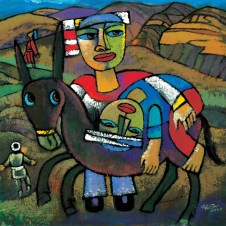
Abraham and the angels - He Qi
Abraham and the Angels by Chinese Artist He Qi

Our reading from the Book of Genesis this morning is part of major turning point in the Biblical narrative: a fundamental redefinition of the nature of God’s relationship with us.

In the first 17 chapters of Genesis, we read about the classic Judgmental and often distant God of the Old Testament. The God we read about in the Creation, the Fall, Noah and the Flood, and the Tower of Babel. But then we arrive here, at the story of Abraham, whom all the great monotheistic faiths claim as their forebear.

Abraham’s story begins with this distant God commanding him to leave his ancestral home in Harran, which he does: taking along his wife Sarah; his nephew, Lot; and all of their goods and possessions. They eventually settle in Canaan.

And there, Lot and Abraham part ways. And soon after, Abraham rescues Lot when Lot and his family are kidnapped in a raid by the enemies of Sodom and Gomorrah.

Then we read about the declaration of God’s new Covenant with Abraham, which we examined in a sermon here over a year ago. At that time we learned how Abraham’s Covenant demonstrates that God hears all of us and sees all of us. That we are all included in this Covenant with God; and that it is one from which none of us shall ever be rejected. But now we will see how Abraham’s Covenant changes the nature of our relationship with God.

The sticking point is that up until this moment, it has been a one-way relationship: God tells Abraham what to do; Abraham does it. We even see this in the Covenant’s requirement that Abraham and all of his household be circumcised. Abraham immediately does this not only to himself and his son Ishmael, but “all of the men of the house, slaves born in the house and those bought with money from a foreigner.”

But, this is no longer a one-way relationship. So, how does the other direction of this relationship work? By virtue of the Covenant, God must be responding to us in some way. This also means that God must be open to being changed by us. And, that is exactly what seems to be happening in this morning’s reading.

Continue reading “Sermon: The Great Bargain”

Sermon: Don’t Stop There!

The Bible is fundamentally a message of Hope. It acknowledges and warns us of pain and loss and evil and hate here in the present; but encourages us to look within ourselves to find the love and grace and hope that God planted there, and which will (eventually) bear fruit within our lives – if we give it a chance.

He Qi Good Samaritan
“The Good Samaritan” by He Qi (2001)

I thought we should begin with some backstory for this morning’s Old Testament reading.

The prophet Amos of Tekoa is the earliest of the so-called 12 minor prophets grouped together at the end of the “Old Testament”. He sets the model for prophetic ministry that is followed by all of his successors, including John the Baptist and Jesus.

Amos began his ministry around 750 BC: shortly after the first Olympics were held in Greece, and about when the legend says Rome was founded by Romulus and Remus. It was a time when the Northern Kingdom of Israel and the Southern Kingdom of Judah were both at the height of their power, wealth and influence. Things were good – the borders are secure; people are getting rich; the land is at peace.

But then there’s Amos: a really gloomy guy, not someone you’d invite to a party! He was the first to prophesy what at the time seemed unthinkable: that the Northern Kingdom would be conquered and laid waste by the Assyrians, the survivors forced into exile.

Amos-5
“They take a bribe and turn aside the poor at the Gate.” (Amos 5:12)

Tekoa, which is we where are told Amos is from, is a Hebrew word that means “trumpet.” “Amos” means “brave” or “strong;” and that is what he was, a brave trumpet: proclaiming the word of God for all to hear, particularly those in power. (Even though they were too busy with the good life to want to hear it!)

Now, the entire Book of Amos is basically two long series of prophesies, with almost no other dialog or prose. The first set of prophecies ends in chapter 7, verse 9 from today’s reading. Then we have this short vignette where the King’s High Priest, Amaziah, misrepresents Amos’s words to the King. Amaziah then demands Amos return home to Judah, which he refuses to do. Instead, Amos defends himself and then launches into his final two chapters of prophetic gloom and doom.

And yet… Amos’s prophecies do not end in despair, but with hope. At the end of his book we read…

I will restore the fortunes of my people Israel,
and they shall rebuild the ruined cities and inhabit them;
they shall plant vineyards and drink their wine,
and they shall make gardens and eat their fruit.
I will plant them upon their land,
and they shall never again be plucked up
out of the land that I have given them,
says the Lord your God.
(Amos 9:14-15)

Like Amos, all of the prophets end on a note of hope for the future, despite all of the catastrophic events and dire pronouncements that fill their prophecies. This pattern is also seen in the Book of Revelation and in the Gospels. The Bible never leaves us in the midst of loss, failure and pain. So, don’t stop there! …As Winston Churchill is reputed to have said: “If you’re going through Hell, keep going!”

Continue reading “Sermon: Don’t Stop There!”

Sermon: Evil

It is easy to find people and groups to blame for what happened in Orlando, but is that what our faith calls us to do?

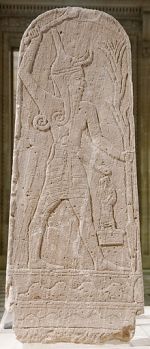
220px-Baal_thunderbolt_Louvre_AO15775
A 14 century BCE stele showing the Sidonian God Baal (with Thunderbolt)

NB: This video by Amaryllis Fox was shown before the start of the sermon, and is referred-to during the course of it.

You know – with regards to the recent events in Orlando, we have once again resorted to the same old game of accusation and counter-accusation: “Who’s fault is it?”

Is it the Muslims?  ISIS?  Gays?  The NRA? (Well …)  Maybe Mr. Trump?

Blaming assumes we can have winners and losers; but nobody ever wins. How long will we continue this mindless charade?

Look: 50 people died, and another 53 were hospitalized.  Uncounted others lost loved ones, many more will be dealing for the rest of their lives with the physical and emotional trauma they experienced that night, or caring for others forever scarred by that attack.

We see pain erupting from within the LGBTQ community because of this. You can understand why: places like Pulse are a refuge from the painful judgmental world they deal with every other moment of every day.  Such refuges are now no longer safe.  LGBTQ people have become a new target of domestic terrorism just when we finally seemed to be on the verge of forever setting aside homophobia.

For an LGBTQ person, this attack was very personal, and very scary: a very real threat to their own individual and communal existence, carried out against them purely because of who they are.  I can’t imagine feeling like I’m living with a target painted on my back, but I’m sure many of our kindred within the LGBTQ community feel exactly that way right now.

50 people died.  Thousands more will never escape the pain and fear planted within their souls that night.

Let’s focus on that.

Continue reading “Sermon: Evil”

Sermon: Scattered and Gathered

The story of the Tower of Babel and of Peter’s Sermon on the First Day of Pentecost are two sides of the same coin: Both stories demonstrate that God values us and speaks to us as individuals. Acts 2 also shows that our relationships with God and each other are both communal and individual in their nature; and that God intends both aspects to be present in our relationships with each other and with the Divine.

Pieter_Bruegel_the_Elder_-_The_Tower_of_Babel_(Vienna)_-_Google_Art_Project_-_edited
“The Tower of Babel” by Pieter Bruegel the Elder, 1453.

This week we celebrate the beginning of the Christian Church, Pentecost.  Among other things, Pentecost is a declaration that Christ’s relationship with his disciples, including us, is a new thing: one that transforms us and our relationship with the Divine in fundamental and lasting ways.

Pentecost reflects a new level of openness, of sharing, of vulnerability. A deeper bond has been created: binding us together and with God through the Holy Spirit that indwells each and every one of us. It is an affirmation of who we are and who we are to become.

Continue reading “Sermon: Scattered and Gathered”

Sermon: Discipleship

At the core of the concept and calling of discipleship is the idea that, while journeying with others as they learn, we are learning more about our own faith, about ourselves, and that God’s Love is around us and within us all the time. And so, it is hard to justify interpreting Paul’s journey to Macedonia as being only to evangelize others or to “save” a rich merchantwoman from eternal Hellfire and Damnation.

BaptistryAtPhilippi
A Modern Greek Orthodox Chapel said to be located on the site of Lydia’s Baptism near Philippi.

Our scripture readings this morning all touch on different aspects of the issue of Discipleship.

In Acts 16, we see Paul and his team of co-workers responding to Paul’s vision that they are to minister in Macedonia. Once they arrive there, we see a woman in turn responding to Paul’s evangelism. She establishes a church within her own home; a church that Paul’s Epistles tell us supported him and his ministry for the rest of his life. Yes, Paul, Silas and Timothy were all Disciples. But, so was Lydia and so were those who succeeded her in the Church at Phillippi, and so are we.

Our reading from the end of the Book of Revelation is John’s penultimate vision of New Jerusalem: descending from Heaven, unifying Heaven and Earth. We will finally see the face of God; forever free from any curse or sin.

Paul’s dream, his work, and ours, are all part of preparing for the New Jerusalem; which is the goal of our Discipleship: the vision in the Book of Revelation is of what will be made manifest when our work, as disciples working together to build the Kingdom of God here on earth, is complete.

But, Literalists tend to see this passage, and the Book of Revelation as a whole, as a declaration of how everyone must become a Christian, and that those who refuse that call will perish. (Meaning us too, since we do not interpret the Bible in the same way they do.) For many of them, the Book of Revelation is an affirmation that there is one and only one true faith, and that it is theirs.  It saddens me how those who believe there is a very narrow path to salvation are often equally certain they are one of the few who have actually found it.

But, did Jesus actually teach this? Is it a helpful interpretation of scripture?

Continue reading “Sermon: Discipleship”

Our Many Judases

Christ gave us a new command: “Love each other deeply and fully. Remember the ways that I have loved you, and demonstrate your love for others in those same ways.” …In so doing we shall find that we are helping others to be healed as well, for that love is in them too; and even in our many Judases.

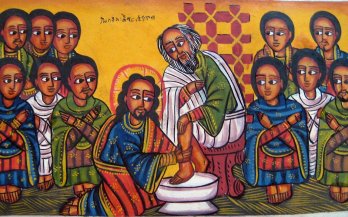
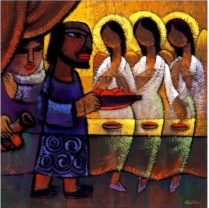
JesusWashingDisciplesFeet-EthiopianIcon
Ethiopian Icon of Jesus washing the disciple’s feet (artist & date unknown)

Monday (April 18th) was the 120th running of the Boston Marathon. And again we remember that moment during that race, three years ago, when the hate and anger that had been fanned to life within two young men exploded; forever altering or destroying the lives of many innocent and wonderful human beings.

We’ve seen people coming together in many ways to minister to those wounded, whether visibly or not, by this and so many other acts of inhumanity, both before and since that day. And, we’ve all seen those who were victims of such violence coming forward with their own stories, sharing them in many different ways, so that others who have suffered similar losses might find healing.

These outpourings of love, compassion and care reflect how Jesus calls upon us to love one another and minister to each other, especially in times if crisis, as we see in this morning’s scripture.  But, here in John 13, the disciples have not yet endured the tragedy that we know so well.

Continue reading “Our Many Judases”

Sermon: Feed My Sheep

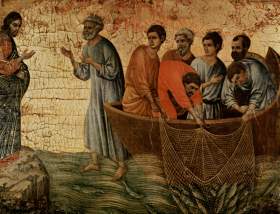
Duccio_di_Buoninsegna_015
“Appearance on Lake Tiberius” by Duccio di Buoninsegna, ca. 1308

The last chapter in the last of the four Gospels, the Gospel of John, is the final statement in the narratives of Jesus’ walk among us here on earth.  And as such, we can imagine that it has much to tell as we voyage forth into the world, leaving behind the physical presence of Jesus, just as a child ventures forth from home, eagerly heading to school on their own for the first time.

John is unique among the four Gospels.  It was written a few decades after the others and has a great deal of material not shared with the other three.  And unlike the so-called Synoptic Gospels of Matthew, Mark and Luke, John is very much focused on the future of the community of believers.

The 21st chapter focuses on our role as believers living and working in the world: Are we to be active or passive agents of the Body of Christ?  How will Christ be present in us in this role?  How will our own strength and faith be sustained as we do so?

Continue reading “Sermon: Feed My Sheep”

An Easter Sermon: A Sissified Jesus?

No, we (who are seen by some as “Liberal” Christians) do not believe in a sissified Jesus. We follow a Jesus who died for us. A Jesus who will never let us go, and a Jesus who loves us no matter what. That kind of love, that walks through any fire, endures any cross, is an uncompromising and fierce love. This is a Jesus who’s Gospel – in whatever form it may take – is for all, not just for some.

Kneeling at The CrossYou know, loving others is hard.

Loving those lost in grief or pain, loving those who have turned away from the world out of their illness or fear or abuse, is hard.

Loving those who are different from us; who’s ways are alien to us; who’s politics or faith, or piercings and tattoos, are offensive to us; is hard.

Loving people when they shout at you, when they refuse to hear what you have to say, when they call you ugly names, when they slander you and despise you and shut you down, is hard.

Loving those who abuse or oppress you, loving those who cannot or will not love you in return, loving others when you are in such pain yourself, loving those who are nailing you to a cross, is hard.

Continue reading “An Easter Sermon: A Sissified Jesus?”

Sermon: The Magic Messiah

Lent teaches us that the Kingdom of God is not a magical solution to all of the bad things we’ve had to endure. It will not take away our pains or erase our scars. The Kingdom of God is about Love, not hate. It is about healing, not magic; it is about conquering fear, not eliminating what spawned that fear within us. The Kingdom of God comes about after the death of all of our hope, and all of our fear. The Kingdom of God is realized only through our openness, brokenness, and repentance.

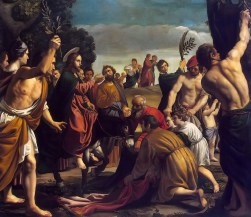
Entry Into Jerusalem by Pedro Orrente c. 1620

On Palm Sunday, we remember Jesus’ dramatic entry into Jerusalem: The Crowds celebrate his arrival, believing it heralds a new era for the people of Israel.   The Messiah has come, and will set everything right: the occupiers and their Empire will vanish; the evils and oppression they brought with them will be cleansed from the land. The incompetence and greed of Israel’s own leaders will be made as if it had never been, once David’s descendant, anointed by God himself, takes his rightful place on the throne.

Israel will regain its long lost greatness, and will indeed become greater than ever: a new Empire of God, with the Son of God himself as their King. The glory of the Temple and God’s renewed presence within it will shine forth to every nation and people in all the world, forevermore.  It’s all so beautiful, so wonderful, so magical: what a great thing to witness. What a great time to be alive.

But then it all comes crashing down. Now, just a few days later, Jesus and his disciples are hunted by the authorities: they know it is only a matter of time before Jesus, and maybe all of them, are arrested and maybe even executed.

The crowds are turning against this latest in a long string of disappointing Messiahs. They now see that the magic they’d seen in him has no substance or reality at all.   In the eyes of the people and their leaders, he is a fraud.

The magic is gone. The people feel that Jesus has betrayed them; and the disciples feel that God has betrayed them, and it seems like everyone has betrayed Jesus.

Continue reading “Sermon: The Magic Messiah”

Sermon: What About THEM?!!

It isn’t about them. … It is about us. Jesus is teaching us that to change the world, to make the Kingdom of God here on earth a reality, does not require that we change others; but rather requires that we change ourselves. This is part of the great journey of Lent after all, a time when we remove distractions. We look inward, taking a realistic look at our flaws and our failures. We repent, and ask God to help us.

shame-finger-pointing-320x198Do you remember, when we were kids, when someone whom we sometimes barely knew approached us in class, on the playground, or maybe even at church, and said “<So and So> just said something terrible about you!” or maybe “Did you hear that <So and So> just said or did some unimaginably awful thing?!”

Admit it, we’ve all not only experienced this, but have done these same things ourselves. (Hopefully less often now than we did as kids!)  We’ve all heard and then unthinkingly repeated things that we’ve heard someone else said or did, something that confirms what we knew about them all along, something that we feel validates why we cannot support them, or why they cannot be our friend, that proves they really do believe or represent something that is completely against the obviously right and true things that we believe.

Continue reading “Sermon: What About THEM?!!”

Sermon: Welcome to The Family

We are simultaneously part of many different families. Some of them endure for generations, others exist only for a particular moment in time. At their best, they give our lives shape, meaning and purpose; at their worst, they drag us down into a pit of despair.

JudeanDesert
The Judean Desert near the Dead Sea

My Grandpa loved life, loved his family, and loved making others laugh. I remember sitting with him in the kitchen: he’d smile a big broad smile, and then let his upper denture drop – “Clunk.” We kids would respond with peals of delighted laughter. Grandma, sitting across the table, would inevitably say: “O, Earl!” – Which only provoked more laughter. They were both lovely people, and were both quite strong and wonderful characters.

We all have such “characters” in our families: some eccentric, some difficult, some amusing or endearing, sometimes a combination of all three! They are people who don’t mind living life a bit off from the norm. In fact, at least in my own experience, these same relatives are often seen as embodying a set of qualities – or oddities – that “run in the family” – traits that are usually good (I hope), but sometimes not. They might include patterns of behavior; health issues; physical traits and gifts; ties to a particular place, time or nationality, or a particular legacy, among other things. But, they identify us as “us”: they help us see how and why our family came to be what it is, what it stands for, and why we are who we are.

We are simultaneously part of many different families: our family of origin, the family we marry into, the family we create with our spouse, our church family, our work and school families. Some of these families endure for generations, others exist only for a particular moment in time. But, they all provide us with an identity, and a reason for being who and what we are. At their best, they give our lives shape, meaning and purpose; at their worst, they drag us down into a pit of despair.

Continue reading “Sermon: Welcome to The Family”