Too Nice for My Own Good

I woke up early this morning to discover a nice white covering on the ground outside our bedroom window: we had some substantial rain that changed to heavy snow late last night. With warming temperatures this morning, I’m concerned that we’ll soon have a thick layer of slush; and my snow blower is not terribly useful in heavy slush!

So, I quickly hopped out of bed, leaving my sleeping sweetheart undisturbed; snug and cozy. Running to the front door, I unlocked it, then opened the storm door while leaving the inner door ajar so that I could get back in. I stepped out on the stoop to see what I had to deal with. I turn around and see the cat at the window: he’s wondering if I’ll let him out. Putting my hand down to the ground, I find that the beautiful whiteness consists of ice and hard snow: not so fun with the snow blower – but better than slush!

I turn around and open the storm door. The inner door has already swung almost shut, but is not latched. Pulling open the storm door causes the air pressure to drop in the space between the two doors: “click!”

Continue reading “Too Nice for My Own Good”

Remembering Carrie Fisher

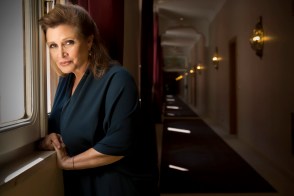
carrie-new-hi-resIt was the Spring of 2002; and Lucasfilm was hosting “Star Wars Celebration II” at the Indiana Convention Center in Indianapolis.  My [then] wife, daughter and I travelled there in our camper: joining 75,000 or so other people to celebrate all things Star Wars, and especially the upcoming release of Star Wars “Attack of the Clones.”

My 13 year old daughter was a huge fan, and had been preparing for this trip ever since we first heard about it, developing her “Jedi Jaina” character: purple and black hair; lavender costume, purple light saber.  She’d written a script and put together a sound track as the background for a solo performance at the talent show that would be part of the convention’s many events, and hosted by Anthony Daniels. (I was the voice of Yoda for her sound track: the worst Yoda voice-over ever!)  Even though she did not win the talent show contest, her pluckiness and costume were a huge hit.  And, she got to give Mr. Daniels a big hug in front of about 5,000 people.  I was so proud of her: her dreams had come true.

Continue reading “Remembering Carrie Fisher”

Sermon: Loving Creation

Our image of God needed to change. In fact, God needed to change. God’s love could not live in a perfect place that was inaccessible to us. For God’s love to be real and meaningful, … God had to become human. God had to become one of us.

the_family-large-john-d-batten-1886
“The Family” by John D. Batten (1886)

The Gospels tell us a lot of things about what Mary must have gone through because of her pregnancy.  She left town and stayed with her Cousin Elizabeth for months, probably to escape public shaming for being an unwed mother. Matthew tells us that Joseph could have abandoned her, but didn’t.

And, shortly before Jesus’ birth, Mary and Joseph had to take a long trip. Mary, at full term, bounced up and down on that (d****d!) donkey all the way from Nazareth to Bethlehem.  They hoped their poverty would discourage robbers. And when they get there, there is no room at the Inn, so they have to stay in a stable.

Then, after the birth, Herod wants to kill them! They had to flee into exile.  They became refugees. Once it is safe to return, they settle in Nazareth. But, it is a hard life: many there believed Mary had been unfaithful. And, because of that “sin,” Mary and her son were not looked-on kindly or with compassion; and we see hints of that throughout the Gospels.

Joseph is said to have been a Carpenter, but a more correct term might be “Day Laborer.” He probably walked several miles every morning from Nazareth in the hills down to Sepphoris, a city being built as the new capitol of  Galilee at the time. Once there, he hung out at the local equivalent of Dunkin’ Donuts: hoping someone would hire him to haul rocks and lumber, or perhaps saw wood for the day. It was a hard life: exhausting, dangerous work; harsh overseers; long hours; terrible pay andno job security. …Not unlike the lives of many of our friends and neighbors here and now.

Joseph was a good man, and like so many people back then (and now) he did what he had to do to survive and provide for his family. His grim situation was common throughout Galilee at the time. Rich foreigners were moving in: confiscating farms; forcing families like the family of Joseph and Mary into poverty. Their fields became vineyards. The people were being taxed beyond reason. Huge villas were being built on those country estates, their absentee owners were living in luxury in cities like Sepphoris, which were built on the backs of men such as Joseph.

There was no hope for the future. Rome and its vassals controlled Judea and Galilee; and the Jews, especially the people in the countryside, starved and suffered. Life for the poor was short, and painful, and brutal.

What does this have to do with Christmas? The Bible teaches us that Christ’s birth marks the moment when God manifested among us; becoming Emmanuel, “God with us,” walking the earth alongside us. It began there in Galilee among the poor and dispossessed. God became fully human; but was still, and at the same time, fully divine.

What does this mean for us now, in this world where nothing seems to be going right? We too are constantly battling to survive, and grieving our losses. We fight for a good life. Yet, no matter what we do, we know it will end in death: the death of those dear to us, the death of everything that matters to us, and ultimately our own death. How can we possibly be joyful when the end of our story is already known, and inescapable, and depressing, and  futile? Why is it important that God became a human being?

The other day, while pondering this and sharing my thoughts with others, someone asked me “Why is it so important that God was not human [to begin with]?”  

Good question!

I’ll tell you.

Continue reading “Sermon: Loving Creation”

A Benediction: The Word Became Flesh

This Benediction is based on the well known “The Word Became Flesh” passage at the start of the Gospel of John (John 1:1-14).  I wrote it for use on Christmas Day in year “A” of the Revised Common Lectionary. 


In the beginning was the Word, and the Word was with God, and the Word was God.   This Word became flesh and lived among us, and we have seen its glory, full of grace and truth. And, all who receive the Word are children of God, born of God.

The Word is the light of all people. It shines in the darkness, and the darkness cannot overcome it. And, so that all might believe, we are called to testify to this light.

So, go forth!  Rejoice in the Love of God made manifest through the Child of God. Go forth, testify to that Love and share it with all of God’s Creation, just as God shares it with each and every one of us.

Amen.


Copyright (c) 2016, Allen Vander Meulen III, all rights reserved.  I’m happy to share my writings with you, as long as proper credit for my authorship is given. (e.g., via a credit that gives my full name and/or provides a link back to this site – or just email me and ask!)

A Reality Check about Trump and Russia

putin-finalWhile I lean towards accepting what is being said by many in the government (and echoed throughout the mainstream media) about Russia deliberately interfering in our elections to benefit Trump, I am also aware that human beings, especially bureaucrats, tend to behave a bit like Lemmings.
 
So, we must ask ourselves: are these many Federal bureaus and agencies all reaching this conclusion of Russia’s deliberate interference out of independent, unbiased investigations and analysis; or are they looking at which way the wind is blowing and finding facts to fit the conclusions they feel others want to see?
 
Such “proof” got us into the the Second  Iraq War; and such “proof” has been the cause of much injustice and pain throughout history. So, let’s be careful about jumping to conclusions prematurely.
 
On the other hand, more than a few Republicans, and especially Trump’s camp, are taking this as an attack against his legitimacy as President. They’re right, it is; but it is a legitimate concern, not a manufactured one.  And frankly, if Hillary had been a stronger candidate, the validity of Trump’s election would never have become a concern.  (To be clear, I was a Hillary supporter; even though I recognize her weaknesses as a candidate.  However, this discussion is about Trump and Putin, not the validity or outcome of her candidacy.)
 
The way for Trump and his supporters to solve the problem is NOT to try and discredit the concerns and accusations, or to try sweep the whole mess under the rug.  It was hard enough for Obama due to similar (although baseless) accusations, and he swept into office with a huge electoral mandate on his side.  It will be far harder for Trump, who will be a President with a shaky mandate from day one.  So, it is in Trump’s own best interest to make sure the truth is revealed, and quickly – even if the accusations turn out to be true. Otherwise, he will find himself to be a President that few see as legitimate and whom no one pays much attention to, outside of an ever-shrinking circle of devoted fans.
 
Our faith, and our Democracy, are both intended to help us to find Truth in spite of ourselves.  So, let’s make sure we take the time to allow the Truth to be made known.

Exploring God’s Creation

As I was preparing for this coming Sunday’s service (Sunday, Dec 18), it seemed to me that it would be appropriate to set aside the standard Lectionary readings and theme for the day, and focus instead on the message of Christmas. (This is, in part because my Congregation has decided to not have a service on Christmas Day, Sunday, Dec 25th: when Christmas falls on a Sunday, most churches have a very small attendance. So, why have me drive all the way out there on Christmas Day, just to minister to a much smaller than normal congregation? Better to use my skills and talents elsewhere. They are right, and I am grateful, as it is a long drive.)

As I reflected on this, I thought of how Christmas reminds us that God (who is omniscient, omnipresent, and – most importantly – nonhuman) was so moved by love and compassion for their Creation that they decided to set aside their divine existence and walk with us as a human being. This meant being born as a human being, growing up as a human being, experiencing all the joys, victories, pains and sorrows of humanity, and finally dying – as a human being.

The message of our faith centers on the reality of the Christ Child, who is also known as Emmanuel, “God with us. And, as I see it, God IS with us a very tangible, real sense. Our Creator is not some amorphous and invisible spirit inhabiting an ethereal realm far beyond our understanding. Instead, the life of Jesus shows that God walks with us, eats with us, suffers with us, laughs with us, and cares deeply about us: always has, and always will.

And yet, our entire world is just a tiny speck in the vastness of Creation. Just how little of a speck we are is made more apparent with each and every new revelation of science; especially through Astronomy and Space Exploration, which are (after all) endeavors that reach out into the vastness of space to see what is there. In so doing, we realize that we are not, and cannot be, at the center of all that is; even though our most ancient myths place us in such a position.

So, I’ve created this little video for you. It reflects upon several aspects of the expansion of our knowledge of God’s Creation and our place within it, and attempts to illustrate that growth while retaining some perspective on just how small “human scale” is in comparison.

And besides, through this I am indulging my inner “Space and Astronomy” geek!

Enjoy!
-Pastor Allen


Copyright (c) 2016, Allen Vander Meulen III, all rights reserved.  I’m happy to share my writings with you, as long as proper credit for my authorship is given. (e.g., via a credit that gives my full name and/or provides a link back to this site – or just email me and ask!)


Sermon: Repent

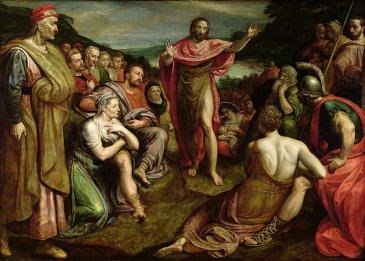
Would God’s love for us have any meaning or value if God did not expect something of us in return? The death of Christ on the Cross is proof that Love does not come cheap. So, while the Love of God is freely given to all, there is a price to accepting it. And, that price is Repentance.

sermon-of-st-john-the-baptist

There are lots of wonderful old traditions we celebrate this time year: the annual church rummage sale. The men’s pancake breakfast. The live nativity scenes. Going Caroling. Maybe in some churches the youth group sets up a tree in the sanctuary; and the younger children make ornaments to hang on them. Perhaps we have an “Angel Tree” or a box to donate gifts for those who would not otherwise have a Christmas at all. And then there’s my personal favorite: all those Christmas cookies!

These are all beautiful and very worthwhile traditions; they express who we are and what is important to us. And, many if not most of them are centered on Christ’s call to take of each other and take care of those in need. This is a good thing. But, such traditions, as wonderful and good and appropriate to Christmas as they are, are not what Advent is about.

Advent is about who we are about to become, not about who we are now. Advent is about preparing for the gift of God: the Christ Child who is not yet here. It is a call to prepare for what is about to happen.

So, what is Repentance? And, why is it a theme of this, our Second Sunday of Advent? I’d like to begin by exploring what Repentance isn’t.

Continue reading “Sermon: Repent”

Sermon: Hope Amidst the Darkness

Christ calls us to see the unseen, and right now the unseen include many who are rejecting the wisdom that we hold dear. They reject it because they see nothing in it for them, and nothing in it that respects who they are or what they need. And, until that changes, nothing we do will have a lasting impact, no matter how well intentioned we are. …And that’s a hard truth to face.

I’m starting today’s message with a slideshow. Each and every quote and image you’ll be seeing in these slides was said or written by someone I know well, or by a friend of someone I know well; and many of the locations shown in these slides (except for the very last one) are probably places you know of and may well have been to, or at least near… So, these are all people and locations with a relatively close connection to me.

These quotes and images demonstrate how this election has caused fear to overwhelm so many people that we know. This is not a criticism of whoever ran. It is trying to help us understand that there are a lot of scared and hurting people out there. People close to us, living in places close to us. I’m hoping they help us see how these reports of terror, bullying, and oppression are not just something from a newscast about a distant place, but are happening to our neighbors and friends and relatives right here, and right now.

Continue reading “Sermon: Hope Amidst the Darkness”

Traditional Marriage

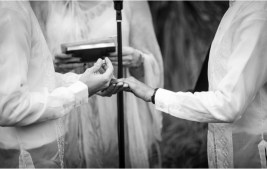
marriageWhen I think about the definition many use for the term “Traditional Marriage”, I wonder whether it is right or fair to define all that marriage is based upon what we do with our genitals, and/or who we do it with.

There are many kinds of traditions out there.  But when the term “Traditional Marriage” is used, it is referring to what the speaker sees as a faith tradition.  Yet, as I spoke about in a recent sermon, “Tradition” is not synonymous with “Faith.”  One must be dependent upon the other, but which one is primary: Faith or Tradition?

Continue reading “Traditional Marriage”

Abolish the Electoral College?

In the last week we’ve all been seeing numerous petitions, blogs, and posts calling to eliminate the Electoral College because it has made it possible for candidates like Donald Trump and George W. Bush to be elected President without a majority of the nationwide vote.
 
Now, it is obvious that the GOP has been waging a war to restrict the ability of minority voters (in particular) to have a voice in elections; and this does affect the Electoral College. But, eliminating the Electoral College is fixing a symptom: it does not address the root causes of gerrymandering (which both major parties are guilty of) and voter suppression.
 
Hillary Clinton appealed to the majority of the country in a numeric sense; but she failed to appeal to the majority of the country in a geographic sense, which is the function of the Electoral College.  Without it, states with small populations like Wyoming and Vermont (both of which I lived in for several years) would have no meaningful role in Presidential elections or the national political dialog.  And without the Electoral College, politicians from smaller states – like Bernie Sanders and Dick Cheney(!) – are less likely to be seen as viable Presidential (or Vice-Presidential) candidates.
 
So, do we really want to the major parties to focus on the largest states, ignoring the needs and concerns of rest of the country?  As Christian, it seems to me the answer is “No.”  As I see it, my faith calls me to work to ensure that everyone has a meaningful voice in determining our nation’s direction, not just those who think and believe like I do.
The Electoral College is not perfect, but it is an important tool we have to ensure that living in certain States does not preclude having a voice in the national political dialog.  We cannot eliminate it without first creating some other mechanism that achieves the same end.

Copyright (c) 2016, Allen Vander Meulen III, all rights reserved.  I’m happy to share my writings with you, as long as proper credit for my authorship is given. (e.g., via a credit that gives my full name and/or provides a link back to this site – or just email me and ask!)

Tradition

I am confident that no matter how this election turns out, God’s plan will not die. The world was created by God as an act of Love. That love is still here, in everything, in us, in our neighbor. All we are called to do is to let God’s Love work as it should, though us. Because, that is what is at the core of who we really are, deeper than any Tradition.

fiddler-on-the-roof1520NB: The sermon was preceded by this video clip of the opening song “Tradition” from the film “Fiddler on the Roof”.

Last week we observed All Saints Day – a day to remember and honor all those who came before us, particularly those whom we have loved, and who loved us, during their journey here on earth. I know that Sharon also mentioned it was Reformation Sunday: the anniversary of that day 499 years ago, when Martin Luther nailed his list of 95 Theses to the door of All Saints Church in Wittenberg, Germany.

And this morning, we heard the theme song from the Fiddler on the Roof, a musical that portrays the challenges of maintaining one’s faith, traditions and identity in the face of change and loss.

So you ask – how do all these tie-in with our scripture reading(s) this morning?

To begin with, our traditions are central to how we express who we are. They are an essential part of our identities as individuals and as a people. As Tevye said in the film clip: Tradition helps us know who we are and what God wants for us.

But, what he learns over the course of his story is that Tradition and Faith are not synonymous. Tradition expresses the truths of our Faith, but those expressions must change as the world changes, and as our understanding of God’s teachings and plans for us deepen and grow.

Tradition. A symbolic act that defines what it means to be us, or express what is an essential part of who we are, or what is important to us. Like: singing the Star Spangled Banner at a ballgame; or helping run the annual church fair; making cookies at Christmas, or celebrating the Holidays each year with our extended family. The rituals of Communion, Baptism, and Weddings are filled with all sorts of traditions – something borrowed, something blue, something old, something new.

Changing our traditions means changing our perceptions of who we really are, and what is important to us. This is a problem we constantly face as we change and grow. We are constantly having to ask ourselves how to remain true to who we are and what is important to us as the world around us changes.

Continue reading “Tradition”

The Lord’s Prayer, Counterpoint

A short meditation written yesterday morning as I pondered all that is going on around us: in our homes, in our nation, and in the world…

Can we pray “Our God” if our faith has no room for others and their needs?

Can we pray “in Heaven” if our interests and pursuits are in earthly things?

Can we truly honor your name if we do not strive to be holy ourselves?

Can we pray “Your Kingdom come” if we are unwilling to accept it into our own lives?

Can we pray “on earth as it is in heaven” if we do not diligently work to make God’s Kingdom a reality here and now?

Continue reading “The Lord’s Prayer, Counterpoint”