
When I first approached Tom about my inspiration for what became this morning’s sermon, it was to be a meditation on politics and faith: looking at the words and lives of those elected to office who call themselves “Matthew 25 Christians”. Unfortunately (or perhaps fortunately) God got in the way. As I labored over it, this message transformed itself into a meditation on how our reading from Matthew demands we see beyond the bit of road in front of our face. With that in mind, please join me in prayer….
Lord God, may your peace and Holy Spirit fill this place. Open your scriptures to us, and may I clearly communicate that which you intend us to receive. May your Word take root and flourish within each and every one of us. And through it may we be strengthened and transformed by your unconditional, living, and limitless love for all of your Creation.
In Jesus Name, Amen.
The part of my Christian witness that needs the most work is when I’m driving alone. Like, when someone cuts me off I’ll spontaneously give them the fist of fellowship. And, I’ve been known to utter a few very warm and heartfelt words when someone steals my parking spot!
It’s easy to be judgmental when we’re safe inside a steel and glass cocoon. We don’t have to deal with the judgement of others. Nor are our own judgements overheard. Like, whether the vehicular faux pas’ of that person is due to their having a bad moment, or whether their IQ really is less than the speed they’re driving. We won’t be challenged, there in our little four wheeled ship. We’re the commander, cruising along the road of life. It’s so easy to let fly with a little emotion, and maybe a gesture or two, safe there in our little mobile Kingdom.
What criteria is Matthew using for judging who is a sheep, or a goat? Does the Son of Man care what we think of him? Is he judging whether we can drive without colorful words and exuberant hand signals? Is he concerned about whether we’ve been baptized, said our prayers every night, or voted for the right candidate? No! Instead, we are judged on whether we feed the hungry, or give drink to the thirsty, or welcome the stranger, or clothe the naked, or care for those who are sick, or visit those who are in prison. Why? Why judge on this? Why does this matter to God?
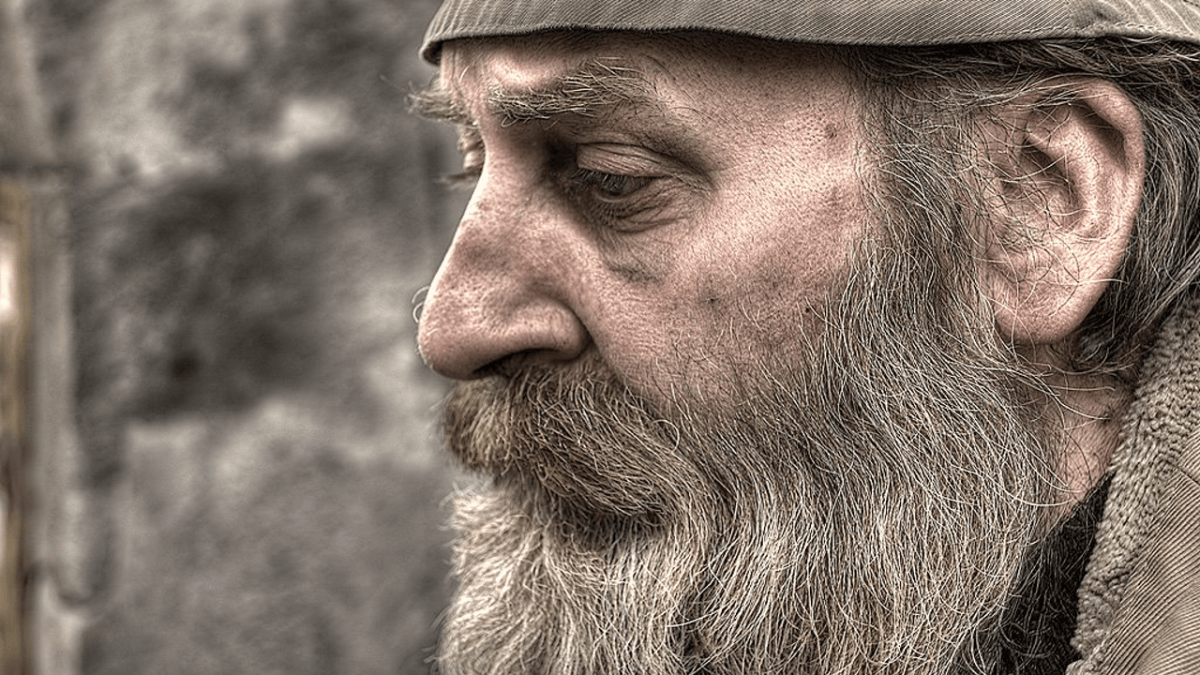
When I first moved to this area, I often saw a man at the grocery store near my home. He was older, white haired. And, no matter what the weather, he always wore the same heavy plaid shirt and frayed pants. He was clean and well groomed; but you could see the pain and humiliation in his eyes as he stood near the store exit, watching us as we came out with our bags and carts full of food and drink. He never spoke, never indicated whether he wanted any help. He stood there, silent, waiting to be noticed. His need plain to those of us who bothered to look. Like many who are hungry, thirsty, strangers, naked, sick, or in prison, he was unseen. We ignored him because we didn’t want to deal with him or his neediness. His existence was inconvenient. But here in Matthew, Jesus says our treatment of him matters a great deal. Not seeing him is no excuse.
We learn that the sheep are those who see the unseen – and respond. They help those in need when no one else looks, or cares, or has the time. The righteous are those who act when it is inconvenient and not easy. But, it is never easy, nor convenient — to help those with nowhere to turn.
I wish I could say that I went up to this man, shook his hand, asked his name, and invited him to lunch. I’ve thought about him many times, both then and in the years since. But, I didn’t do anything. I can say that I cared and had good intentions, but Matthew tells us that it’s what we do, not our intentions, that matter. So, I am a goat: I failed our Lord. I failed this man.
You could ask why I didn’t go back and look for him. I could have; and who knows, maybe he is still hanging around that store. Did I ever try? No.
I keep on telling myself that I’m too busy. I don’t have the time. I have work to do. And now it’s too late, it’s been way too long. Besides, I needed to write this sermon.
Other things always seem to have a higher priority. Apparently, being a goat suits me well.
There are other things to notice in our passage … the things Matthew doesn’t say out loud: First, nothing is said about helping anyone publicly. It doesn’t matter whether anyone knows who we are or what we did. What matters is that God always sees what we do, and what we don’t do. God knows.
Second, nothing is said about the fate of these who are called “least”. We aren’t told whether what we do has any lasting effect, or anything to do with their salvation at all. This passage doesn’t even say that we have to be any good at feeding, or clothing, or healing, or visiting them. This isn’t about what happens to them. It is not their choices or their actions or their failures or their redemption that is being judged. It’s ours. They did not choose to be as they are, or where they are, or who they are, or what they are. They did not choose to be unseen.
In our reading, the goats ask “Lord, when was it that we saw you hungry and gave you food or thirsty and gave you something to drink?” The King answers “… just as you did it to one of the least of these brothers and sisters of mine, you did it to me.”
Being unseen is not a choice made by those who have no choices. It is not some flaw they can fix. They are unseen because those of us with choices refuse to see them. We made the choice, not them. Our choice, not theirs. The sin is that we refused to see them, and then act. We refused to let what we saw impel us to action. We walled up our hearts. We did not allow our compassion or our humanity or the Love that God has planted within us – a chance to manifest. We did not make room for God’s love of both us and the Other to take root and grow.
And so, what does all this say about my drive here to church this morning? I was once again walled off, safe from the judgment of the world around me. An anonymous participant in that race we all encounter every day. A race that has no beginning and no end.
And yet, I am not faceless to the Lord, I am not unseen; which brings me to my third point: there is also the unseen-ness of the ordinary.
We forget that Jesus was a very extraordinary, ordinary man. Even his disciples saw him as a human being, like them. Most of the time, his divine nature was hidden from them. Jesus was born with an ordinary mother. He grew up as an ordinary child. He walked the earth as an ordinary adult. He knew real hunger. He experienced real passion and real anger. He was really bullied. He experienced real pain; and he died a real death. … All of these are things that every one of us will experience ourselves. And, that’s the whole point. Jesus walked this earth as an ordinary man. It is an affirmation that our lives, our ordinary, boring, frustrating, challenging, unseen lives are seen by God, and are important to God. It isn’t just the extraordinary moments or people that God sees and cares about, it’s the ordinary ones too. … Especially the ordinary ones.
Those in Matthew who are called “least” are experiencing ordinary things: hunger, thirst, illness. We have all endured such things. We have all been, and are, one of the Unseen.
But, the most loving, giving people that I know, and that you know, are those who minister out of their own pain, out of their own experiences of hunger, or sickness, or loss.
Once we understand such pain, we will see that same pain in others. And, we want to help or to heal those going through that pain. Jesus knows this. In refusing to see those in need, we are not seeing ourselves. To Christ, none of us are ever an inconvenience, never unseen. His life on earth was a statement that we matter, that we as ordinary, fleshy (and very human) human beings, matter. Jesus sees the ordinary, and shows us that we must give those who are unnoticed a chance to be heard and seen and loved, because they are us.
We may be a goat today, but tomorrow we will be one of the unseen. And, God willing, we will be seen, and helped, by a sheep.
So, when I drive my car later today, I will remember (I hope) that the driver who cut me off is child of God, just like me. With God’s grace I will see them as Christ sees me: another one of God’s ordinary and yet very extraordinary sheep.
Amen.
Scripture reference:
Matthew 25:31-46, The Judgement of the Nations [NRSVue]
Delivered at Memorial Congregational Church UCC in Sudbury MA, November 22nd, 2026 (Reign of Christ).
Copyright 2026, Allen Vander Meulen III, all rights reserved.
This work is licensed under a Creative Commons Attribution-NonCommercial 4.0 International License.


