#BlackLivesMatter and The Legacy of Slavery

Much of what the “Black Lives Matter” movement is doing makes us uncomfortable, particularly those of us who are white. This is as it should be. If we’re comfortable where we are “at”, we won’t move, we won’t improve, we won’t change. If the injustices that exist are to be righted, we must be made uncomfortable. We must be made to see those things which are invisible to us because they’ve “always been that way” – working well for us, and so we ignore them or are unaware that they operate in our favor: that’s the very definition of “structural racism.” Yet, these same structural prejudices that are so deeply intertwined within our society and legal system do not work so favorably for others.

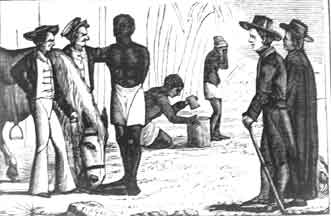
The first slaves arrive in Massachusetts on board the Desire, December 12, 1638.

We often forget that slavery was everywhere in the US until the early 1800’s, and it was no prettier in Massachusetts, New York, or New Hampshire than it was in Texas, Delaware, or Virginia.

Some of the best known Blacks in U.S. History – such as Sojourner Truth, William Still, and Lucy Terry Prince – were born into slavery in the North, or were transported here as slaves from Africa.  Many of our most famous native sons here in New England (such as John Winthrop, founder of the Massachusetts Bay Colony) sanctioned slavery.  Many of the wealthiest families of New England and New York in the 17th, 18th and 19th centuries built their fortunes upon the slave trade.  And, we forget that slavery was very much present in places like Massachusetts for over 150 years.  In fact, with the sole exception of Vermont, slavery was not abolished in any Northern State until after the American Revolution, and was not fully abolished from all Northern States until 1865.

Another aspect of oppressive systems, such as slavery – and like any institution or behavior deeply embedded in any society or organization – is that its effects persist long after people even remember that it was there. You see this in how some churches keep on “chewing up” new Ministers, in how corruption keeps on toppling one political figure after another in certain communities, or in why we here in America drive on the right hand side of the road, or why we set the table with the fork on the left.

Continue reading “#BlackLivesMatter and The Legacy of Slavery”

A Matter of Words – Losing a Customer and Opening a Conversation

As this St Louis Bookstore owner says, “Black Lives Matter does not mean White People are Bad. It never did. Saying someone matters does not mean that nobody else matters. It just says to someone who feels invisible, ‘I see you and I value you.'”

Civil Disobedience and Gay Marriage?

shutterstock_124493413Todd Starnes, host of Fox News & Commentary on Fox radio, recently posted an article that supports a pledge recently signed by many Religious leaders, in which they commit to rising up with acts of “Civil Disobedience” to highlight their opposition to Gay Marriage.

I am puzzled by this: how could “Civil Disobedience” be exercised here? “Civil Disobedience” is the act of deliberately, nonviolently and publicly transgressing a law that prohibits you from exercising rights that others can exercise without a second thought – highlighting the inconsistencies inherent in allowing some people a right that is denied to others.  Further, such disobedience is done from a position of powerlessness and humility, allowing the “illegal” act you perform to speak for itself through confronting others with the pain and injustice you personally experience because of that unjust law. The point is never to directly hurt the other, but rather to force them to see the injustice they are participating-in or allowing to happen (and therefore are complicit in inflicting upon you).

Currently, the U.S. Supreme Court is considering whether to widen the legal definition of marriage, so that anyone can marry the person whom they love.  We all know and acknowledge this will be hard to accept for some.  I think it is right and proper – and compassionate – to be cognizant and understanding of this, even though we do not share their opinion, and are not called to set aside our own expanded sense of what is just and right for the purpose of alleviating that discomfort.

But, what law could those (who oppose such a change) disobey to show how their own liberties are being unjustly limited in this case?  Refusing to serve another because they are married to someone of the same sex doesn’t do it – the only person you’d be hurting is yourself (and perhaps those who depend on you) through the resulting loss of income.

Continue reading “Civil Disobedience and Gay Marriage?”

Just Show Up

Being faithful isn’t about being skilled or perfect at anything. It’s about showing up. That’s all that God asks us to do – show up, and you’ll find that God is there too: showing us the way, impelling us to speak or act as needs to be done, helping us to learn what we need to learn, and providing the grace for those we encounter to rejoice in our presence and willingness to stand with them, no matter how clumsy we feel we might be.

5428
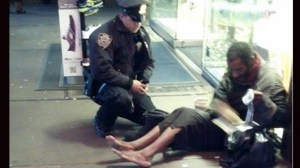
NYPD Officer Lawrence DePrimo buying boots for a homeless man in Times Square this past November.

During this past Sunday’s “Open and Affirming Forum” at ARK Church our guests related some of their own experiences to help us better understand the pain and alienation that many transsexuals encounter every day, and also provided a great deal of information to help us be more sensitive, compassionate and affirming when dealing with anyone who is “other” – especially those in the LGBTQ communities. Our eyes were opened to the challenges of being someone who doesn’t fit into the neat (and very binary) categories of “male” or “female” or “opposite sex loving” or “same sex loving.” It was a moving, growing (and humbling) experience.

The leader of the forum said something near the end of the meeting that has stuck with me all week: “just show up.”

Continue reading “Just Show Up”

The Tale of Injustice

Back in the mid 1990’s I worked for a well known conservative Christian organization.  All employees of that organization were periodically required to spend a day ministering to those in need, in various ways.  My role in one of those efforts was to be part of a crew that distributed food to those in need.

One of the people that I encountered that day, a very slightly built black woman, lived several blocks away from the place where we were handing out our boxes of food.  The box I gave her was very heavy, so I offered to help her carry it back to her home.  She gratefully accepted.  She said it was only a block or two, so I didn’t worry about telling anyone what I was doing, since I figured I’d be back in just a few minutes.

We chatted as we walked along, she was quite an interesting person – but as we went on, I steadily became more and more nervous,  Here I was, getting further and further away from my team, several blocks, in fact, in the middle of a one of the worst neighborhoods in the Tidewater region of Virginia.  I was the only white anywhere in sight, and a red head at that!  I knew that no one would be looking out for me when it was time to pack up and head back.  So, I was likely to be stranded if I didn’t get back soon.  I felt conspicuous, I felt alone, and I was afraid.

Continue reading “The Tale of Injustice”

Risky Business

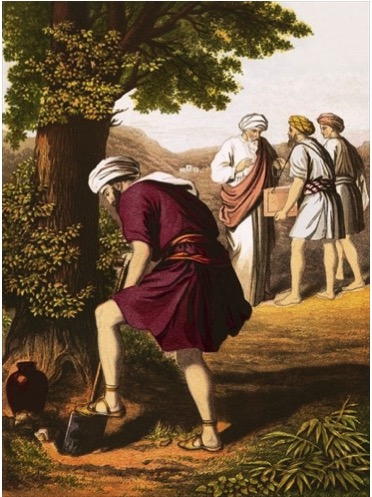
The Third Slave recovers his buried talent.

Delivered at ARK Community Church, Dalton MA, November 16, 2014.

Scriptures:
Matthew 25:14-30 The Parable of the Talents (The Voice Bible)

The Parable of the Talents in Matthew 25 has always left me a little uneasy. For one thing, parables, by intent, are meant to end with a question mark: leaving their audience with an anxious and counterintuitive decision that they would rather not face and can’t quite pin down. And yet, in this parable, the answer seems pretty clear – “Put our God-given talents to use.” In fact, this is so widely accepted that the word “Talent” itself came to be used in the English language as a reference to our God-given gifts because of this parable; transformed from its ancient use as a word for a standard measure of great wealth.

So, from that point alone, I am curious as to whether the traditional interpretation that we’ve probably all heard in many sermons is actually in line with the intent of Matthew’s Gospel, or Jesus’ intent, for that matter.

Increasing my unease is this: Jesus is the Social Revolutionary, constantly campaigning against the evils of privilege and position and power.  And yet, in this story, the person who already holds position and power seems to be eager to acquire even more through the efforts of others, and engages with his servants in ways that would have been perceived by the original audience as unfair and dishonest.

But first, let’s look at the setting for this parable… It is part of a very clear and intentional sequence of events and teachings in Matthew’s narrative, all of which focus on the issue of the return of Christ.

Continue reading “Risky Business”

The Besiegement Narrative

Original Article: Even After Hobby Lobby, the Religious Right is Still Terrified

The “besiegement narrative” that the Right Rev. V. Gene Robinson talks about in his recent article found on The Daily Beast is indeed a theme I frequently saw and heard during my sojourn through many of this country’s more [religiously] conservative Christian denominations.

Such an “us vs. them” theology has a long history in Christian thought, going back to at least the time of the persecutions and martyrdoms of the early church, and even further back into ancient Judaism.  And, in fact, in examining other faiths, you quickly find that it is a universal theme.  This is because such a narrative is  a good way to define the boundary between who is and who is not one of “us” (whoever “us” is).  It is a theme that can bind people together; generate and focus emotional and physical energy upon a (real, potential or imagined) threat; and define what it means to be “us” by making it crystal clear who and what we are not.

This is not necessarily a bad thing.  Being able to draw a line that separates “us” from “not us” seems to be necessary – because if a group cannot define that boundary, it has a very difficult time explaining who they are, what they stand for, why they should continue to exist, and why you might want to be one of “us.”

Continue reading “The Besiegement Narrative”

Hobby Lobby – a Different Point of View

The Hobby Lobby decision implies that it is OK to treat others differently, and unfairly, merely because our religious beliefs dictate that we should do so. This is the sort of logic used by the religious extremists found in any faith: they believe their faith gives them the right to treat others in a way that is not respectful of them or their humanity.

Hobby Lobby315*304We’ve all heard (and read) lots of angry denouncements of the Supreme Court’s recent “Hobby Lobby” decision. I agree with many of them, especially George Takei’s eloquent statement; but, I’d rather not delve into that right now.  Instead, let’s begin by going in a different direction and ask “What is the decision, really?”

To be specific, the Supreme Court deems that “closely held corporations [shall not be forced to] provide health-insurance coverage for methods of contraception that violate the sincerely held religious beliefs of the companies’ owners. … regulations that impose this obligation violate RFRA, which prohibits the Federal Government from taking any action that substantially burdens the exercise of religion unless that action constitutes the least restrictive means of serving a compelling government interest.”

The court’s decision is also very carefully written to limit its scope and effect, even though efforts are already underway to extend the impact of this decision into new territory.   The justices explicitly state that they did not deem it necessary to address or consider the First Amendment (“Freedom of Religion”) claims of the plaintiffs, since the “Religious Freedom Restoration Act” (RFRA) is applicable to this case, and in the court’s opinion, the defense’s case clearly fails the tests imposed by the RFRA, as passed by Congress under President Clinton in 1993.

The justices go on to state: We do not hold … that for-profit corporations and other commercial enterprises can “opt out of any law (saving only tax laws) they judge incompatible with their sincerely held religious beliefs.” … Nor do we hold … that such corporations have free rein to take steps that impose “disadvantages . . . on others” or that require “the general public [to] pick up the tab.” … And we certainly do not hold or suggest that “RFRA demands accommodation of a for-profit corporation’s religious beliefs no matter the impact that accommodation may have on . . . thousands of women employed by Hobby Lobby.” … The effect of the HHS-created accommodation on the women employed by Hobby Lobby and the other companies involved in these cases would be precisely zero. Under that accommodation, these women would still be entitled to all FDA-approved contraceptives without cost sharing.

So, at first blush this all seems fairly reasonable, and it was such reasoning that helped lead to the end of the so called “Blue Laws” in many states that required businesses to be closed on Sundays. At that time – a generation or two ago – it was determined that such laws proved an unfair burden for – for instance– Jewish small business owners, who were already closing their shops on Saturdays due to their sincerely held religious beliefs.

Continue reading “Hobby Lobby – a Different Point of View”

Of Walls and of Mustafa Aslan

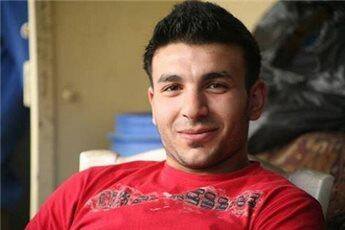
I never met Mustafa Aslan, but I know the people of Israel and Palestine – Christians, Jews, Muslims and Druze alike. Good people. People filled with compassion and faith. People with so much to offer for the benefit of their neighbors and the world as a whole. People who want peace, and through peace, a better life for them, their children, and their people.

10365995_10152221308927671_1126578232388527161_n
Mustafa Aslan

Mustafa Aslan, age 24, was a champion boxer is Palestine, and coached many children and teens there who were  interested in boxing.

He was shot dead last week in an Israeli Defense Force (IDF) raid, part of Israel’s massive effort to find the three Israeli teens who disappeared on June 12th while traveling within the Gush Etzion block of settlements near Jerusalem in the West Bank.

Given that there is no solid evidence as to the fate or location of these teens at the moment (nor even who kidnapped them) the IDF’s operations are not about finding the three teenagers, at least not any more:  It has become a vendetta: a campaign of revenge and collective punishment, terrorizing a largely defenseless and submissive population.

So far, from what I can tell (as this incident, particularly with regard to the IDF’s actions, is hardly mentioned in the US Media), at least 5 Palestinians have been killed by IDF forces in this “search.”

Many of my Palestinian friends, the West Bank’s Palestinian political leadership, the United Nations, US Leadership, and many in Jews as well, are universal in unequivocally condemning the disappearances.  All of them also call for restraint on the part of Israeli military and police forces in their use of force in their search.

It almost goes without saying that the IDF’s brutal actions, which go far beyond reasonable given the circumstances and lack of any actionable information as to the status or fate of the missing teens, departs from wisdom, let alone international law.  The logic used to justify the actions of the Israeli military, and the shedding of innocent blood, only makes sense if one views all Palestinians as vermin who have no right to exist.

Continue reading “Of Walls and of Mustafa Aslan”

All Too Silent a Witness

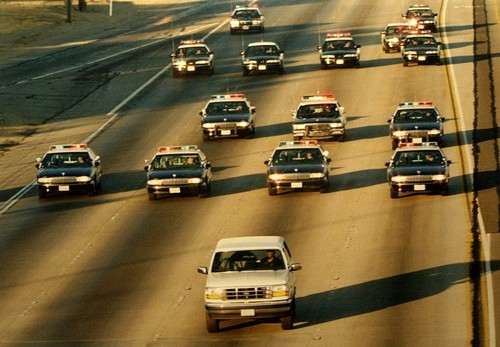
The irony of the watching the famous slow motion chase of OJ Simpson as I stood next to Ben Kinchlow alone in that room struck me as I stood there, and is one I still think of from time to time even now, 20 years later: There I was, a theologically progressive Christian working for a conservative Christian organization, standing next to a man who had once been a black nationalist, heavily influenced by Malcom X; then ordained as a minister in the African Methodist Episcopal church and who was founder of an organization dedicated to helping underprivileged African American kids and a man who for many years had been a prominent member of CBN’s leadership.

OJ and the Slow Chase

NB: A recent CNN opinion piece by Dorothy A. Brown entitled “Why Holder Remark Made White People Mad” has a lot to say that is right in line with what I say here.

You know, 20 years is a long time, and yet not so long…

Late in the evening of Friday June 17, 1994, I was in the lobby of The Founder’s Inn in Virginia Beach, VA watching the news on a television there while waiting for my (first) wife to finish up her work for the evening at the hotel’s bookstore and gift shop.

For those of you who aren’t familiar with the conservative Christian universe, The Founder’s Inn is on the campus of the Christian Broadcasting Network (CBN), the headquarters for Pat Robertson’s television ministry. I had only recently been hired there, to manage a software development department in their IT Division.

As I stood there, up on the screen came a “news alert” followed by a live telecast via helicopter of the famous “slow motion chase” by police down Interstate 405 in Los Angeles of a white Ford Bronco carrying O. J. Simpson, who was sitting in the back seat of the vehicle, pointing a gun at his own head.   At the time, he was the prime suspect in the murders of his former wife, Nicole Brown Simpson, and her friend Ronald Goldman.

Standing next to me watching that broadcast was a gentleman I barely knew, but whom I heard a great deal about and admired: Ben Kinchlow, a prominent Black evangelist and activist, and (at the time) co-host of Pat Robertson’s daily “700 Club” broadcast.

We stood side by side, wordlessly watching the spectacle unfolding before us for around 20 minutes before we both went our separate ways.

Continue reading “All Too Silent a Witness”

The Facts of Gun Ownership

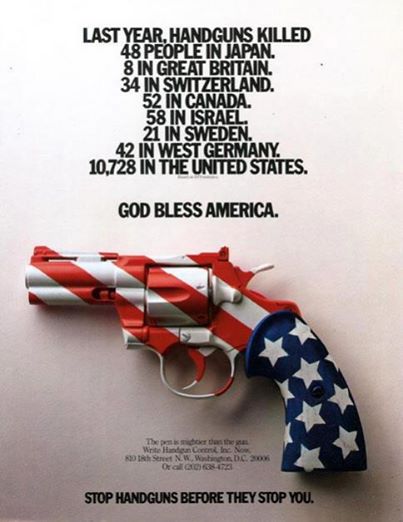
This recent Facebook Meme makes it clear that unrestricted gun ownership has severe consequences. Let’s take a look at each of the countries mentioned in that poster, and compare their gun laws to what we have here in the US. What can we learn from such a comparison?

72316_10151146554085872_516093712_nThe poster shown here must be a bit old (there is no country named “West Germany” any more), but the relative ratios of handgun deaths in the US to levels in these other countries has not improved with time.

In reviewing the gun laws of each of  the countries in this list, wikipedia provides the following information

Continue reading “The Facts of Gun Ownership”

It’s not about Wingnuts and the “N” word

Racism is far from merely being about wingnuts using offensive language or people oblivious to the issue admitting they once spoke in that way. Racism has changed in some ways, but the basic mechanisms and patterns of it have not. What has changed is that people have gotten better at hiding their racist attitudes from others and even from themselves. The way we express our racism may have changed, but the basic issue still exists, and is a pervasive cancer in our politics and society. The real (and far more dangerous and despicable) racists are those who seek to exclude specific groups from participation in the political process when those groups are seen as not supporting the political party that is already in power. The biggest obstacle to change is that racists assume they are faultless.
Let’s begin by saying that the “N” word is an offensive, ugly word, and one I never willingly use. Racism is a topic that I feel deeply about, and am absolutely committed to confronting whenever (and wherever) it rears its ugly head.

So – when Nevada Rancher Cliven Bundy makes racist comments, when celebrity chef Paula Deen admits to using that ugly word, or when LA Clippers owner Donald Sterling is accused of making racist remarks – yes, I’m angered; and I will speak up.

But, I’ve done (and said) racist things, too.

In my early 20’s, I worked in a retail store.  One day, when I was the only sales clerk on duty, an elderly black man came in to ask for help with a particular item. Right then I was waiting on another customer, a woman, and so ignored him for the moment – in fact, I hardly noticed him. He waited patiently at the counter, since he saw that I was almost done with her.

In the meantime, another person came in – a white male – who walked around the first man and came over to where I was, at the other end of the sales counter.  When the woman left, this second man immediately began talking and I allowed my attention to focus on him, rather than turning to the man who had been waiting.

The first man immediately spoke up, saying (and I quote, as it is burned into my memory!), “Hey, I’m a customer too!  Or, is it that you don’t like to wait on n—-rs?

I was mortified, as you might imagine, and immediately turned to help him.

Was I racist, or acting in a racist way?  Well, I didn’t think so. I had long prided myself in being “open minded” and respectful of others, no matter who (or what) they were. But I was being racist because the one who determines whether we are racist (or not) is not us, but those who are impacted by our attitudes and actions. The elderly gentleman was right: I was acting in a racist way, even if unintentionally.

Racism is far from merely being about wingnuts using offensive language or people oblivious to the issue admitting they once spoke in that way. Racism, as the columnist LZ Granderson points out, has changed. Or, to put it another way, the basic mechanisms and patterns of racism have not changed. What has changed is that people have gotten better at hiding their racist attitudes from others and even from themselves. The way we express our racism has changed, but the basic issue still exists, and is a pervasive cancer in our politics and society.

Continue reading “It’s not about Wingnuts and the “N” word”