I’ve met Rev. Heath only briefly, but her spouse was a classmate of mine in Seminary. She is far from the only trans or gender non-conforming person I know; and they all relate the same narrative that Emily gives voice to here: “I’m telling you that no trans or gender non-conforming person wants to use the bathroom for any other reason than you do. I’m telling you that this has never been about sexual predators (who don’t need bathrooms to hurt people, and who won’t be discouraged by an anti-trans bathroom law), but about harming trans people. I’m telling you that I’d like to spend a whole lot less time thinking about bathrooms than I do.”
If we are serious about our Christian faith, then we need to ask – FIRST – how our attitudes to others express the love that Christ mandates – MANDATES (via the Second Great Commandment) – that we show in all our dealings them, and that we do so without condition or exception.
And, will they see that love in how we are acting and speaking towards them? If they don’t, then we are failing to love them as we are required to do by the most basic tenets of our faith.
The anti-LGBTQ laws recently passed in NC and elsewhere do not pass this test. And so, we must seriously and deeply re-examine our own motivations and faith principles if we believe this was the Christian thing to do.
Christ gave us a new command: “Love each other deeply and fully. Remember the ways that I have loved you, and demonstrate your love for others in those same ways.” …In so doing we shall find that we are helping others to be healed as well, for that love is in them too; and even in our many Judases.
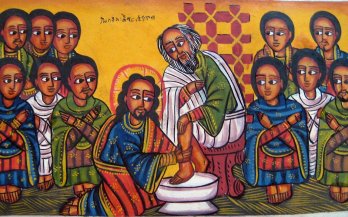
Ethiopian Icon of Jesus washing the disciple’s feet (artist & date unknown)
Monday (April 18th) was the 120th running of the Boston Marathon. And again we remember that moment during that race, three years ago, when the hate and anger that had been fanned to life within two young men exploded; forever altering or destroying the lives of many innocent and wonderful human beings.
We’ve seen people coming together in many ways to minister to those wounded, whether visibly or not, by this and so many other acts of inhumanity, both before and since that day. And, we’ve all seen those who were victims of such violence coming forward with their own stories, sharing them in many different ways, so that others who have suffered similar losses might find healing.
These outpourings of love, compassion and care reflect how Jesus calls upon us to love one another and minister to each other, especially in times if crisis, as we see in this morning’s scripture. But, here in John 13, the disciples have not yet endured the tragedy that we know so well.
It is clear from his interactions with these students that this is not simply a show for the cameras. The President is involved: asking these young scientists questions, encouraging them, and engaging in extended dialog with them; not allowing other (more “adult”) priorities to distract him.
Whether we agree with his policies and political stances or not; we must admire how, in so many ways, the President is constantly and concretely demonstrating how much he cares for people, all people.
Which of our current crop of Presidential candidates show that they care?
Do we really want our next President to be someone determined to destroy people’s lives through deportations, carpet bombing, or draconian social and economic policies? If a candidate demonstrates a complete lack of compassion for so many whom we see as “other,” can we reasonably expect them to concern themselves at all for how their leadership will impact us?
Our faith – and in fact every Faith – begins with compassion and love. If these things are not present in the words and deeds of a prospective leader, then they have no business being in the business of caring for this nation.
– Allen
Copyright (c) 2016, Allen Vander Meulen III, all rights reserved. I’m happy to share my writings with you, as long as proper credit for my authorship is given. (e.g., via a credit that gives my full name and/or provides a link back to this site – or just email me and ask!)
No, we (who are seen by some as “Liberal” Christians) do not believe in a sissified Jesus. We follow a Jesus who died for us. A Jesus who will never let us go, and a Jesus who loves us no matter what. That kind of love, that walks through any fire, endures any cross, is an uncompromising and fierce love. This is a Jesus who’s Gospel – in whatever form it may take – is for all, not just for some.
You know, loving others is hard.
Loving those lost in grief or pain, loving those who have turned away from the world out of their illness or fear or abuse, is hard.
Loving those who are different from us; who’s ways are alien to us; who’s politics or faith, or piercings and tattoos, are offensive to us; is hard.
Loving people when they shout at you, when they refuse to hear what you have to say, when they call you ugly names, when they slander you and despise you and shut you down, is hard.
Loving those who abuse or oppress you, loving those who cannot or will not love you in return, loving others when you are in such pain yourself, loving those who are nailing you to a cross, is hard.
Lent teaches us that the Kingdom of God is not a magical solution to all of the bad things we’ve had to endure. It will not take away our pains or erase our scars. The Kingdom of God is about Love, not hate. It is about healing, not magic; it is about conquering fear, not eliminating what spawned that fear within us. The Kingdom of God comes about after the death of all of our hope, and all of our fear. The Kingdom of God is realized only through our openness, brokenness, and repentance.
On Palm Sunday, we remember Jesus’ dramatic entry into Jerusalem: The Crowds celebrate his arrival, believing it heralds a new era for the people of Israel. The Messiah has come, and will set everything right: the occupiers and their Empire will vanish; the evils and oppression they brought with them will be cleansed from the land. The incompetence and greed of Israel’s own leaders will be made as if it had never been, once David’s descendant, anointed by God himself, takes his rightful place on the throne.
Israel will regain its long lost greatness, and will indeed become greater than ever: a new Empire of God, with the Son of God himself as their King. The glory of the Temple and God’s renewed presence within it will shine forth to every nation and people in all the world, forevermore. It’s all so beautiful, so wonderful, so magical: what a great thing to witness. What a great time to be alive.
But then it all comes crashing down. Now, just a few days later, Jesus and his disciples are hunted by the authorities: they know it is only a matter of time before Jesus, and maybe all of them, are arrested and maybe even executed.
The crowds are turning against this latest in a long string of disappointing Messiahs. They now see that the magic they’d seen in him has no substance or reality at all. In the eyes of the people and their leaders, he is a fraud.
The magic is gone. The people feel that Jesus has betrayed them; and the disciples feel that God has betrayed them, and it seems like everyone has betrayed Jesus.
We are simultaneously part of many different families. Some of them endure for generations, others exist only for a particular moment in time. At their best, they give our lives shape, meaning and purpose; at their worst, they drag us down into a pit of despair.
The Judean Desert near the Dead Sea
My Grandpa loved life, loved his family, and loved making others laugh. I remember sitting with him in the kitchen: he’d smile a big broad smile, and then let his upper denture drop – “Clunk.” We kids would respond with peals of delighted laughter. Grandma, sitting across the table, would inevitably say: “O, Earl!” – Which only provoked more laughter. They were both lovely people, and were both quite strong and wonderful characters.
We all have such “characters” in our families: some eccentric, some difficult, some amusing or endearing, sometimes a combination of all three! They are people who don’t mind living life a bit off from the norm. In fact, at least in my own experience, these same relatives are often seen as embodying a set of qualities – or oddities – that “run in the family” – traits that are usually good (I hope), but sometimes not. They might include patterns of behavior; health issues; physical traits and gifts; ties to a particular place, time or nationality, or a particular legacy, among other things. But, they identify us as “us”: they help us see how and why our family came to be what it is, what it stands for, and why we are who we are.
We are simultaneously part of many different families: our family of origin, the family we marry into, the family we create with our spouse, our church family, our work and school families. Some of these families endure for generations, others exist only for a particular moment in time. But, they all provide us with an identity, and a reason for being who and what we are. At their best, they give our lives shape, meaning and purpose; at their worst, they drag us down into a pit of despair.
…I ask that you share not just the joys of romantic love, but the sadness that is within all of us, show your love by reaching out to them, helping to share the burden that they carry hidden in their heart, even if only for a little while; because, walking with another through their sadness and hard times is central to what our faith is all about.
On this Valentines Day and the First Sunday of Lent, I ask that we remember not only the importance of Romantic Love; but of Divine Love, the Love of a friend or sibling, LovingKindness, Self Love, and the many other kinds of love out there.
There are many out there who celebrate and remember the romantic aspects of Valentines Day – of marriage proposals and weddings, of building family. But, there are many, many people for whom this day carries a tinge of sadness, such as…
I came across this poem the other day, which I wrote and emailed to my daughter when I was on a business trip about 15 years ago. The sentiments expressed within it are just as true and strongly felt now as they were then. I thought that you, my readers, would appreciate it….
Those who seek to minimize the Christ in their Christianity do so out of a conviction that we must not offend, and must not intimidate (through “churchy” language and ritual) those who are looking for a touch of the divine in their lives. This is a worthy impulse, but we must be careful to not allow such thinking to seduce us into creating a faith for ourselves that is inoperative and unchallenging.
In my view, the tradition that has been passed down to us, combined with the teachings and example of Christ and others as found in the New Testament and elsewhere, forms a foundation or framework for our faith: denying, minimizing, or casting aside that framework really would leave our faith “rootless” as many Evangelicals often (erroneously) label we who are Progressive Christians.
Christianity is not about supplying all the answers or enforcing a rigid set of doctrines and laws to live by. Jesus preached against exactly that sort of thinking and practice in the First Century, and it doesn’t work any better now than it did then. (And, frankly, doing so has never worked well.)
On the other hand, our faith isn’t just about making us feel good about who and where we are at the moment, either: Yes, we are to love and accept ourselves and each other as we are right now, but we are called to continually seek to do better, not simply accept what is.
Keeping Christ in our faith is challenging, and should always be so: if our faith is not challenged, if it is not continually being refined in the tension of this place we exist that lies between what was and what is to come, then our faith would be fruitless and meaningless. It would simply be a rationale for accepting things as they are, rather than challenging us to become better: to become more just, more thoughtful, and more compassionate.
Love is not a wimpy or sentimental emotion; but a passionate, fierce action. … Such Love requires us to participate in the life of the person in front of us. It makes us see that it isn’t all about us or our agendas. … Jesus will always confound our expectations because he isn’t here to meet our expectations, but rather to help us achieve all that God hopes for us.
Christ Teaching in the Synagogue at Nazareth by Gerbrand van den Eeckhout, 1658
This morning’s gospel reading focuses on the most extensive narrative we have of Jesus in a Synagogue; and, it didn’t go so well! Or did it?
Please pray with me… Lord, let it be your voice that speaks through my mouth, and let our hearts and minds be open and receptive to hearing the Word & Mission you have for us here today. Amen.
Chapter 4 of the Gospel of Luke narrates the beginning of Jesus’ ministry. At the start of this morning’s reading, we are told that “filled with the power of the Spirit,” Jesus ministers in Galilee and eventually returns to the village where he grew up.
People throughout Galilee are saying he is the first true prophet in centuries, and perhaps more than that. But for those in Nazareth, he’s more: he is their celebrity – their hometown hero. Can you imagine? Such an important person, from a tiny, obscure village: they know him! …So exciting! The community was abuzz with rumors and speculation, hopes for a bright future to be brought about through the glory of their native son.
But some are filled with doubt: they watched him grow up. They know him as the son of Joseph the Carpenter. They know Jesus and his family all too well.
#BlackLivesMatter helps us see a universal truth: that unless we start treating all people as human beings, we will all loose our humanity. We may not die, but we will no longer live. … We must invest in each other if we are to succeed. Defeating those who oppose us only means we’ve defeated ourselves. The battle is within us, not against us, and not against them. To overcome the challenges we all face requires that we all change.
Statue of Michael Jackson in the favela of Santa Marta, on the outskirts of Rio De Janeiro; where Michael filmed the video for “They Don’t Care About Us” (directed by Spike Lee) in 1996.
For decades the Brazilian government refused to extend utilities, sanitation, roads or even law enforcement into these slums. Ultimately, they moved their Capitol elsewhere, escaping the angry vigilance of the poor looking down upon them from the hills above. They are still there: filled with suffering and the anger of a people left behind, cast aside as worthless. We see in the video that their anger is powerful.
At this point in time, Michael Jackson was the object of tabloid ridicule and accusations of child molestation, strange behavior and weird habits. He’d been sued; arrested; strip searched. I am sure he identified with the people in these slums because he felt abandoned and alone, he was struggling to not die, just like them. But, not dying is not the same thing as living. Life is more than merely existence continued.
Let us be clear: there is no magic wand that will make everything in this life better. God is not going to come down and make it as if we – meaning all of us – never made all of the mistakes (and good decisions) we’ve made that have gotten us to this point. We cannot escape responsibility for what we’ve done to each other, or to God’s Creation.
The command to “Love our Neighbor” means acknowledging this, and so embracing compassion for ourselves and others as a way of life. It means conscientiously making room for “The Other” – for those who are different from us. We can begin by opening our minds and our hearts to what they have to say.
“Bede’s Sparrow” by Carrie Wild
This past Friday evening, George Takei was preparing for a performance of his musical which opened on Broadway a few days ago, a very personal story of the terrible price George and his family paid for being of Japanese ancestry and living in America during World War II.
On hearing of the attacks in Paris, Mr. Takei wrote: “…I’m writing this backstage at Allegiance, my heart heavy with the news from Paris, aching for the victims and their families and friends.
Aziz Abu Sarah, Peace Activist
My friend Aziz Abu Sarah, who, like George, spends his life urging peace and building bridges to span the gaps separating people around the world, and whose family has also paid a very heavy price through years of terror and oppression, had this to say: “Two days of ongoing terrible news… From Beirut to Paris, bombs, murder and dozens of victims. Its another heartbreaking day.”
My lifelong “older brother” in spirit, Ahmed, said this in his email to my parents yesterday morning: “We are all distressed as Paris has become our home .… I am flying there on Friday unless the borders are closed. France has been openly at war with Islamists for a number of years and terrorist attacks were expected. But they can never be predicted or controlled. I expect life in France will change following the latest carnage.”
Ahmed’s wife, Lena, who is in Paris at the moment, posted this on Facebook yesterday: “Tears this morning. With a very heavy heart I start the day.”
All of these people have labored their whole lives to bring peace and justice into this world. They’ve all worked diligently against poverty, oppression, despair and injustice. They have all taken firm and often costly stands against the dehumanization of “The Other” that lies at the heart of these attacks. Some of them are hurt and despairing, as you heard. But I think I can give voice to what lies in all of their hearts by quoting this from Mr. Takei’s message:
“There no doubt will be those who look upon immigrants and refugees as the enemy as a result of these attacks, because they look like those who perpetrated these attacks, just as peaceful Japanese Americans were viewed as the enemy after Pearl Harbor. But we must resist the urge to categorize and dehumanize, for it is that very impulse that fueled the insanity and violence perpetrated this evening.”
Now. let’s skip back 1400 years, to a time when England was a collection of little Kingdoms, almost 300 years before they would be united under King Alfred the Great and his heirs.

 You know, loving others is hard.

 On this Valentines Day and the First Sunday of Lent, I ask that we remember not only the importance of Romantic Love; but of Divine Love, the Love of a friend or sibling, LovingKindness, Self Love, and the many other kinds of love out there.
 Rev. Heath is absolutely right in her recent article in Christian Century entitled



 The Here and the Hereafter