Joseph of Arimathea inspires me because his deed is a lesson for us all on what it means to have a living faith. He was the first. Like him, we are called to see what others can’t see, or don’t want to see, and do what we can to help.
Please join me in prayer…
Lord God, may your peace and Holy Spirit fill this place. Open your scriptures to us, and may I clearly communicate that which you intend us to receive. May your Word take root and flourish within each and every one of us. Through it may we be strengthened and transformed by your unconditional, living, and limitless love for all of your Creation.
In Jesus Name, Amen.
Our journey through the Christian year often seems like a rush from one major event to the next, skipping over the smaller stories in-between. But then again, that’s the point of this summer’s series of sermons; such as this morning’s meditation on the story of Joseph of Arimathea.
Like Joseph and the others we’ve studied, there’s a whole chorus of us here at MCC – seen and unseen – whether officially members of this congregation or not – who make this service, this congregation, this community of Faith, and its many ministries and outreaches, part of our own stories. We are all part of that community. All of us make the Body of Christ a living reality. It works because of all of us.
There are no heroes here, nor in the stories we’ve studied. There is no one waving a magic wand to make it all happen. They and we are just one of a bunch of people working together to help all of us move along on our journeys of faith. And in that light, our subject this morning fascinates and inspires me for three reasons.
Good Friday is the day when we hear the first half of this story, where we mourn the death of Christ – and claim him as one of our own. And now, on Easter, we hear the rest of the story, the Divine did not relinquish its claim on Jesus either, but instead raised him from the dead. He is the missing link: we and God both claim him for our own. God has saved us through Christ, just as Jesus told Nicodemus so long ago. Jesus binds us together as members of the Body of Christ, and as children of God. The resurrection is a living reality. But, unless we come to know Christ in the depths of our hearts, unless we take the risk of claiming Christ for our own, the resurrection will never be a living reality for us.
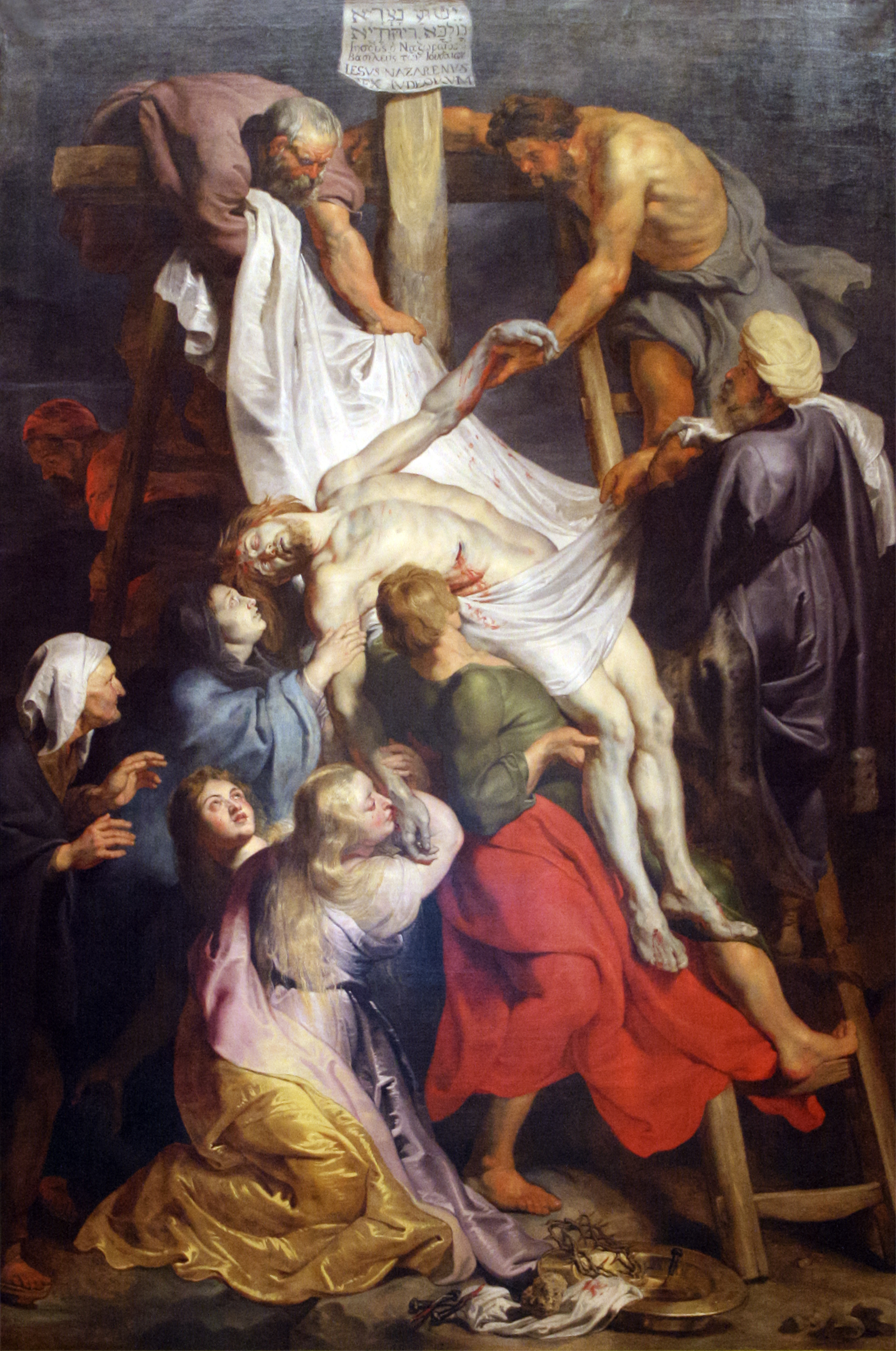
La Descente de Croix – Rubens (1617)
On Easter, we celebrate the heart of our faith, the story of Christ’s death and resurrection. Why is it so important? How does this narrative bridge the gulf between Human Sin and Divine Grace? And, why does this Act of God from two Millennia ago matter to us today?
Let us pray…
Lord God, we lift up this morning’s message. May it touch our hearts, may it speak clearly to our souls. We know that your Word and your love have bridged the huge chasm that separates us from you, and affirmed that all of us are your beloved children. Speak to us now, Lord. Help us to know you in the ways you have wanted us to know you since the beginning. Amen.
Three years ago, I visited the Church of the Holy Sepulcher in Jerusalem, the place at the heart of the events of Easter. As you enter that Church, to your right and up a flight of stairs, is the shrine of the Crucifixion. To the left, what would be behind me and deeper into the church, is the Shrine of the Tomb. So, on one side is the place where our Sin brought about the death of our Savior; and on the other is the spot where he was resurrected by the Grace of God.
Man’s Sin sent Jesus to his death, and God’s Grace brought him back, but what ties the two together?
The answer is in front of you, unavoidable as you enter the Church: the Stone of Unction.
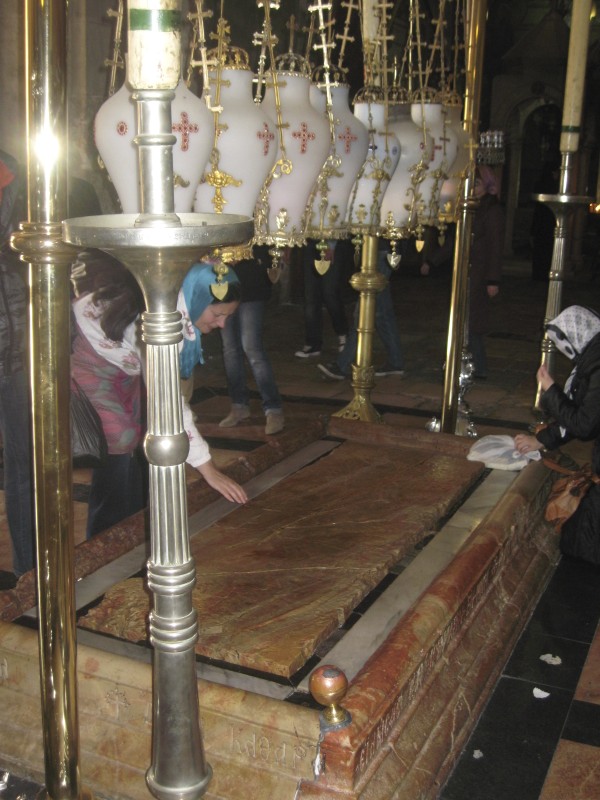
It is a simple stone, unadorned, surrounded by a few lamps, and just long and wide enough for a body. On the wall behind it is a modern mural that depicts the event that took place at this spot, where Joseph of Arimathea and the Pharisee named Nicodemus laid Jesus’ body after taking it down from the Cross.
“Unction” means “anointing,” and it is here on this stone that they washed Jesus’ body, anointed it with oil, and prepared it for burial.
Why is this important? Why did the designers of this Church orient it such that this spot is right in front of you as you enter the church? And, why is the building laid out such that you must pass by it a second time as you go from Calvary to the Tomb? In other words, why does it matter?
Let’s start by imagining what would have happened if Joseph and Nicodemus had not taken Jesus ‘ body down from the Cross.
The Stone of Unction: the spot where Jesus’ body was laid when first taken down from the Cross. Church of the Holy Sepulcher, Jerusalem.
Presented at a joint Ecumenical Service at Christ Lutheran Church, West Boylston, MA; April 6, 2012 (Good Friday).
Gospel Reading: John 19:31-42.
Seeing this beautiful Cross laid out here before us this evening, I am reminded of my recent visit to the Church of the Holy Sepulcher in Jerusalem, the focal point of the events that take place in this evening’s reading from the Gospel of John, the central narrative of our faith, which we remember in this Good Friday service, as well as on Easter, the story of Christ’s death and resurrection.
What made the biggest impression on me in that place was not the elaborate shrines of Calvary and the Tomb. It was a humbler shrine near the main entrance to the Church, “The Stone of Unction.”
This stone marks where Joseph of Arimathea, a prominent member of the High Council in Jerusalem, and the Pharisee named Nicodemus, a leader of the Jews; laid Jesus’ body after taking it down from the Cross. It was there that they washed Jesus’ body, anointed it with oil, and prepared it for burial.
Why is the Stone of Unction important? Why did the builders of that Church orient the building such that this spot is so close to the main entrance? Why is the building laid out such that you must pass by the Stone of Unction as you go from the Cross to the Tomb? In other words, why does it matter?
Let’s start by thinking about what would have happened if Joseph of Arimathea and Nicodemus had not taken the body of Jesus down from the Cross.

 The Here and the Hereafter