The point of this exercise is to challenge our preconceptions of what Jesus must have been like: Why do we think he is male, and why do we assume Jesus is just like us?
This particular discussion was inspired by this (admittedly facetious) blogpost entitled “Where Would Jesus Pee?”
In it, Andrew Seidel raises an interesting point: Jesus had a biological mother, but no biological father. Therefore, even if the Holy Spirit intervened to cause Mary to become pregnant, all of the genetic material was from his mother.
Now, a person of female gender has two X chromosomes (XX) while a person of male gender has an X and a Y (XY). The gender of their child is determined by which chromosome they get from the father – either the X or the Y. But, since Jesus has no biological father, then all of his genetic material would come from Mary, meaning he got an “X” instead of a “Y” and so must be female.
I recently presented this as part of our church’s “Message for All Ages” (being very careful of how I presented it, given that grammar school aged children were present). Then asked the question, “So, what do you think; why isn’t Jesus a Girl?”
As you can imagine, this produced some amazing facial expressions (and answers) from kids and adults like!
The point of this exercise is to challenge our preconceptions of what Jesus must have been like: How can we be sure he was genetically male, or even that he presented himself as a typical male, for that matter? Why do we assume Jesus is just like us?
I just had to share this beautiful post, no additional commentary needed…
The other day, Zac and I went into a retail store and were greeted by an associate. I soon recognized the associate as someone I used to go to church with years ago. Someone close to my age, who I …
I’ve met Rev. Heath only briefly, but her spouse was a classmate of mine in Seminary. She is far from the only trans or gender non-conforming person I know; and they all relate the same narrative that Emily gives voice to here: “I’m telling you that no trans or gender non-conforming person wants to use the bathroom for any other reason than you do. I’m telling you that this has never been about sexual predators (who don’t need bathrooms to hurt people, and who won’t be discouraged by an anti-trans bathroom law), but about harming trans people. I’m telling you that I’d like to spend a whole lot less time thinking about bathrooms than I do.”
If we are serious about our Christian faith, then we need to ask – FIRST – how our attitudes to others express the love that Christ mandates – MANDATES (via the Second Great Commandment) – that we show in all our dealings them, and that we do so without condition or exception.
And, will they see that love in how we are acting and speaking towards them? If they don’t, then we are failing to love them as we are required to do by the most basic tenets of our faith.
The anti-LGBTQ laws recently passed in NC and elsewhere do not pass this test. And so, we must seriously and deeply re-examine our own motivations and faith principles if we believe this was the Christian thing to do.
The video shows us that a word for the color “Blue” usually develops much later in most languages than do words for “Black,” “White,” “Red,” “Green” or “Yellow.” So, the question is “Can people without a word for ‘Blue’ in their language actually see the color we know as ‘Blue’?” The video answers this question by presenting convincing evidence that people have great difficulty in distinguishing Blue from other colors when they have no word for Blue in their language.
This suggests several things – any one of which would be sufficient for a brief “Message for All Ages” – pick the one that suits your situation best…
Those who seek to minimize the Christ in their Christianity do so out of a conviction that we must not offend, and must not intimidate (through “churchy” language and ritual) those who are looking for a touch of the divine in their lives. This is a worthy impulse, but we must be careful to not allow such thinking to seduce us into creating a faith for ourselves that is inoperative and unchallenging.
In my view, the tradition that has been passed down to us, combined with the teachings and example of Christ and others as found in the New Testament and elsewhere, forms a foundation or framework for our faith: denying, minimizing, or casting aside that framework really would leave our faith “rootless” as many Evangelicals often (erroneously) label we who are Progressive Christians.
Christianity is not about supplying all the answers or enforcing a rigid set of doctrines and laws to live by. Jesus preached against exactly that sort of thinking and practice in the First Century, and it doesn’t work any better now than it did then. (And, frankly, doing so has never worked well.)
On the other hand, our faith isn’t just about making us feel good about who and where we are at the moment, either: Yes, we are to love and accept ourselves and each other as we are right now, but we are called to continually seek to do better, not simply accept what is.
Keeping Christ in our faith is challenging, and should always be so: if our faith is not challenged, if it is not continually being refined in the tension of this place we exist that lies between what was and what is to come, then our faith would be fruitless and meaningless. It would simply be a rationale for accepting things as they are, rather than challenging us to become better: to become more just, more thoughtful, and more compassionate.
There is no need to sling mud at Ms. Davis – she’s no more flawed than any of us. There is no need to parade her in front of the cameras as a paragon of Christian Virtue – she isn’t, any more than we are. … We need to stop making her into something she is not. Instead, as Christians, we are called to hope and pray that she will come out of this experience without wrecking her life, and with a deeper and fuller appreciation of what her faith means to her, and how better to live her faith in compassion and love.
By now we’ve all heard about the Clerk of Rowan Country Kentucky, Kim Davis, who has refused to issue marriage licenses because she cannot in good conscience sign her name to a marriage license that, in her mind, violates God’s command that marriage is to be a heterosexual union between a man and a woman.
There has been a whole lot of very personal and nasty invective spewed in Ms. Davis’ direction because of this. Factually, most of it is true: she herself admits that her life was a mess until she began attending church about 4 and a half years ago. But does the fact that she has a checkered past matter? No. What matters is that she is a faithful person, trying to live out her faith as best she can. That needs to be respected. We need to remember that digging up such old dirt to throw at another runs contrary to Jesus’ words in Matthew 7:3-5: “Why do you see the speck in your neighbour’s eye, but do not notice the log in your own eye? Or how can you say to your neighbour, ‘Let me take the speck out of your eye’, while the log is in your own eye? You hypocrite, first take the log out of your own eye, and then you will see clearly to take the speck out of your neighbour’s eye.”
Many have used such stories when claiming to know God’s will, and so bull their way ahead towards some predetermined goal. They are full of hubris, not listening – or looking – for any further guidance from anyone, let alone God; confident that they are not mistaken in of their understanding of God’s will. More often than not, they fail, or else their road to success brings such great sacrifices and pain upon others that one rightfully wonders where God is in all of this.
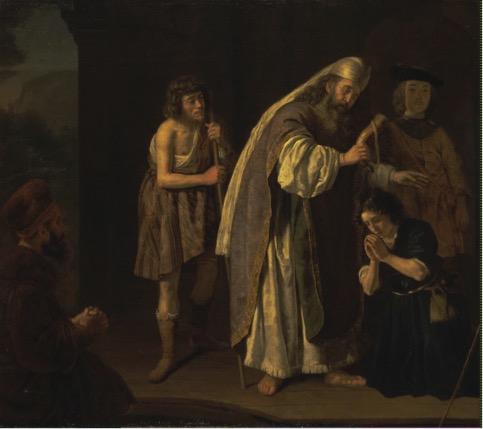
The Anointing of David by Victors Jan, ca 1645
I love reading from the histories in the Old Testament, such as this morning’s text in First Samuel about the anointing of David to replace Saul as King of Israel.
One thread in this story – as with all of our readings today – is about seeing. About what we see vs. what God sees.
This is made very plain at the heart of this passage, where the Lord says to Samuel about Jesse’s son Eliab: “Do not look on his appearance or on the height of his stature, because I have rejected him; for the Lord does not see as mortals see; they look on the outward appearance, but the Lord looks at the heart.” To say this another way, God sees that which we cannot see: the Lord sees the Unseen.
And yet, even after God says this, Samuel keeps on looking at six more of Jesse’s sons, and each time fails to discover what he has been sent to find. Finally, Samuel says “The Lord has not chosen any of these. Are all of your sons here?”
Well, it turns out that one of Jesse’s sons was not seen because he could not be seen, he was not there at all. The eighth and youngest son was up in the hills, tending his father’s sheep. David was the least of Jesse’s sons, and no one even bothered sending for him until Samuel explicitly asked that this last son of Jesse be brought before him. We see that David was unseen in many ways, but the Lord saw him!
Christianity is the faith-language we use here in encountering the Divine, but there are many such languages. It would be nice if there was a single, simple answer, but faith never provides a single answer, let alone a simple one – how could you have such an answer with an infinite God? You can’t write a symphony with a single note, and God’s Creation is far more complex, extensive and wonderful than any symphony! Our faith-language, combined with many others, are sung by the great choir that extols the greatness, diversity and immensity of an infinite and loving God, who loves each of us for who we are, just as we are – treasuring the unique and special gift that each of us is – a gift from God to all of Creation.
Our faith is like a language, a framework that helps us explore, express and deepen our relationship with the Divine. Everyone has a faith-language, whether we are Christians, Jews, Buddhists, Shamanists … even Atheists (since even non-relationship with the Divine is still a type of relationship).
We use this framework to understand and express our faith. It shapes how we look at the world around us: how we see our relationships with each other; and how we interact with each other; how we perceive the world is organized, what the purpose of Creation is (if any); and the purpose and limits of our own existence. Our faith-language is a lens we use all the time – not just in encountering the Divine, but in dealing with the everyday realities of life.
Our own faith language is Christianity. How we experience and express our faith is influenced by our familial roots, education, relationships and life experiences, the choices we’ve made in life, and many other factors. They all affect how we see and express the relationship we have with God and our relationships with each other. These relationships and experiences are uniquely ours, never to be repeated.
We all have a unique relationship with the Divine because our faith tells us that God values and loves us as and because we are unique and distinct individuals. The faith-language share binds us together as a community in relationship with each other, and with God.
And, Christianity works well for us (I hope!): we are familiar with it. It is part of the “cultural wallpaper” of our lives. It’s a tool that we constantly use throughout our lives: developing, strengthening and exploring our relationships with each other and with God. But, that does not mean that Christianity is the only faith-language for everyone, or even anyone, else. In fact, it can’t be.
The Crowd, Pilate, Caiaphas, Judas, and Peter: They all try to do the right thing, and we can see ourselves in them; because they are us in this story.
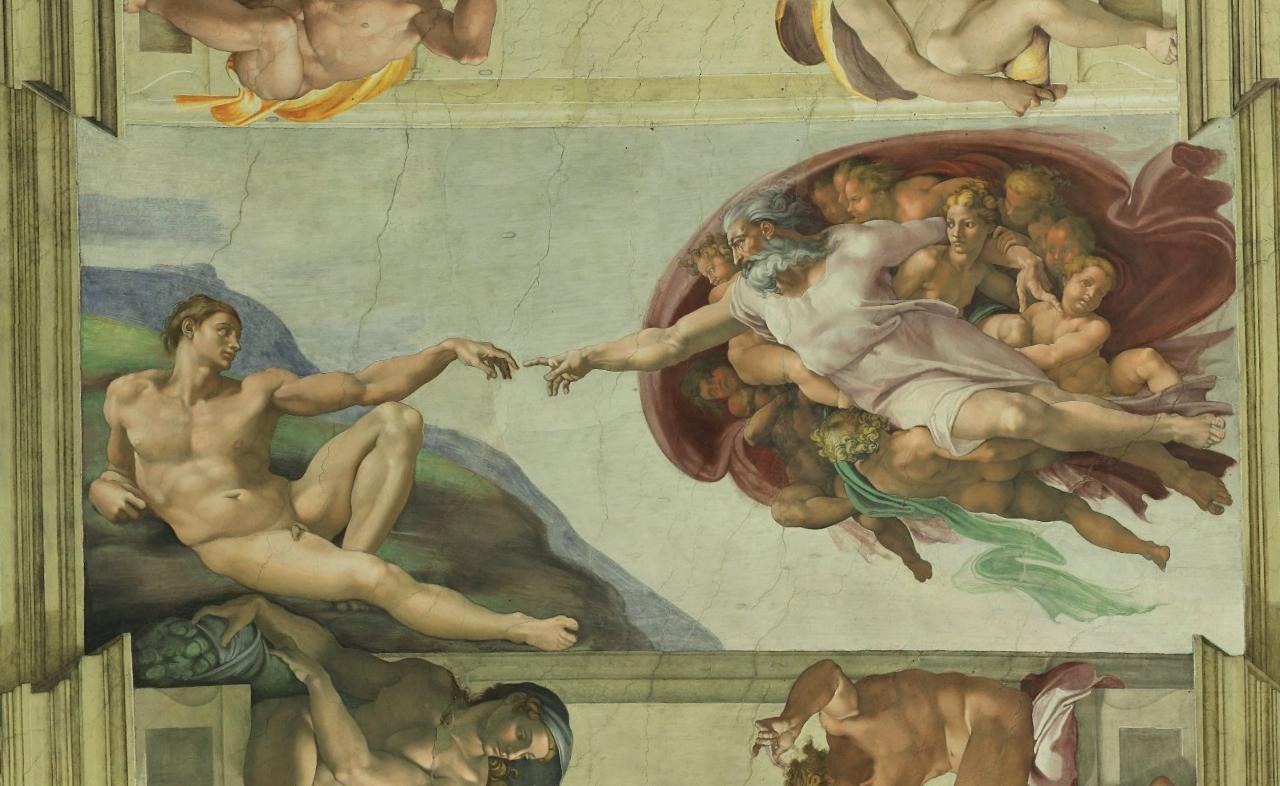
One central lesson of Palm Sunday is that that no matter how powerful we may be, no matter how well intentioned we are, no matter how wise, or how foolish, or how rich, or how poor, we all constantly make choices that widen the chasm that lies between us and God. We can’t help it, we can’t change it: … it’s part of being human. That is what Sin is: Sin with a Capital “S”; the Sin that has been passed down to us as our share in the brokenness of all existence, the Sin that began with Adam.
How does it feel to be one of them, one of the mob, one of those calling for His death? To turn on him in his hour of need?
How does it feel?
Let us pray…
Lord God, we lift up this morning’s message. May it touch our hearts, may it speak clearly to our souls. We believe your word and your love will rescue us from the depths of our doubt, unbelief, and Sin. Speak to us now, Lord. Help us to know you in the way you have wanted us to know you since the beginning. Amen.
Peter really tried to do the right thing. In the Garden of Gethsemane, he really tried to stay awake while Jesus prayed, but failed. We’ve all been there: like many of you, I have a hard time staying awake for my son after a long day of work, let alone during a sermon. Peter was no different!
But then, when Jesus was arrested, Peter ran away, just like everyone else. He tried again, tried to be there for his friend, the man he knew to be God’s anointed: stumbling along in the dark behind that mob, following their torches to the house of Caiaphas. He then sat in the courtyard, wondering what to do, listening to the voices coming through the window above him, hoping to hear his master speak, hoping that – somehow – Jesus would escape the fate they’d all feared for him. But, Peter also feared for his own safety, fearing he would be recognized as he warmed himself beside that fire.
He did his best, but it was too much for him. When the test came, when that servant girl called him out, he did the only thing he could do: he lied.
And then, when he heard the cock crow the second time, he wept. His failure was complete, his weakness contributed to the death of the man he loved. But Jesus had known this all along, and out of an abundance of compassion and love, had warned Peter this would happen.
We all know how this feels. We’ve all been confronted by situations we could not overcome. How many of us are Peters?
Being faithful isn’t about being skilled or perfect at anything. It’s about showing up. That’s all that God asks us to do – show up, and you’ll find that God is there too: showing us the way, impelling us to speak or act as needs to be done, helping us to learn what we need to learn, and providing the grace for those we encounter to rejoice in our presence and willingness to stand with them, no matter how clumsy we feel we might be.
NYPD Officer Lawrence DePrimo buying boots for a homeless man in Times Square this past November.
During this past Sunday’s “Open and Affirming Forum” at ARK Church our guests related some of their own experiences to help us better understand the pain and alienation that many transsexuals encounter every day, and also provided a great deal of information to help us be more sensitive, compassionate and affirming when dealing with anyone who is “other” – especially those in the LGBTQ communities. Our eyes were opened to the challenges of being someone who doesn’t fit into the neat (and very binary) categories of “male” or “female” or “opposite sex loving” or “same sex loving.” It was a moving, growing (and humbling) experience.
The leader of the forum said something near the end of the meeting that has stuck with me all week: “just show up.”
Paul tells us in this week’s Lectionary reading from 1 Corinthians that “the message of the Cross is foolishness to those who are perishing.…” And, that “God made foolish the wisdom of the world.”
In other words, foolishness (at least in one’s faith) is a good thing. But, can we have too much of a good thing? Are there boundaries beyond which our foolishness should not go?
I’ve been pondering how faith operates in and through us – both positively and negatively.
For a positive example, I look to our own congregation: We saw faith at work last night in our Annual Meeting – a time of remembering, visioning and deciding; sharing our knowledge, and evaluating the effectiveness of the wealth, wisdom and work we’ve expended in the past year. It was a time of counting up the resources available to us and deciding how to best utilize them to accomplish the mission and goals we believe are a part of our journey into the future.
That meeting, just like this worship service, and the many other things we do – either individually or jointly – are all positive, beneficial, things – or at least we see them as such. And, we see them as expressions of our faith.
It seems to me that we need to understand what Faith is, since what it is is central to who we are as Christians, and therefore critical in our discernment and pursuit of God’s Call upon our lives.

 This particular discussion was inspired by this (admittedly facetious) blogpost entitled “Where Would Jesus Pee?”
 Rev. Heath is absolutely right in her recent article in Christian Century entitled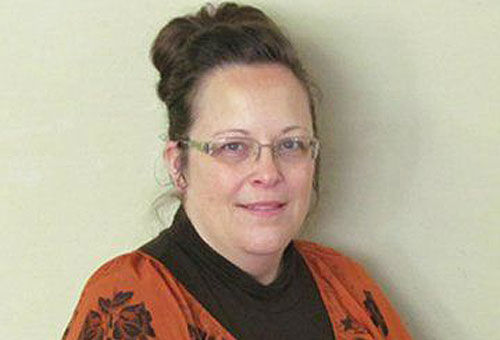




 The Here and the Hereafter