Sermon: A Mighty River

We’re all in this together, which is a good thing. We all have a stake in the outcome, which means we all have a role in the solution; and there is a solution.  Amos teaches that God’s plan is for us to work together: caring for the poor, the hungry, the destitute, and the land; looking for the good, and rejecting the evil.

Amos and Dr. Martin Luther King present salvation in a way we don’t normally think about  … for them salvation is communal, not individual.  We cannot achieve salvation for ourselves if we allow our community, our nation, and its people, and our world, to suffer and die.

Please join me in prayer.  Lord God, may your peace and Holy Spirit fill this place. Open your scriptures to us, and may I clearly communicate that which you intend us to receive. May your Word take root and flourish within each and every one of us. And through it may we be strengthened and transformed by your unconditional, living, and limitless love for all of your Creation.

In Jesus Name, Amen.

The other day, my son and I saw a truck driving on Route 2. It was what is known as a stake body truck (I had to look that one up!): it has a flat bed with metal rails on each side, mounted on stakes.  It had a tailgate on the back, which is little unusual.  It was very old and had seen hard use: battered, bald tires. It was driven by an equally ancient man.  (As my son would say, he was even older than I am.)  The truck was filled with what looked to me like a huge pile of random tools, equipment, mysterious bags and boxes.

The bed of the truck tilted to one side at an alarming angle.  The broken tailgate was held on by a single ancient strap fastened across the back, tied to the rails on each side – which was a good thing because otherwise they would have collapsed into the road.

The driver had trouble keeping his truck in the lane.  I shudder to think of what would have happened in a sudden stop.  I could not believe he dared to drive it, let alone at highway speeds.  What was so important that he felt such a risk with all of his mysterious cargo was worth it?

Continue reading “Sermon: A Mighty River”
Sermon: Knowledge, Faith, and Love

Solomon is certain he has built a place worthy of being God’s dwelling place forever.  … Forever is a long time: building a permanent dwelling place for God strikes me as an attempt to create boundaries for God that work for us, but perhaps not for God.  God’s former home was that tent made out of cloth, and skins, not stone.  It was not a permanent dwelling.  And so I think of that tent as representing how our Faith is a journey, not an endpoint; a path we must walk.  We might stop occasionally to dwell for a time, but we always move on.  A tent is not a monument.

Lord God, may your peace and Holy Spirit fill this place. Open your scripture to us, and may I clearly communicate that which you intend us to receive. May your Word take root and flourish within each and every one of us; and through it may we be strengthened and transformed by your unconditional, living, and limitless love for us and all of your Creation. 

In Jesus Name, Amen.

Tom texted me yesterday and asked if I would fill in for him this morning.  I immediately said yes, certain I had a sermon somewhere in my archive that would provide a good starting point for a meditation on this morning’s scripture.  Oops.  It took a lot more work than I thought; which is probably a good thing, actually: because if it wasn’t a journey to write this sermon and prepare for this service, then it probably wasn’t worth doing.

This morning’s reading is about Israel redefining its relationship with God in the time of Solomon the Wise.  The old tent that long housed the Ark of the Covenant no longer seemed fitting to them, for their prosperous and peaceful Kingdom.  

At the end of our reading, Solomon is certain he has built a place worthy of being God’s dwelling place forever.  …Forever is a long time: building a permanent dwelling place for God strikes me as an attempt to create boundaries for God that work for us, but perhaps not for God.  God’s former home was that tent made out of cloth, and skins, not stone.  It was not a permanent dwelling.  And so I think of that tent as representing how our Faith is a journey, not an endpoint; a path we must walk.  We might stop occasionally to dwell for a time, but we always move on.  A tent is not a monument.

Also, for a while now, I’ve been pondering how Faith operates in and through us on our journey through life.

For example, we saw Faith at work last week here, at our Special Congregational Meeting  – a major stepping stone in a long period of our congregation evaluating what works, what doesn’t, what’s broken, and what needs to be replaced or rethought.  We were asked to commit ourselves to the next step in that journey in the form of a Capital Campaign, to prepare our church’s infrastructure for the future. 

That meeting, just like this worship service, and so many other things that we do – either individually or jointly – are all expressions of faith.

Continue reading “Sermon: Knowledge, Faith, and Love”

Sermon: What’s Missing?

Lord God, may your peace and Holy Spirit fill this place. Open your scriptures to us, and may I clearly communicate that which you intend us to receive. May your Word take root and flourish within each and every one of us. Through it may we be strengthened and transformed by your unconditional, living, and limitless love for all of your Creation.

In Jesus Name, Amen.

One of my earliest memories is of sitting in the front pew at our new church with my mother and brother; my father’s voice booming out as he sang hymns and preached.  (Although I was mostly interested in raiding the treat table after the service, before they all disappeared.)

Eventually I realized that something went missing during our first few weeks there. I overlooked it for a long time, a very long time, before realizing it was gone. So, five decades later, I asked him about it.  In response, he told me the following story…

The church had a new sound system. The first one Dad ever used; and he wasn’t sure how to work with it.  The Church Moderator was Pony Felch, a true old time Vermonter, right down to his accent. One day, Pony came to my Dad and said “You know Reverend, we appreciate your strong voice.  But when singin’ the hymns, could you take a step or two back from the Mic?”

Continue reading “Sermon: What’s Missing?”

A Message for All Ages: “The Codex”

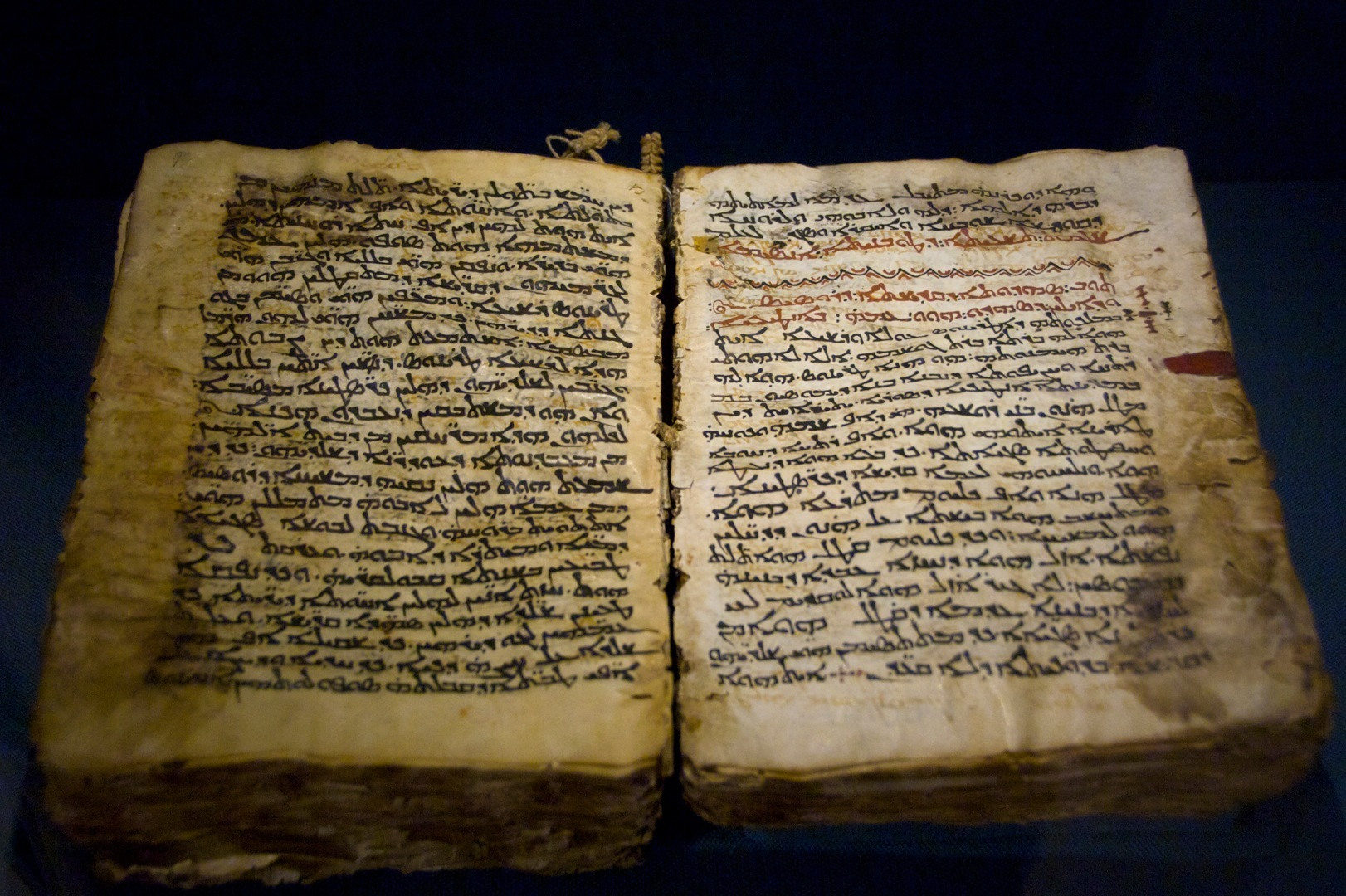
By the second century, the codex was the preferred format for preserving and transporting the written word among Christians evangelists and scholars, and it is thought that the spread of Christianity both drove, and was facilitated by, the adoption of the codex in place of scrolls.

codex sinaiticus St Catherine's
The Codex Siniaticus is the oldest known complete text of the Bible, from ca. 350 AD. This copy was discovered in 1844 at St. Catherine’s Monastery in the Sinai (hence its name).

A short history of the codex and why it was so important to the development and spread of Christianity.  Portions of this outline were presented in an informal “Message for All Ages” at ARK Community Church in Dalton, MA; Feb 1, 2016.

Prior to the first century CE (or so), nearly all written documents were in the form of single sheets or scrolls.

Because of the difficulty of unrolling scrolls to find particular passages and then having to roll them up again, longer books were often broken up into multiple scrolls. You can see this even today in the segmentation of 1 & 2 Kings and 1 & 2 Chronicles in the Hebrew Scriptures, both of which were originally single continuous texts.

And, because of the difficulty of managing and storing scrolls, very short books were often collated together into a single scroll.  For instance, the 12 minor Hebrew prophets (Hosea, Joel, Amos, Job, Malachi, etc.), were often kept together in one or two scrolls.

The word “Codex” is from the Latin word for “wood” or “block” and is the technical term for a folio of pages stitched together.  In other words, a book.  The codex was developed by the Romans shortly before the time of Christ, Julius Ceasar may have been the first prominent Roman to use them.

Continue reading “A Message for All Ages: “The Codex””

“Bible Mindedness”

bibleI find a recent survey done by the “American Bible Society” quite troubling, not just because of the conclusions the survey’s authors present, but also because of the criteria used in evaluating where people stood on what the ABS termed “Bible Mindedness.”

The authors of this study evaluated “Bible Mindedness” using the following criteria: “Respondents who report reading the bible within the past seven days and who agree strongly in the accuracy of the Bible are classified as ‘Bible Minded…’”

I take strong exception to this, as I find just as many devout and thoughtful Christians here in the Boston area (which was near the bottom of the study’s rankings) as I do anywhere.  The criteria used here heavily skew the results towards a very narrow and slanted view of what “Bible Mindedness” means.

For me, reading the Bible on a nearly constant basis should not equate to “Bible Mindedness” because such a practice assumes the Bible can be relevant and useful to us in our daily lives entirely without reference to the world in which we live, an assumption that is deeply flawed.

Reading other works that reflect upon the Bible and our faith, such the writings of various theologians, works of poetry, histories, science, novels, the Talmud, the Koran, etc; all provide new insights about how our faith impacts us and impacts the world around us.  Such readings help us gain a greater appreciation of the variety and magnificence of God’s Creation.  And, they provide new and deeper revelations of what our faith means to us, and how we can apply that faith to the challenges of life, as well as helping us attain a broader perspective of what it means to be a person of faith.

Since God is infinite, God must encompass an infinitude of perspectives.  Therefore, limiting ourselves to a single (and literal) perspective of the Bible limits us in our understanding of Creation and of our relationship with our Creator.

So for me, being a person of faith – being “Bible Minded” – means using the Bible as a starting point – not an end point.  A view shared by many who were dismissed (by the criteria used in this survey) as “not engaged with the Bible” and not using the Bible to make sense of [their] life.

Copyright (c) 2014, Allen Vander Meulen III, all rights reserved.  I’m happy to share my writings with you, as long as you are not seeking (or gaining) financial benefit for doing so, and as long as proper credit for my authorship is given (e.g., via a credit that gives my full name and/or provides a link back to this site). 

Like the Bible Says… | The Congregational Church of Westborough

Like the Bible Says… | The Congregational Church of Westborough

OLYMPUS DIGITAL CAMERAMy friend (and fellow Andover Newton graduate) Pedro S. Silva is right on target with this meditation on the lack of knowledge that most of us have nowadays (including ministers!) of what’s really in the Bible; and the net of mis-appellation and misinterpretation we build around it as a result of that illiteracy.