The Nature of Love

shutterstock_124493413It seemed appropriate on this, Valentines Day, to reflect on the nature of Love.

In Christian Scripture, the Apostle Paul’s First Epistle to Corinthians (chapter 13) is known as the “Love Chapter.” I quote it in full here…

1If I speak in the tongues of mortals and of angels, but do not have love, I am a noisy gong or a clanging cymbal. 2And if I have prophetic powers, and understand all mysteries and all knowledge, and if I have all faith, so as to remove mountains, but do not have love, I am nothing. 3If I give away all my possessions, and if I hand over my body so that I may boast, but do not have love, I gain nothing.

4Love is patient; love is kind; love is not envious or boastful or arrogant 5or rude. It does not insist on its own way; it is not irritable or resentful; 6it does not rejoice in wrongdoing, but rejoices in the truth. 7It bears all things, believes all things, hopes all things, endures all things.

8Love never ends. But as for prophecies, they will come to an end; as for tongues, they will cease; as for knowledge, it will come to an end. 9For we know only in part, and we prophesy only in part; 10but when the complete comes, the partial will come to an end. 11When I was a child, I spoke like a child, I thought like a child, I reasoned like a child; when I became an adult, I put an end to childish ways. 12For now we see in a mirror, dimly, but then we will see face to face. Now I know only in part; then I will know fully, even as I have been fully known. 13And now faith, hope, and love abide, these three; and the greatest of these is love.

The thing I observe about Paul’s eloquent prose is that it talks about how Love is at the core of the Christian message.  Without it, says Paul, Christianity is nothing, and our words meaningless.

In fact, in reflecting upon the Gospels I do not recall a single instance where Jesus limits the ways in which we are encouraged (or allowed) to love others.  Instead, like Paul, Jesus focuses us on the importance and centrality of Love, often being an example to us of how to love others, and how our love for the other must be grounded in our Love of God.

I remember the first time I saw a young couple passionately kissing, when I was an early teen, I think.  It was a new thing for me – an unfamiliar sight, something I was not comfortable with, something that unnerved me more than a little bit.  I remember thinking “Ewwww!”  … I’m sure most of us have had similar experiences!

Continue reading “The Nature of Love”

Religious Illiteracy – Good or Bad?

osterhasen-0177I read an article on CNN a couple of years ago that quoted a social studies teacher who said that each year he asks his students “What is Easter about?”  He said they invariably bring up the Easter Bunny but never mention the significance of the holiday to Christianity.

I’ve also noted a tendency among some Churches and Christian leaders in recent years to “circle the wagons” and retreat into Orthodoxy or relatively conservative statements of doctrine.  This seems to be a reaction to the declining influence of organized Christianity in American society as a whole, and may also reflect a perception that more conservative, evangelical Christian groups are growing while “mainstream” Protestant denominations (and Catholicism) are on the decline.

I am convinced that by retreating into more orthodox expressions of the Christian faith, progressive Christians are abandoning the greatest advantage they have in the face of an increasingly secular society, which is their ability to engage with others in ways they can easily understand.   That Vermont teacher’s observation that young people are not able to identify Easter’s origins in the Christian Tradition (still less the underlying Judaic traditions), means they have no basis for comprehending words like “Christ”, “Jesus” or “Salvation”.  Such concepts mean nothing to them.  Therefore, using such terminology to try and reach them is fruitless.

Also, the only impression of Christianity many people have nowadays comes from news articles about the hate-filled activism of Westborough Baptist Church, and the anti-intellectualism, racism, misogynistic attitudes and/or homophobia of various religious groups and personalities.  So, if we use the same words such people use, even though the message itself is far different, we, as progressive Christians, are being lumped together with them in the public mind.  We are therefore perceived as out of touch and irrelevant to modern realities and concerns.  (And, as any politician will tell you, perception always trumps truth!)

Continue reading “Religious Illiteracy – Good or Bad?”

Just a Slut

rush_limbaughIn the movie “Definitely, Maybe“, Dakota Fanning asks her philandering father the question “What’s the male word for ‘Slut’?” To which he sheepishly responds “They’re still working on that one.”

It’s sad that in this day and age, the slang word for a female who is suspected of having multiple intimate partners is still an accusatory, denigrating term (“slut”); while the nearest equivalent for a male denotes admiration or envy (“stud”).

Ultimately, this reflects the ongoing imbalance of power between men and women in this society.  While there has been steady improvement over the last century or so, our language, laws and social expectations still grant men dominance and marginalize the role of women in relationships and society; we are far from resolving the problem.

This dichotomy has been highlighted in recent attempts by some Christian leaders, and political leaders at both the State and National level, to cast the issue of reproductive rights for women as a “freedom of religion” issue.

In my own view, this is alarmingly disingenuous.  “Freedom of Religion” has always meant the freedom to practice ones’ own faith without interference from the state.  It does not include the right to impose ones’ religious beliefs on others, nor the right to practice ones’ faith in a way that causes harm to others.

Yet, this is what is being proposed by those who are using the “Freedom of Religion” argument in the current controversy, that I, as a person of faith, have the right to determine whether another person has the right to “Life, Liberty and the Pursuit of Happiness.”  Or, to put it less grandiloquently, has the right to determine what is best for themselves.

So, which of the two trumps the other?  Should “Freedom of Religion” take precedence over our right to self-determination?  I think not.  To do so would push our nation in the direction of a Theocracy while turning the cry of “Freedom of Religion” into the perfect excuse for avoiding any responsibility or law that we find distasteful.

Continue reading “Just a Slut”

Homelessness

image courtesy of Wikimedia commons

Most Thursday mornings you can find me at a local shelter for homeless families, working as a volunteer chaplain.  I’m not as useful as I’d like to be, since I am male – and many of those needing the services of this facility (and similar shelters) are there because of domestic abuse – meaning that men are to be feared and avoided, not trusted.  So, it can take a great deal of time to get past that hurdle before communication (and trust) can grow.  And, many of the residents move on to other shelters, or (hopefully) a home, before such a bond can develop.

As a result, I spend a great deal of my time observing those who are there in the shelter, mostly Moms (and some Dads) getting their kids to the school bus, preparing to go to work.  Often they are also preparing for a new round in the endless struggle with the Social Services bureaucracy and various other agencies and organizations: a struggle dedicated to providing enough food for their family, finding a new home, a new job, and perhaps medical or other care.

It’s an interesting place.  I usually see kids reading schoolbooks, watching TV, talking with their parents and playing with friends.  Both parents and kids will be eating from the continental breakfast buffet that the hotel puts out for them.  (The State of Massachusetts contracts with a number of hotels around the state, such as the one I work at, to provide shelter for the several thousand homeless families that cannot be housed within state-owned and run homes.)

The kids are dressed just like any kid would be on a school morning – jeans or (for the younger set) some sort of themed clothing – (perhaps a superhero, Barbie, Hello Kitty, and so on…)   Backpacks full, sometimes with Mom (as all Mom’s do) doing her best to make their hair and outfits presentable before they have to run out to the school bus.

When I drive up on those mornings, I sometimes see parents running from the hotel to the commuter bus stop nearby with plates of food – perhaps two or three bagels or toast, and (usually) coffee.  Moms might be pushing a stroller, or shepherding a young child or two, while the dads might have a backpack or briefcase.

These are people, people like you and me.

Continue reading “Homelessness”

Evolution vs. Creationism

2hs-2009-05-a-printA thought to consider for today…

There has been a fair amount of discussion in the media in recent days of Creationism vs. Evolution, perhaps sparked by Bill Nye (“The Science Guy”) and his recent online debate with Creationist Ken Ham.

My concerns with Creationism are threefold: one scientific and two theological in nature.

The scientific one is simply that Creationism flies in the face of established science, science with a very deep and well supported history of research behind it.  To choose Creationism over Evolution requires rejecting a multitude of well established and well defended facts that are highly supportive of each other, and have shown a massive amount of predictive value in terms of where to look for new revelations of the nature of Creation.  Creationism cannot do this, and also (in effect) requires rejecting the majority of scientific theory and research made over the last 500 years or so, along with the advances that have been made as a result of those theories and research.

For me, Faith is of paramount importance (which is probably obvious, given that I am a minister).  However, Faith must pass the “sniff test” – meaning that it is relevant and meaningful in this world that we live in and know.  Creationism fails that test.  This leads to my two theological concerns, where Creationism fails even more egregiously than it does when portrayed as a scientific theory.

Continue reading “Evolution vs. Creationism”

“Bible Mindedness”

bibleI find a recent survey done by the “American Bible Society” quite troubling, not just because of the conclusions the survey’s authors present, but also because of the criteria used in evaluating where people stood on what the ABS termed “Bible Mindedness.”

The authors of this study evaluated “Bible Mindedness” using the following criteria: “Respondents who report reading the bible within the past seven days and who agree strongly in the accuracy of the Bible are classified as ‘Bible Minded…’”

I take strong exception to this, as I find just as many devout and thoughtful Christians here in the Boston area (which was near the bottom of the study’s rankings) as I do anywhere.  The criteria used here heavily skew the results towards a very narrow and slanted view of what “Bible Mindedness” means.

For me, reading the Bible on a nearly constant basis should not equate to “Bible Mindedness” because such a practice assumes the Bible can be relevant and useful to us in our daily lives entirely without reference to the world in which we live, an assumption that is deeply flawed.

Reading other works that reflect upon the Bible and our faith, such the writings of various theologians, works of poetry, histories, science, novels, the Talmud, the Koran, etc; all provide new insights about how our faith impacts us and impacts the world around us.  Such readings help us gain a greater appreciation of the variety and magnificence of God’s Creation.  And, they provide new and deeper revelations of what our faith means to us, and how we can apply that faith to the challenges of life, as well as helping us attain a broader perspective of what it means to be a person of faith.

Since God is infinite, God must encompass an infinitude of perspectives.  Therefore, limiting ourselves to a single (and literal) perspective of the Bible limits us in our understanding of Creation and of our relationship with our Creator.

So for me, being a person of faith – being “Bible Minded” – means using the Bible as a starting point – not an end point.  A view shared by many who were dismissed (by the criteria used in this survey) as “not engaged with the Bible” and not using the Bible to make sense of [their] life.

Copyright (c) 2014, Allen Vander Meulen III, all rights reserved.  I’m happy to share my writings with you, as long as you are not seeking (or gaining) financial benefit for doing so, and as long as proper credit for my authorship is given (e.g., via a credit that gives my full name and/or provides a link back to this site). 

Like the Bible Says… | The Congregational Church of Westborough

Like the Bible Says… | The Congregational Church of Westborough

OLYMPUS DIGITAL CAMERAMy friend (and fellow Andover Newton graduate) Pedro S. Silva is right on target with this meditation on the lack of knowledge that most of us have nowadays (including ministers!) of what’s really in the Bible; and the net of mis-appellation and misinterpretation we build around it as a result of that illiteracy.

Hoping for a Future

534100_445597948860210_865607878_n

Some thoughts on the tension between Certainty and Hope, inspired by’s book “The Prophetic Imagination”…  

“I have a dream!” said the Preacher.

A dream implies hope: hope for a better life, for redemption, or justification, or perhaps vindication.  Hope is the conviction that the future holds the promise of better things to come, that the future is a better place than the present.

And the Preacher, representing a people who had endured centuries of oppression, terror, bondage, and worse, gave voice to their hopes that hot afternoon, more than 50 years ago.

“I have a dream!” he said.  And yet, the hundreds of thousands who first heard those words had little else but those words.

Hope flourishes in the forgotten corners of human existence, in those places where certainty either does not exist, or where the only certainty to be had is dark and painful.  Hope flourishes where human voices are not given the chance to speak, where human hands are not allowed to build a future for themselves, and quite often where those with power and wealth have done all within their power to eliminate the future.

Stop! …Say that again?  Eliminate the future?

Yes.

Continue reading “Hoping for a Future”

Absolute Knowledge

J Edgar HooverAs a recent New York Times video (about the event that proved J. Edgar Hoover was on a crusade to destroy liberal dissent) demonstrates, it is natural for those in power to view ANY challenge to their authority and/or policies as a threat.  It is not much of a step from there to justify the need to silence all who oppose their policies, even though (as one of the people in this video says) “dissent is the lifeblood of Democracy.”

So, one must reflect on how the legacy of Karl Rove & Dick Cheney, Richard M. Nixon, Joe McCarthy, J. Edgar Hoover, and Albert S. Burleson (among others), proves that this temptation to squash dissent (rather than allow it to have a place in “the marketplace of ideas”) has a long and unrelenting history in this nation (let alone elsewhere!) and that preserving free speech is a never-ending and often thankless battle.

I should note that several people I know are mentioned in the FBI’s surveillance files from the 1950’s, 60’s and 70’s. Some (like my Dad) merited only a passing reference.  Others were the target of prolonged harassment and pressure, to try and silence them and/or to force them to name others as threats to the public order.

Our modern euphemism for such threats is the word “terrorist” – which is a term that has become fashionable in some circles as a label for any who dissent, used far more often than is merited.

So, in the current furor over Richard Snowden and the NSA’s spying activities, one must remember that the NSA has accumulated the largest trove of information and knowledge about the activities of millions of people that has ever been assembled – far greater than what the most repressive regimes in history were ever able to accumulate.  Whether Snowden is a hero of free speech or not, he is but one in a long line of those who have paid a great price for their attempts to shine a light in the dark corners of our government.

Can we trust that there isn’t a nascent J. Edgar Hoover somewhere within the Beltway who has access to this mountain of data?

I doubt it.

Knowledge is power.  Absolute power corrupts absolutely.

Copyright (c) 2014, Allen Vander Meulen III, all rights reserved.  I’m happy to share my writings with you, as long as you are not seeking (or gaining) financial benefit for doing so, and as long as proper credit for my authorship is given (e.g., via a credit that gives my full name and/or provides a link back to this site). 

Who Owns Christmas?

Recently I saw a news article on a local TV channel about a family here in a Boston suburb that has been celebrating Christmas for decades with an extravagant display of lights.  This year, for the first time, an anonymous “neighbor” sent them a letter claiming to be insulted by the display.

Now it is true that there are many who react  negatively to such celebrations of Christmas.  Comments I’ve heard and read include people saying they feel insulted, offended, disgusted, oppressed and/or marginalized because of this Holiday, and this letter writer certainly sees the display as a statement of exclusion – Christians celebrating their cultural dominance in an insensitive way.  And, they’re not alone, many have written similar anonymous letters (some with threats) in the past.

OK, Let’s accept that: many do feel this way, including our anonymous letter writer, just as the owners of that home, and many others, are feeling hurt and insulted by what the anonymous letter writer had to say.  Such feelings are a reality and cannot be denied.  But I wonder, was this letter a healthy way of expressing one’s feelings about the display of lights?   (In this case, given what they said, I’d say not!)  But, it does raise the issue: is such a display of Christmas lights as insensitive and insulting as this person claims it to be, and how should we react when such concerns are raised?

Continue reading “Who Owns Christmas?”

An Advent Prayer of Hope

Slightly modified version of a prayer presented at Centre Congregational Church, UCC in Brattleboro, VT, December 15, 2013

11207_13320_5The Advent Season and Christmas are a dark time for many, a time when the pain of past and present injuries and losses become almost unbearable.  A time when we’d rather run than have to face it all once again.

God knows this because God has walked among us, as one of us, as a human being.  Jesus experienced birth, the love of a devoted mother, the pain of losing those dear to him.  He knew rejection, hunger, despair and fear.  He was betrayed by those he loved, and he experienced a painful and humiliating death.  God knows what it means to be human.  God knows our deepest, greatest, most deeply hidden fears, failures and weaknesses.

And so, our faith tells us, God walks with us.  God knows our pain, God feels it, God and the Kingdom of Heaven are near us at the hardest of moments, just like every other moment of our lives, including now.

Know that you are loved.  Know that God has, and will, do anything and everything to free us from the troubles and trials of life in this world.  And, in fact, has already freed us, for the certainty of that freedom and healing is what is in our future.  We cannot escape healing, for God is with us on every step of our journey; and, no matter how dark our valley may be, we are pursued by our Creator’s fierce, relentless love until we are finally embraced in God’s strong, loving arms and so come to dwell in the House of the Lord, forever.

Amen.

Copyright (c) 2013, Allen Vander Meulen III, all rights reserved.  I’m happy to share my writings with you, as long as you are not seeking (or getting) financial benefit for doing so, and as long as proper credit for my authorship is given (via a credit that gives my full name and/or provides a link back to this site). 

Waiting…

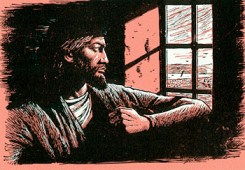
John the Baptist in prison

Presented at Centre Congregational Church, UCC in Brattleboro, VT
December 15, 2013  (Advent, Week 3)

Scriptures: 

Luke 1:47-55 (The Magnificat)
James 5:7-10 (“Be Patient … Strengthen your hearts”)
Matthew 11:2-11 (“Are you the One who is to come?”)

This is Gaudete Sunday, the Third Sunday of Advent; and tradition tells us it is “…a day to be joyful even in the midst of long waiting and keen awareness of suffering.”   

Our Advent readings started two weeks ago with a focus on the future: “The reign of God is coming. Prepare!” They end next week with a focus on the past: “The Messiah is about to be born in Bethlehem. Rejoice!”  And, as I said earlier, the word Gaudete is a Latin word meaning “to rejoice” in the imperative – meaning we are commanded to rejoice.

As Advent progresses, our emphasis on the future declines as our emphasis on the past increases.  Our readings for Advent begin with a mature Jesus teaching us about the reign of God, and they close with the unborn Christ Child in Mary’s womb.

This movement reflects our Christian understanding that the sacred story, to be understood fully and correctly, has to be told backwards.  The birth and ministry of Jesus are incomprehensible until we know of his death and resurrection.  To put it another way, our understanding of the past is muddled and incomplete until we grasp the nature of the future and purpose of History.  Christianity sees History as having a definite start, a definite end, and that it reflects the plan and purpose of God, reaching its crescendo in Christ.

Advent binds the future and past together.  It reminds us that there is a tension between them, and that this tension is where our faith is centered – the conviction that there is a known end to the road we are called to follow through History, and that God is continuously involved, even though the path that our feet tread at the moment is never clear to us.  You see this tension in each of our scriptures for today.

In the Magnificat from the Gospel of Luke (much of which we sang as our first hymn this morning) Mary begins by saying “My soul rejoices in God my saviour!” and she ends with “He has helped his servant Israel … according to the promise he made to our ancestors …”  Mary is linking past, present, and future – naming the promise made to Abraham long ago; and rejoicing because the long wait for its coming fulfillment is over.

In our first reading, in his Epistle to a Church that wonders why the Messiah has not returned, and why the suffering continues, James tells us to be patient and take comfort, in the same way that a farmer waits for the crop to mature, and warns us that the Judge is standing at the doors.  In other words, the time is at hand, and God is waiting to see the results of the work of the Messiah.

All of this comes to a head in this morning’s Gospel reading, where the Baptist’s disciples confront Jesus.  But first, let’s consider the setting of the story.

Continue reading “Waiting…”