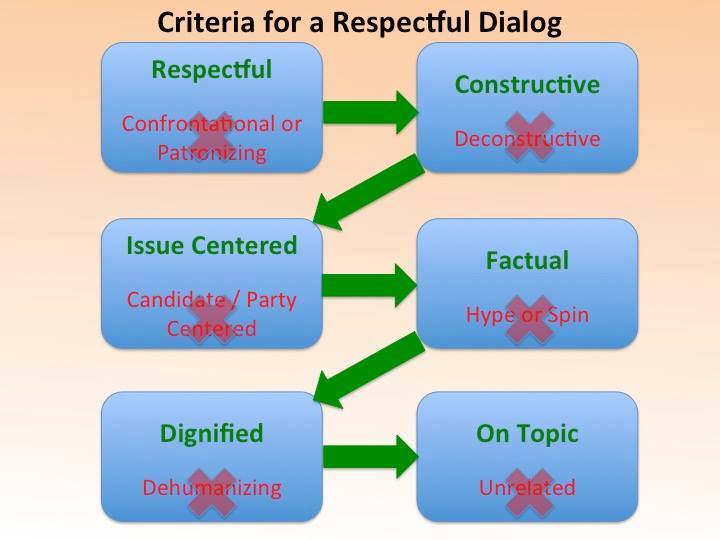
What is a “Respectful Dialog”?

I welcome and enjoy hearing out viewpoints different from my own – and almost always learn something valuable from such discussions. But, abusive speech is never acceptable, and won’t be tolerated. It’s how the views are being communicated that is the issue, not what is being communicated.

11027993_10153228240696773_4766521774461750123_nI spend much of my time writing or posting content on the internet that is intended to educate and inform, and to encourage discussion.  These discussions often manifest themselves in the form of comment-threads with a large number of participants.  (Sadly, most of the more interesting and productive discussions occur on my Facebook page, and so aren’t visible on my WordPress sites.  I wish there were a way to replicate comments between the two!)

Every so often (especially in response to my posts on more controversial topics), I will get a hoard of what I mentally label as “Whacko Conspiracy Theorists” making a rash of comments that have little to do with what is being said, and everything to do with how they feel about what they feel the topic should be: often hijacking what had (or could have) been a productive discussion.

Such comments are a quandary for me: Yes, I want to encourage discussion.  But it is clear that many of these “Whacko Conspiracy Theorists” have no interest whatsoever in learning anything, or in developing a common ground of understanding (and a possible basis for united action on the topic at hand).

So, how does one identify those who are really “Whacko” as opposed to those who merely hold views different from my own?  It is all too easy to label any who disagree with you as “Whacko” and move on – which is what many do on both sides of the fence.  But, this is not productive.  Responding to others’ nutty comments with your own favorite flavor of nuttiness does not help the situation: it does not encourage dialog, and does not do anything to develop a common understanding.  What’s more, when you dig under the covers, you often find significant areas of agreement in terms of identifying what the basic problem is.  The disagreement usually comes with ones’ preferred solution.  We cannot hear what those areas of agreement are if we stay focused only on our disagreements.
Continue reading “What is a “Respectful Dialog”?”

#BlackLivesMatter and The Legacy of Slavery

Much of what the “Black Lives Matter” movement is doing makes us uncomfortable, particularly those of us who are white. This is as it should be. If we’re comfortable where we are “at”, we won’t move, we won’t improve, we won’t change. If the injustices that exist are to be righted, we must be made uncomfortable. We must be made to see those things which are invisible to us because they’ve “always been that way” – working well for us, and so we ignore them or are unaware that they operate in our favor: that’s the very definition of “structural racism.” Yet, these same structural prejudices that are so deeply intertwined within our society and legal system do not work so favorably for others.

The first slaves arrive in Massachusetts on board the Desire, December 12, 1638.

We often forget that slavery was everywhere in the US until the early 1800’s, and it was no prettier in Massachusetts, New York, or New Hampshire than it was in Texas, Delaware, or Virginia.

Some of the best known Blacks in U.S. History – such as Sojourner Truth, William Still, and Lucy Terry Prince – were born into slavery in the North, or were transported here as slaves from Africa.  Many of our most famous native sons here in New England (such as John Winthrop, founder of the Massachusetts Bay Colony) sanctioned slavery.  Many of the wealthiest families of New England and New York in the 17th, 18th and 19th centuries built their fortunes upon the slave trade.  And, we forget that slavery was very much present in places like Massachusetts for over 150 years.  In fact, with the sole exception of Vermont, slavery was not abolished in any Northern State until after the American Revolution, and was not fully abolished from all Northern States until 1865.

Another aspect of oppressive systems, such as slavery – and like any institution or behavior deeply embedded in any society or organization – is that its effects persist long after people even remember that it was there. You see this in how some churches keep on “chewing up” new Ministers, in how corruption keeps on toppling one political figure after another in certain communities, or in why we here in America drive on the right hand side of the road, or why we set the table with the fork on the left.

Continue reading “#BlackLivesMatter and The Legacy of Slavery”

A Matter of Words – Losing a Customer and Opening a Conversation

As this St Louis Bookstore owner says, “Black Lives Matter does not mean White People are Bad. It never did. Saying someone matters does not mean that nobody else matters. It just says to someone who feels invisible, ‘I see you and I value you.'”

Political Correctness

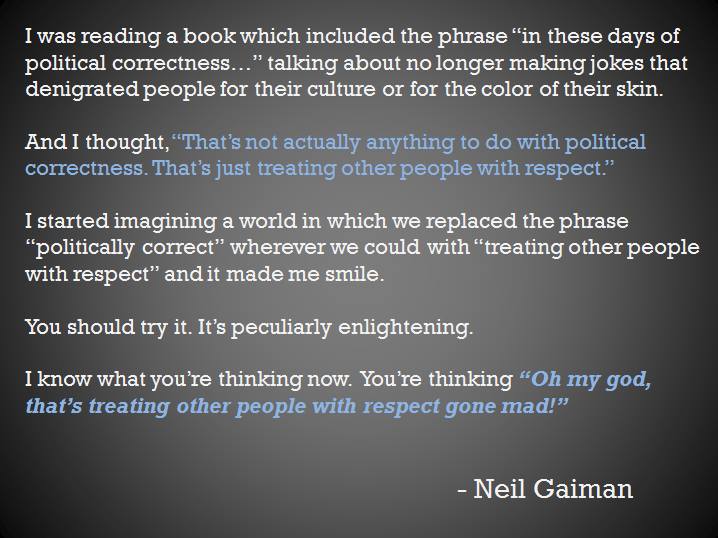
11836927_10153464980125629_6062162762026020487_nAs much as I admire and respect the work and words of Neil Gaiman, this meme that is said to be quoting him (I have not verified that this is the case) is half right.  It is only half right because there are two kinds of political correctness.

The first kind, “treating people with respect,” is a very worthwhile impetus: treating people in ways that demonstrate we truly value and respect them and what they have to say is something we should do all the time, regardless of who they are. I see this kind of “Political Correctness” as one important way of living Christ’s command to “love thy neighbor” in everyday life. So, in this light, Neil Gaiman is absolutely correct.

But then, there’s the second kind of “Political Correctness”…

Continue reading “Political Correctness”

Sermon: Silence

There are two kinds of silence present in both of these two passages: the silence which makes space for the inner witness, and the silence of oppression. But, the ways in which the characters in each narrative respond is very different. What can we learn from these two stories?

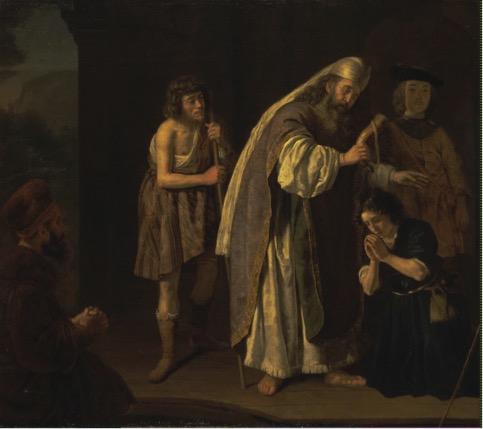
"Thou Art The Man" (1884) by Peter Frederick Rothermel
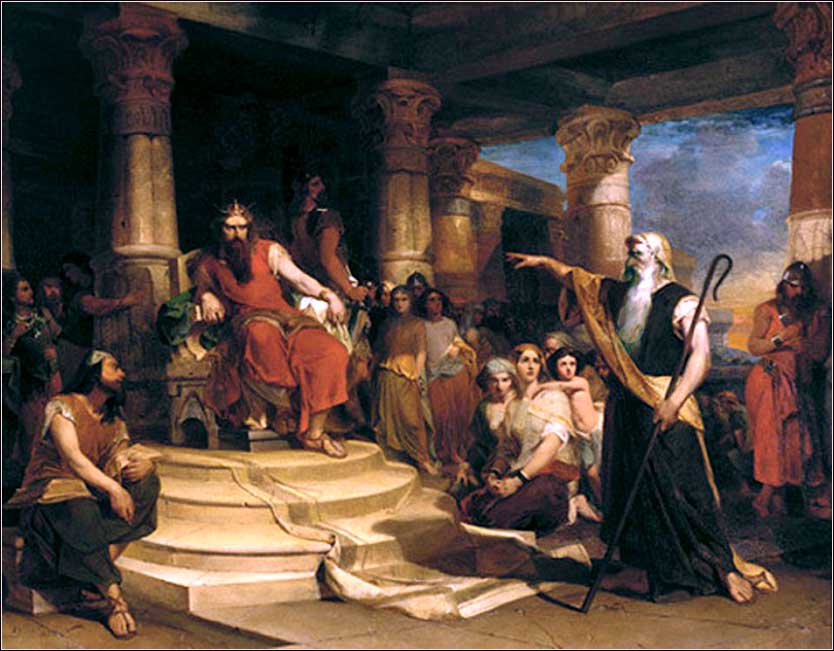
“Thou Art The Man” (1884) by Peter Frederick Rothermel

For all of recorded history, bringing legal disputes to the local ruler or wise man for public airing and judgment was a centerpiece of good government, and still is. And, doing so – among other things – makes all who are there part of the public witness for each case and decision; so, the community as a whole is in effect a party to the success and enforcement of each judgment that is made.

In our reading from 2 Samuel, Nathan makes his case to David in just such a setting; which was a wise move on his part! He knew he needed that public witness for the accusations he was about to make.

Imagine the scene: David is sitting in a chair with his scepter and crown on a platform in front of the crowd. People are standing around, waiting for their turn to be heard, or perhaps hoping for some drama to enliven their day. The King’s advisors are off to one side, waiting to be called upon when needed.

Then, Nathan steps forward, and begins to tell his story. The King listens, his anger rising as he hears the tale; and, when he can’t restrain himself any more, his face red, gripping his chair with both fists, he leans forward and says “As the Lord lives, the man who has done this deserves to die!”

Nathan pauses, then says four simply painful words: “You are the man!” Then, turning his back on his King, he tells the people of all the terrible things David has done: Rape, Deception, Betrayal, Murder.

I imagine David sitting there, mouth open, silent. The sin he’d so carefully hidden from the people, from God and even from himself, is revealed. He has not fooled anyone. He took Uriah’s wife and impregnated her. He engineered the death of one of his greatest and most loyal warriors. He married the grieving widow to make the pregnancy appear legitimate. He tried to deceive everyone, betraying the peoples’ trust and that of the Lord. Yes, he deserved to die: condemned before the people and before God out of his own mouth.

But not one word is said in condemnation of Bathsheba. Nathan does not accuse her, nor does David defend himself through blaming or implicating her. (Unlike Adam’s blaming of Eve and Eve’s blaming of the serpent in the Garden.)

Many have said that Bathsheba enticed David, but doing blames a victim who has lost everything. Nowhere in the Bible is it even hinted that Bathsheba had done anything wrong.

Continue reading “Sermon: Silence”

Sermon: Forgiveness

Our God is a God of second chances, a God of Healing not just for us, but also for those who hurt us. We cannot deny the pain they cause, nor should we, but we can receive God’s healing. We begin this process for ourselves, and those who sin against us, through forgiveness. Forgiveness is God’s love in action.

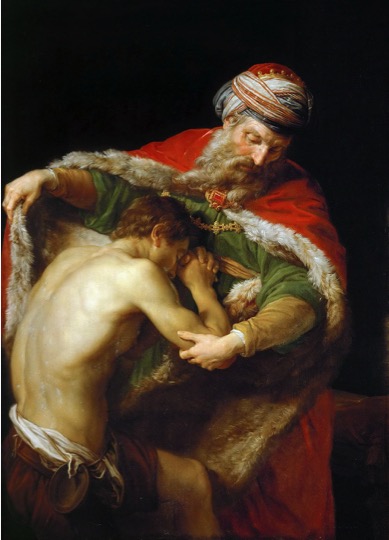
The Return of the Prodigal Son (1773) by Pompeo Batoni

With the recent mass shooting in Charleston and the death sentence for the Boston Marathon Bomber we are once again witnessing the spectacle of one who is a purveyor of hate being confronted by those who have survived their brutality and evil. Some say such monstrosity can never be forgiven.  Others say that while justice must be done, it is wrong to answer evil with evil.  Both are correct.

We’ve seen the survivors in Charleston confronting the unrepentant murderer, and forgiving him. They’ve been lauded as an example of what Christian forgiveness is really all about. But is that true? Doesn’t their forgiveness seem too soon, perhaps even forced?

Continue reading “Sermon: Forgiveness”

To the Guy Flying a Confederate Flag in Exeter, New Hampshire

Rev. Heath is Absolutely right…

The Pain of Father’s Day

Fathers Day is a day that is both joyful and painful for me, as it is for many.

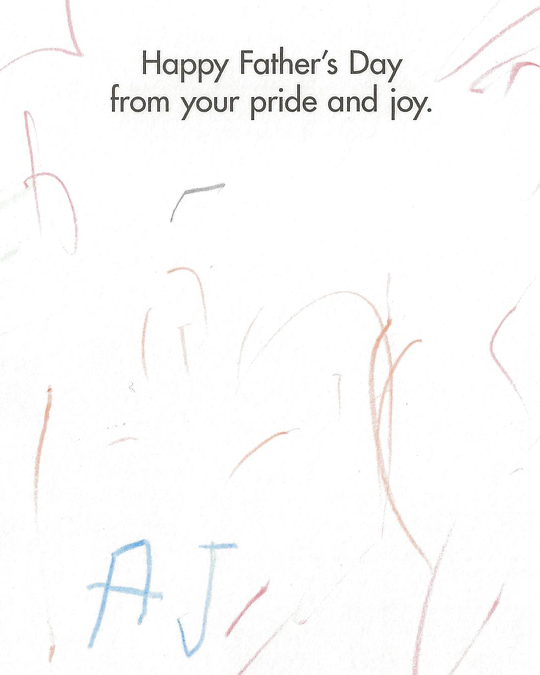
AJCardFathersDay2015Father’s Day is meant to be a happy time, and so it is for me – in part: a time where my wife and son conspire to present Daddy with some nice little momento, usually (at this point) a card with artwork, to tell Daddy how much he is loved by his youngest child.  And I love it: he and I do the same thing for Mom on Mother’s Day.  All such things speak of the love and care that is within this home and our life.  It also speaks of the importance we attach to family, and modeling for our son that it is important to tell those closest to us how much we love them, in many ways, all the time.

Unfortunately, Father’s Day is also a day of sadness for me, as it is for many.  In my case, it is a stark and painful reminder of the long separation between my daughter (who is now 26 years old) and myself.  July 12th of this summer will mark ten years since the last time I spoke to her, or had any idea of how her life was going, where she was living, or anything else about her.

Now, I could dwell on the events surrounding my divorce from my first wife, which began with our separation on July 10th of that year (2005), but that would be doing her a disservice, since she is not here to defend herself.  So, I will merely say that my separation from our daughter is the outcome of a great deal of dysfunction in that relationship, magnified by a legal system that grants custody to the mother as the default, on the assumption that doing so is in the best interest of the child; and made worse in turn through my own ignorance of how to navigate that same system.

Now, assuming the mother (and children) are the ones who need more (and immediate) protection when accusations of abuse are being made is not a bad thing.  In fact, it should be that way, since they are (generally) much more likely to be the ones at risk in a dysfunctional relationship.

Continue reading “The Pain of Father’s Day”

A Message for All Ages: “Garlic Mustard”

The seeds of the Kingdom of God always surprise us – often originating as what others see as a weed or a nuisance. And yet – they grow and grow and grow, and are unstoppable. … This is how our faith is: small beginnings that produce wonderful results we didn’t know could happen!

Garlic Mustard Plants in Full Bloom

This particular lesson looks at the Parable of the Mustard Seed, which is found (with only minor differences) in Matthew 13:31–32, Mark 4:30–32, and Luke 13:18–19.

This lesson works best when presented at the time of the year (May or early June) when the “Garlic Mustard” plant – an invasive weed here in the U.S. – is in blossom.  It is often widespread in the understory of forested areas, and can also be found growing in disturbed soils, including along the edges of roads, paths, fences, etc.

Continue reading “A Message for All Ages: “Garlic Mustard””

Sermon: Seeds

Many have used such stories when claiming to know God’s will, and so bull their way ahead towards some predetermined goal. They are full of hubris, not listening – or looking – for any further guidance from anyone, let alone God; confident that they are not mistaken in of their understanding of God’s will. More often than not, they fail, or else their road to success brings such great sacrifices and pain upon others that one rightfully wonders where God is in all of this.

The Anointing of David by Victors Jan, ca 1645

I love reading from the histories in the Old Testament, such as this morning’s text in First Samuel about the anointing of David to replace Saul as King of Israel.

One thread in this story – as with all of our readings today – is about seeing. About what we see vs. what God sees.

This is made very plain at the heart of this passage, where the Lord says to Samuel about Jesse’s son Eliab: “Do not look on his appearance or on the height of his stature, because I have rejected him; for the Lord does not see as mortals see; they look on the outward appearance, but the Lord looks at the heart.” To say this another way, God sees that which we cannot see: the Lord sees the Unseen.

And yet, even after God says this, Samuel keeps on looking at six more of Jesse’s sons, and each time fails to discover what he has been sent to find. Finally, Samuel says “The Lord has not chosen any of these. Are all of your sons here?”

Well, it turns out that one of Jesse’s sons was not seen because he could not be seen, he was not there at all. The eighth and youngest son was up in the hills, tending his father’s sheep. David was the least of Jesse’s sons, and no one even bothered sending for him until Samuel explicitly asked that this last son of Jesse be brought before him. We see that David was unseen in many ways, but the Lord saw him!

Continue reading “Sermon: Seeds”

Not White Enough, Not Black Enough

Rachel Dolezal

You’ve probably heard the story of Rachel Dolezal in the news: a young woman who is (apparently) “White,” but who some now claim has been masquerading as “Black” for most of her adult life.  She is also the [now former] President of the NAACP chapter in her community of Spokane, Washington; and a professor of Africana Studies at Eastern Washington University.

The concern of many is that she is not a “real Black” even though she claims to be.  But, what is a “Real Black” – or, for that matter, a “Real White”?  And, is all this controversy over her perceived racial makeup relevant in any case?

Continue reading “Not White Enough, Not Black Enough”

Escaping Eternity

Eating of the Tree was the only thing in the Garden for which we’d been told there was a consequence of making a choice – “In the day you eat of it, you shall die.” Yet, the man and woman did not know what a “consequence” was, they did not even know what death was. Yahweh was speaking way over their heads: a specific day? Time? Death? What’s that? I’m sure the man and woman thought: “Hmmm, sounds bad, let’s not go there!” Time was infinite, so why rush? Why push the boundaries? Why risk change?

Yet, there was a reason. The serpent knew what it was: they would “become like God, knowing Good and Evil.” Eating that fruit meant we’d learn new things: we’d escape from our existence in a mindless and meaningless eternity. Something new would happen in our never-ending cycle of days. But, to do so, we had to be willing to face what we had never known: change. We would experience limited time, we would experience death.

Genesis3:8 Lego Adam And Eve
Genesis 3:8 Lego Adam And Eve, from “The Brick Testament”

You know, the story of Adam and Eve is a great story, but it’s always bothered me.  I mean, come on: if the Tree of the Knowledge of Good and Evil were so darned important, why didn’t God put a fence around it, or stick it in some remote and impossible to access place?  I mean – seriously: even if the man and woman obeyed, one of their kids or grandkids, or great-grandkids would eventually “forget” and taken a bite.  It was inevitable.  So, why?

Now, this morning’s reading is the passage in which the so-called “Original Sin” takes place, an event that we are taught “cursed” mankind for all time, until we were redeemed by Christ. But, is this event that affects every one of us – whether it is factual or metaphorical – really the great failure and source of all sin that we have been taught it is? Perhaps not.

…Let’s step back for a minute and consider the text as a whole.  This particular story, the second of the two “creation narratives” at the beginning of the Bible, portrays Yahweh as a very hands-on sort of God: unlike the more remote vision of God we find in the first Creation narrative in Genesis 1.  In that narrative, God “spoke” the world into being, hovered over the waters and said “Let there be light.” – All these are commands and things done from a distance, like you’d expect a remote and unapproachable God to do.

But, in Genesis 2 & 3 God doesn’t command anything into being, Instead, Yahweh gets down and dirty: She lovingly forms us with her own hands, then gently breathes the breath of life into our nostrils. She is presented as an up close and in your face sort of God, a very hands on sort of diety.

Yahweh is concerned for us as individuals, saying “it is not good that the man is alone” and so creates the woman.  She talks face to face with us.  The man and woman, we are told, “heard the sound of Yahweh walking in the garden at the time of the evening breeze.”  Yahweh works, walks, talks and breathes.  She is a very human God – not some powerful spirit being. She is a very personal God – not some distant and unreachable entity.  Yahweh is a God of Relationship – not a dictator.  She is not a god who demands obedience and taking whatever she wants from us – Yahweh is a God filled with love and concern for us and for all of her Creation.

Keep Off!So, what does the type of God we find in this passage have to do with all this?  Why wasn’t there even something like one of those little gnomes holding a “keep off” sign put there in the garden?  Why was this tree left unguarded, tempting us? …Why no fence?

Continue reading “Escaping Eternity”