Risky Business

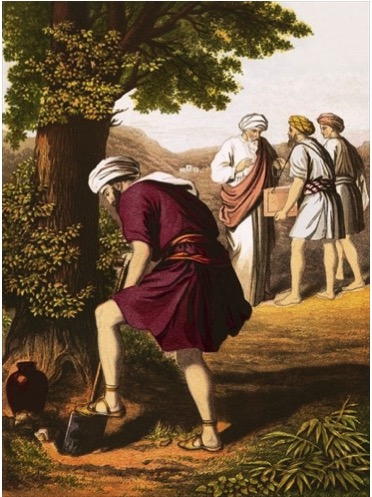
The Third Slave recovers his buried talent.

Delivered at ARK Community Church, Dalton MA, November 16, 2014.

Scriptures:
Matthew 25:14-30 The Parable of the Talents (The Voice Bible)

The Parable of the Talents in Matthew 25 has always left me a little uneasy. For one thing, parables, by intent, are meant to end with a question mark: leaving their audience with an anxious and counterintuitive decision that they would rather not face and can’t quite pin down. And yet, in this parable, the answer seems pretty clear – “Put our God-given talents to use.” In fact, this is so widely accepted that the word “Talent” itself came to be used in the English language as a reference to our God-given gifts because of this parable; transformed from its ancient use as a word for a standard measure of great wealth.

So, from that point alone, I am curious as to whether the traditional interpretation that we’ve probably all heard in many sermons is actually in line with the intent of Matthew’s Gospel, or Jesus’ intent, for that matter.

Increasing my unease is this: Jesus is the Social Revolutionary, constantly campaigning against the evils of privilege and position and power.  And yet, in this story, the person who already holds position and power seems to be eager to acquire even more through the efforts of others, and engages with his servants in ways that would have been perceived by the original audience as unfair and dishonest.

But first, let’s look at the setting for this parable… It is part of a very clear and intentional sequence of events and teachings in Matthew’s narrative, all of which focus on the issue of the return of Christ.
Continue reading “Risky Business”

Challenged

It’s all so easy when no one challenges your views. No arguments, no wasted time or energy in the discussion of technicalities, no need to build consensus, no need to defend what you believe, no need to educate others who have differing opinions. No dissension! You have time to get things get done! And, in today’s world, with things moving so fast, especially when one or more crises are brewing (as always seems to be the case), it’s easy to not even listen for any dissension, and easy to justify squelching those who do question or challenge what we have to say.

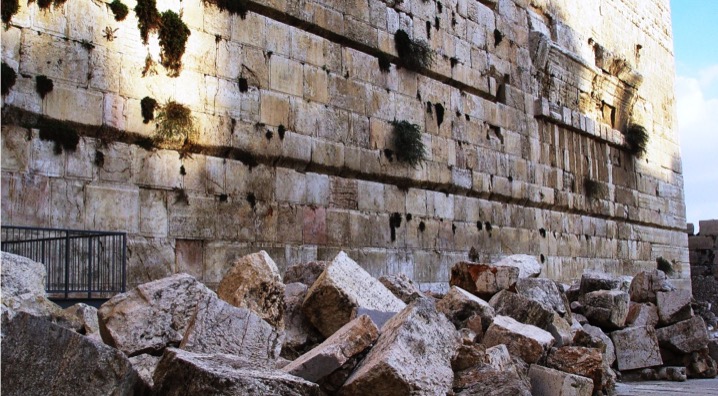
Modern Remnants Of Herods Temple, Destroyed 70 AD
Stones at the base of the Temple Mount in Jerusalem: remnants of the destruction of Herod’s Temple in 70 AD.

Delivered at ARK Community Church, Dalton MA, November 2, 2014.

Scriptures:
Micah 3:5-12
1 Thessalonians 2:9-13
Matthew 23:1-12

In the early 1960’s, Paul T. Fuhrmann was a professor at Columbia Theological Seminary in Decatur, Georgia. He would often present the following list (which I’ve amended slightly) to students in his Church History courses, claiming it was from his grandmother…

Grannie’s Notion of Church History…

  1. The ancient world was a desert, such a wilderness that not even a chicken could be found there.
  2. In the year 1, a King James Bible in English, bound & printed in New York (by the American Bible Society) and sold at $1.00, falls to the ground in that desert.
  3. The Apostles Peter, John, and Paul run to grab that Bible & organize the Primitive church, which was exactly like our church. Things were marvelous because the Apostles did things exactly as we do.
  4. In the year 100 the Devil came in and upset and corrupted everything, then went on to set up the Pope and later (much later) the Tea Party. The Pope plays all sorts of dirty tricks to make money. The Tea Party spends all sorts of money to play dirty tricks.
  5. In 1520, Martin Luther finds a Bible in chains, translates it, and the Bible spreads like butter on bread. In his barn in Rome, the Pope gets mad and swears to get even.
  6. In 1536, John Calvin comes in and organizes the UCC. Since he was intelligent, he must have thought exactly as we do in everything, and so did everything just as we do. The evidence of this is found in his two volumes of Institutes.

Please join me in prayer…

Lord, let it be your voice that speaks through my mouth, and let our hearts and minds be open and receptive to hearing the Word you have for us here, today. Amen.

It’s all so easy when no one challenges your views. No arguments, no wasted time or energy in the discussion of technicalities, no need to build consensus, no need to defend what you believe, no need to educate others who have differing opinions. No dissension! You have time to get things get done! And, in today’s world, with things moving so fast, especially when one or more crises are brewing (as always seems to be the case), it’s easy to not even listen for any dissension, and easy to justify squelching those who do question or challenge what we have to say.

Continue reading “Challenged”

The Second Commandment

Unlike the King James Version, the New Revised Standard Version of the Bible, which is less archaic and takes advantage of recent scholarship and knowledge of the best ancient texts we have, presents the second commandment as follows:

“You shall not make wrongful use of the name of the LORD your God…”

Like the King James, the NRSV still presents this commandment as a prohibition against swearing with the name of God. But the term “wrongful use” implies that there is more to this commandment than the common interpretation…

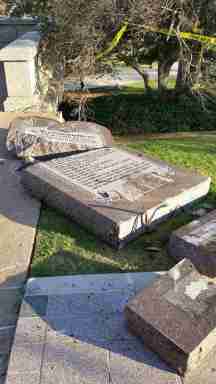
Oklahoma Ten Commandments Monument DestroyedDelivered at ARK Community Church, Dalton MA, October 26, 2014.

Scriptures:
Exodus 20:2-17 – “The Ten Commandments” (The Message)
Romans 8:1-17 (The Message)

This morning, as I was eating breakfast and preparing leave for my drive here, I noticed an item in this morning’s news about a man who destroyed a controversial “Ten Commandments” memorial that was on public land in Oklahoma City.  He smashed the memorial with his car, left the car there, walked into the nearby Federal Courthouse and surrendered himself, saying “The Devil made me do it.”  The irony is wonderful, and dovetails so well with this morning’s message that I had to tell you about it and show you the photo of the destroyed monument.  Notice that the break near the top of the stone runs right through the second commandment itself.

And so, let us begin…

Continue reading “The Second Commandment”

The First Commandment

We have all learned to set and achieve goals for ourselves, and to own them. We learn to say “I did that” or “I own that” or “I am that.” We want to be (or have) the biggest, the best, or the fastest, and know how to achieve such things; and there is nothing wrong with this: it is part of our identity, one of the ways we define who we are to ourselves and to others.

But sometimes, we come to want something because in some way we think it will magnify or justify our identity, rather than just defining it. When that subtle line is crossed, a line we are rarely (if ever) aware of, we have begun making an idol of ourselves.

WallStreetBullStatueDelivered at ARK Community Church, Dalton MA

October 5, 2014.

Scriptures:
   Exodus 32:7-14  (The Message): The Golden Calf
   Acts 16:11-15 (NRSV): Paul Establishes the Philippian Church
   Philippians 4:1-9 (NRSV): Paul Advises the Philippian Church

Podcast:


Note: This sermon was presented at the church where I serve is Minister.  It is derived from last week’s sermon, which was given at my boyhood church, where I am from time to time invited to preach as a Pulpit Supply Minister: Centre Church in Brattleboro, VT.  Both sermons in turn have their genesis in a sermon given while I was a Seminarian at First Congregational Church (UCC) in West Boylston, MA.”  While this sermon is almost identical to last week’s sermon (and similar to the original from three years ago) there are some significant differences, partly due to my tailoring each message to address where each congregation was “at” at the time; and partly due to the evolution of my thinking and insights regarding the relevance and implications of the First Commandment for us in the modern world.


I’ve noticed that when young children play, it’s often about the process – or journey, if you will – not the goal.  For instance, when my son builds a tower with blocks and it gets too high, he knocks it down and starts over, and over, and over.

Such play is not about being the biggest, nor the best, nor the tallest, nor any other measure of success.  It’s about playing – about stacking blocks.  That’s where the fun is, that’s what makes it valuable.  What’s more, as parents, our judgment of the quality of the results is not important. …Well, at least not yet!  – But our participation is.

A couple of years ago, we invited some of our friends and their toddlers over for dinner. Once everyone arrived, we all went into the room where the kids were playing, and … guess what …  … … The Dads saw the kids playing with my son’s big cardboard blocks!

Well, as good fathers, we had to participate, didn’t we?

But our play was very different.  We didn’t build towers just for the fun of building.  Noooo…  We had to build the BIGGEST tower.  And, so we built a HUGE tower, nearly touching the ceiling, which in that room is quite high.

The Moms held the kids back from participating while we worked, saying they didn’t want them to topple the tower; but I think they were more afraid that someone would get trampled in all that furious activity.

When the tower was done, we took a few pictures, congratulated ourselves, and then the Moms let the kids go.  … … A few seconds later, we had to act as human umbrellas to prevent our little ones from getting seriously bonked as that tower came tumbling down. Continue reading “The First Commandment”

The Most Pernicious Idol of All

Discovery-Kids-Eco-Friendly-Cardboard-Building-Blocks-Assorted-Colors-0Sermon presented at Centre Congregational Church, UCC (Brattleboro, VT)
September 28, 2014

Scriptures:
Exodus 32:7-14  (NRSV): The Golden Calf

   Acts 16:11-15 (NRSV): Paul Establishes the Philippian Church
   Philippians 4:1-9 (NRSV): Paul Advises the Philippian Church

One thing I’ve noticed about my son, like most young children, is that when he plays, it’s about the process – or journey, if you will – not the goal.  For instance, when he’s building a tower with his blocks and it gets too high, he knocks them down and starts over again.

His play is not about being the biggest, nor the best, nor the tallest, nor any other human measure of success.  It’s about playing – about stacking blocks.  That’s where his fun is, that’s what makes it meaningful and valuable to him.  What’s more, his parents’ judgment of the value of his work is not important. …Well, at least not yet!  – But our participation in his play is important.

A couple of years ago we had a dinner for some of our friends and their toddlers at our home. Once everyone arrived, we all went into the room where the kids were playing, and … guess what …  … … The Dads saw the kids playing with AJ’s big cardboard blocks!

Well, as good fathers, we had to participate, didn’t we?

Continue reading “The Most Pernicious Idol of All”

Being Holy

Being Holy is not a goal, but a process, founded upon the unconditional and undying love we share with each other and with God. Being Holy is a gift freely given to all of us, together. It is not a prize for good behavior presented only to a select few.

Labyrinth at Amiens Cathedral
The Labyrinth Floor of Amiens Cathedral

Sermon: “Being Holy”

Delivered at ARK Community Church, Dalton MA
13th Sunday after Pentecost: September 7, 2014.

Scripture readings:

Leviticus 19:2-18 (NRSV)
Romans 12:1-2,9-18,21 (NRSV)
Matthew 22:36-40 (NRSV)

Podcast:

Please join me in prayer…

Lord, let it be your voice that speaks through my mouth, and let our hearts be open and receptive to the Word you have for us here, today. Amen.

One afternoon, a few years ago, a good friend of mine was crossing the street on a marked crosswalk at a stoplight, when a well-dressed man in his brand new white Cadillac SUV zoomed through the red light without stopping as he made a right hand turn.  He hit my friend, knocking him to the ground and leaving him dazed.  The driver stopped, rolled down his window, cussed my friend out for getting in the way, and roared off, never to be seen again.

We could use this incident to launch into a discussion about social justice, highlighting how those with power and position are often arrogant and believe their position entitles them to special privileges and consideration. We could then contrast this with my friend’s situation: a man of great talent and a good heart, but who, through no fault of his own, has long lived in the margins of our economy. Then asking whether he is any less deserving of consideration or respect than the driver?

But Jesus teaches us to be more concerned with our own hearts than with the hearts of others, even the hearts of those who seem to be self centered, wealthy and reeking of a sense of entitlement. So let’s look instead at how this situation is illuminated by this morning’s readings.

Continue reading “Being Holy”

Crossing Boundaries

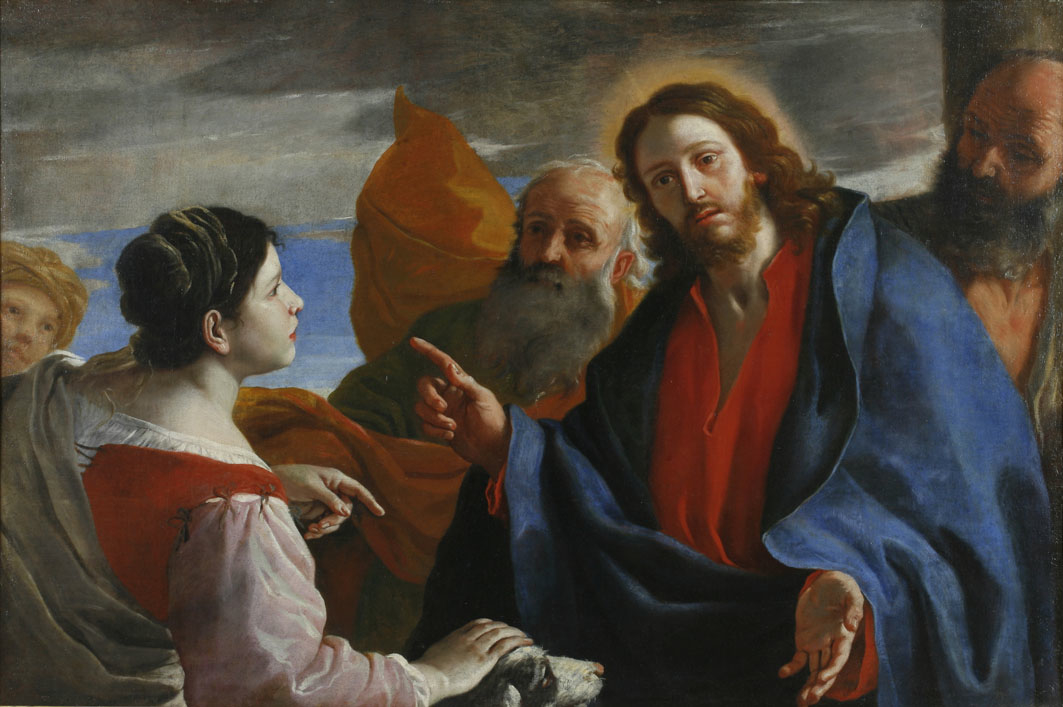
Mattia Preti (Il Cavalier Calabrese), Christ and the Canaanite Woman, c. 1665-70

Sermon: “Crossing Boundaries”

Delivered at ARK Community Church, Dalton MA
9th Sunday after Pentecost: August 17, 2014.

Scripture readings:
Isaiah 56:1-8 (NRSV)
Matthew 15:21-28 (NRSV)

Podcast:

Please join me in prayer…

Lord, let it be your voice that speaks through my mouth, and let our hearts be open and receptive to the Word you have for us here, today. Amen.

The story of the “Canaanite Woman” in this morning’s reading from Matthew 15, and also in Mark 7, is a narrative that crosses all sorts of boundaries.

To begin with, the setting isn’t located near any of our other stories about Jesus. Matthew tells us that Jesus has journeyed with his disciples to “Tyre and Sidon.” Doing so means he has left behind the familiar comforts and safety of his native land, moving across Israel’s frontier into the Gentile lands to the North. He’s in a new and strange place. But, is it strange for him, or strange for us?

Continue reading “Crossing Boundaries”

Fish in the Wilderness

We are those who followed Jesus and the Disciples out into that Wilderness: a wilderness in a country of Gentiles, a place where people have not yet heard or embraced the Gospel; and, a place where we will experience that renewal and that deepening of relationship with God we all need to fulfill the call upon our lives. So, why feed us bread and fish?

"The Miracle of the Bread and Fish" by Giovanni Lanfranco, 1620-23
“The Miracle of the Bread and Fish” by Giovanni Lanfranco, 1620-23

Sermon: “Fish in the Wilderness”
Delivered at ARK Community Church, Dalton MA
7th Sunday after Pentecost: August 3, 2014.

Scripture readings:
Isaiah 55:1-5 (from “The Message”)
Matthew 14:13-23 (from “The Message”)

Podcast: 

The “Feeding of the Five Thousand” is the only miraculous sign found in all four Gospels. What’s more, Mark and Matthew each have two variations, for a total of 6 versions in the Four Gospels.

Clearly, the early church saw this story as central to their faith, and therefore it is central to ours. Many ask “How did this Miracle come about?” And there are a number of explanations as to the “How” of this story. Some claim it is a true miracle, others say it isn’t, many say it doesn’t really matter whether it was a miracle or not.

But for me, the central question is not how (or if) this miracle happened, but “Why is it important?”

Continue reading “Fish in the Wilderness”

Changing Perspective

The last Chapter of the Gospel of Luke and the First Chapter of Acts are readings that describe the same event, Christ’s Ascension. Both passages are written by the same author (Luke) and both are addressed to the same person (Theophilus). Yet, there are significant differences between the two narratives, to the point where reconciling them (if both are viewed as absolute fact) is difficult to do. The reasons for these differences lie in an existential crisis that Christians were struggling with at that time. In these two readings we see Luke’s thinking on the crisis evolve as he struggles to reconcile his faith with the facts and then portray The Ascension in a way that helps his audience to see their faith and relationship with God in a new light, and so find new hope for their Salvation.

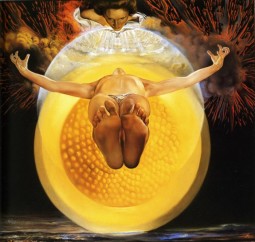
Salvador Dali's "The Ascension"
Salvador Dali’s “The Ascension”

Sermon: “Changing Perspective”
Delivered at ARK Community Church, Dalton MA
Seventh Sunday of the Easter Season: June 1, 2014.

Scripture readings:
Luke 24:44-53 (from “The Message”)
Acts 1:1-11 (from “The Message”)

Our readings this morning both cover the same event, Christ’s Ascension; both are also written by the same author, Luke; and both are addressed to the same person, Theophilus. Yet, there are some significant differences between the two narratives, to the point where reconciling them (if both are viewed as absolute fact) is difficult to do.

Why is this, what are those differences, and why do they matter?

Continue reading “Changing Perspective”

Letting Go

Dad and son on bike with training wheelsSermon: “Letting Go”
Delivered at ARK Community Church, Dalton MA
Easter, April 20 2014.

Scripture readings:
Acts 10:34-43 (from “The Message”)
John 20:1-18 
 (from “The Message”)

As you know, I often speak of the many ways God holds on to us, and how we are called to claim Jesus for our own, and called to hold on to Christ and to God’s love. But, Easter is not about holding on!

Let us pray… 

Lord, on this Easter morning, we celebrate your victory over death, and with it your promise of new life in our own futures. Open the scriptures before us, and enable me to clearly communicate what you intend for us to receive here today.  May your gospel live within each and every one of us, driving all despair and fear from our hearts.

We rejoice in this opportunity for new revelations and a deeper understanding of your call to walk before you, spreading your gospel to all nations. We ask that your Word live and work through us to amaze and transform not only our own lives, but the lives of all whom we encounter.  Help us to embody your teachings, and to live them, in all that we do, think, speak, and are.  

In Jesus Name, Amen.

It’s Easter. At the start of our reading from John this morning, Mary Magdalene is alone in the predawn light, weeping before the empty tomb. The mortal remains of the man she loves are missing. Although she doesn’t know it yet, Jesus has been set free from the bonds of death.

As I said earlier, Easter is not about holding on. John makes this clear by telling us that once Mary realizes who is standing before her, Jesus says, “Do not cling to me, because I have not yet ascended to the Father.”

It seems that holding on to Jesus frustrates the plan of God! Jesus the man is again alive, just like Lazarus; but the transformation of the man into the Christ is not yet complete. Jesus is still in the process of as he puts it, of “ascending to my God and your God.

Mary is given a role in this when he says, “Go to my brothers and tell them….” Her mission involves leaving him behind and carrying his message to all who believe. Her task is to let go, to forever turn away from the man she loves.

I imagine this was very hard for Mary. He was lost, and now he’s found. He was dead, but is alive again. Her arms ache to hold on to the man she loves, the man she’d given up as forever lost. What would happen when she turned her back to leave? Would she ever see him again? She must have asked herself whether her heart could bear losing him again. Turning away was a big risk.

Continue reading “Letting Go”

Jesus Wept

Sermon: “Jesus Wept”
Presented at ARK Community Church in Dalton, MA
April 6, 2014 (Fifth Sunday of Lent)

Scripture readings:
Ezekiel 37:1-14 (from “The Message”),
John 11:1-45 (from “The Message”)

This morning’s reading from Ezekiel 37, and our Gospel reading from John 11, are parallel stories. They both deal with the same issues, are presented in similar ways, and both demonstrate how utterly powerless we are in the face of death and darkness: readings we do well to consider on this, the last Sunday in Lent before Palm Sunday.

Let us pray…

Lord God, we ask that your Holy Spirit fill each and every one of us here this morning.  Open the scriptures before us, and enable me to clearly communicate what you intend for us to receive here today.  Make your gospel come alive within each and every one of us, driving all darkness from our hearts.

We rejoice in this opportunity to encounter new revelations and a deeper understanding of your unconditional, living, infinite love; and we ask that we be amazed and transformed by that love.  Help us to embody your gospel, and to live it, in all that we do, think, speak, and are; both individually and jointly, as members of this congregation which stands before you as a portion of the Body of Believers who share your Gospel with their neighbors in this community. 

In Jesus Name, Amen.

Both of our readings this morning deal with dark times, placing us within the narrative of those who have lost all hope, those who have nothing whatsoever left, and see nothing in their future.

We all have such valleys of darkness in our lives, times when the walls close in, times when the way forward is not just unclear, but entirely nonexistent. Times when we cannot see beyond that dark horizon that we cannot penetrate; times when all hope dies and death itself seems all too near at hand, or perhaps not near enough.

Continue reading “Jesus Wept”

Waiting…

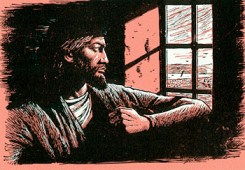
John the Baptist in prison

Presented at Centre Congregational Church, UCC in Brattleboro, VT
December 15, 2013  (Advent, Week 3)

Scriptures: 

Luke 1:47-55 (The Magnificat)
James 5:7-10 (“Be Patient … Strengthen your hearts”)
Matthew 11:2-11 (“Are you the One who is to come?”)

This is Gaudete Sunday, the Third Sunday of Advent; and tradition tells us it is “…a day to be joyful even in the midst of long waiting and keen awareness of suffering.”   

Our Advent readings started two weeks ago with a focus on the future: “The reign of God is coming. Prepare!” They end next week with a focus on the past: “The Messiah is about to be born in Bethlehem. Rejoice!”  And, as I said earlier, the word Gaudete is a Latin word meaning “to rejoice” in the imperative – meaning we are commanded to rejoice.

As Advent progresses, our emphasis on the future declines as our emphasis on the past increases.  Our readings for Advent begin with a mature Jesus teaching us about the reign of God, and they close with the unborn Christ Child in Mary’s womb.

This movement reflects our Christian understanding that the sacred story, to be understood fully and correctly, has to be told backwards.  The birth and ministry of Jesus are incomprehensible until we know of his death and resurrection.  To put it another way, our understanding of the past is muddled and incomplete until we grasp the nature of the future and purpose of History.  Christianity sees History as having a definite start, a definite end, and that it reflects the plan and purpose of God, reaching its crescendo in Christ.

Advent binds the future and past together.  It reminds us that there is a tension between them, and that this tension is where our faith is centered – the conviction that there is a known end to the road we are called to follow through History, and that God is continuously involved, even though the path that our feet tread at the moment is never clear to us.  You see this tension in each of our scriptures for today.

In the Magnificat from the Gospel of Luke (much of which we sang as our first hymn this morning) Mary begins by saying “My soul rejoices in God my saviour!” and she ends with “He has helped his servant Israel … according to the promise he made to our ancestors …”  Mary is linking past, present, and future – naming the promise made to Abraham long ago; and rejoicing because the long wait for its coming fulfillment is over.

In our first reading, in his Epistle to a Church that wonders why the Messiah has not returned, and why the suffering continues, James tells us to be patient and take comfort, in the same way that a farmer waits for the crop to mature, and warns us that the Judge is standing at the doors.  In other words, the time is at hand, and God is waiting to see the results of the work of the Messiah.

All of this comes to a head in this morning’s Gospel reading, where the Baptist’s disciples confront Jesus.  But first, let’s consider the setting of the story.

Continue reading “Waiting…”