Love is not a wimpy or sentimental emotion; but a passionate, fierce action. … Such Love requires us to participate in the life of the person in front of us. It makes us see that it isn’t all about us or our agendas. … Jesus will always confound our expectations because he isn’t here to meet our expectations, but rather to help us achieve all that God hopes for us.
Christ Teaching in the Synagogue at Nazareth by Gerbrand van den Eeckhout, 1658
This morning’s gospel reading focuses on the most extensive narrative we have of Jesus in a Synagogue; and, it didn’t go so well! Or did it?
Please pray with me… Lord, let it be your voice that speaks through my mouth, and let our hearts and minds be open and receptive to hearing the Word & Mission you have for us here today. Amen.
Chapter 4 of the Gospel of Luke narrates the beginning of Jesus’ ministry. At the start of this morning’s reading, we are told that “filled with the power of the Spirit,” Jesus ministers in Galilee and eventually returns to the village where he grew up.
People throughout Galilee are saying he is the first true prophet in centuries, and perhaps more than that. But for those in Nazareth, he’s more: he is their celebrity – their hometown hero. Can you imagine? Such an important person, from a tiny, obscure village: they know him! …So exciting! The community was abuzz with rumors and speculation, hopes for a bright future to be brought about through the glory of their native son.
But some are filled with doubt: they watched him grow up. They know him as the son of Joseph the Carpenter. They know Jesus and his family all too well.
#BlackLivesMatter helps us see a universal truth: that unless we start treating all people as human beings, we will all loose our humanity. We may not die, but we will no longer live. … We must invest in each other if we are to succeed. Defeating those who oppose us only means we’ve defeated ourselves. The battle is within us, not against us, and not against them. To overcome the challenges we all face requires that we all change.
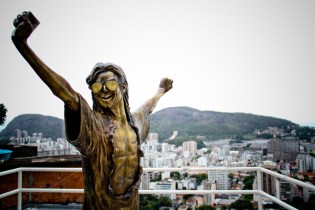
Statue of Michael Jackson in the favela of Santa Marta, on the outskirts of Rio De Janeiro; where Michael filmed the video for “They Don’t Care About Us” (directed by Spike Lee) in 1996.
For decades the Brazilian government refused to extend utilities, sanitation, roads or even law enforcement into these slums. Ultimately, they moved their Capitol elsewhere, escaping the angry vigilance of the poor looking down upon them from the hills above. They are still there: filled with suffering and the anger of a people left behind, cast aside as worthless. We see in the video that their anger is powerful.
At this point in time, Michael Jackson was the object of tabloid ridicule and accusations of child molestation, strange behavior and weird habits. He’d been sued; arrested; strip searched. I am sure he identified with the people in these slums because he felt abandoned and alone, he was struggling to not die, just like them. But, not dying is not the same thing as living. Life is more than merely existence continued.
The light of that star reveals the brokenness and darkness that surrounds us and which was always there, but now the veil behind which it was hidden is torn. The new star reveals how inadequate human effort is, and reveals the destructiveness of hubris and denial. But, it also brings the promise of God’s perfect gift, lying in that manger, the promise that new and better things are to come, and indeed are already here, and that God’s will and love for us can never be denied or defeated. But fear Not! For in Jesus the dream becomes reality and the light he brings will never die.
NASA image of Sirius, the brightest star in our nighttime sky.
As a kid, my two great loves were science and exploration. I would consume the National Geographic the second it arrived in the mail, and my bedroom was festooned with space posters, photos, astronomic charts, and lunar maps. I faithfully read the New York Times Science and Technology section every Sunday afternoon. I so wanted to be an explorer, or maybe a Scientist! In fact, for a long time my ultimate goal was to become an Astronaut, or perhaps an Astronomer!
But, becoming an Astronaut was simply not possible for someone as nearsighted as I am. So much for that dream, things change.
That left Astronomy, which I pursued diligently for a long time. In fact, I audited a college level Astronomy class in 9th grade.
I loved our late night labs in that course, hauling out the telescopes and looking at the moon, planets and stars. Plus, hanging with college kids late at night was – ah – educational. That class was really fun, and cool – not to mention cold, there in Wyoming in the late fall!
What you soon learn when you regularly and carefully observe the celestial sphere is that the Sun, Moon and stars circle overhead, faithfully following their courses year after year. True, the planets wander, but even their wanderings have a regular pattern. And so, particularly for the ancients, nothing about the heavens is random. All the movements they saw were very regular, very repetitive and very predictable. From the point of view of the ancients, the only things that broke the rules were an occasional eclipse, or the rare comet. When such things occurred, their strangeness, unpredictability and frightening appearance were often taken as evidence of turmoil in the heavens: a sign of supernatural displeasure, great catastrophes, and doom.
But then we have the star in this morning’s reading.
Let us be clear: there is no magic wand that will make everything in this life better. God is not going to come down and make it as if we – meaning all of us – never made all of the mistakes (and good decisions) we’ve made that have gotten us to this point. We cannot escape responsibility for what we’ve done to each other, or to God’s Creation.
The command to “Love our Neighbor” means acknowledging this, and so embracing compassion for ourselves and others as a way of life. It means conscientiously making room for “The Other” – for those who are different from us. We can begin by opening our minds and our hearts to what they have to say.
“Bede’s Sparrow” by Carrie Wild
This past Friday evening, George Takei was preparing for a performance of his musical which opened on Broadway a few days ago, a very personal story of the terrible price George and his family paid for being of Japanese ancestry and living in America during World War II.
On hearing of the attacks in Paris, Mr. Takei wrote: “…I’m writing this backstage at Allegiance, my heart heavy with the news from Paris, aching for the victims and their families and friends.
Aziz Abu Sarah, Peace Activist
My friend Aziz Abu Sarah, who, like George, spends his life urging peace and building bridges to span the gaps separating people around the world, and whose family has also paid a very heavy price through years of terror and oppression, had this to say: “Two days of ongoing terrible news… From Beirut to Paris, bombs, murder and dozens of victims. Its another heartbreaking day.”
My lifelong “older brother” in spirit, Ahmed, said this in his email to my parents yesterday morning: “We are all distressed as Paris has become our home .… I am flying there on Friday unless the borders are closed. France has been openly at war with Islamists for a number of years and terrorist attacks were expected. But they can never be predicted or controlled. I expect life in France will change following the latest carnage.”
Ahmed’s wife, Lena, who is in Paris at the moment, posted this on Facebook yesterday: “Tears this morning. With a very heavy heart I start the day.”
All of these people have labored their whole lives to bring peace and justice into this world. They’ve all worked diligently against poverty, oppression, despair and injustice. They have all taken firm and often costly stands against the dehumanization of “The Other” that lies at the heart of these attacks. Some of them are hurt and despairing, as you heard. But I think I can give voice to what lies in all of their hearts by quoting this from Mr. Takei’s message:
“There no doubt will be those who look upon immigrants and refugees as the enemy as a result of these attacks, because they look like those who perpetrated these attacks, just as peaceful Japanese Americans were viewed as the enemy after Pearl Harbor. But we must resist the urge to categorize and dehumanize, for it is that very impulse that fueled the insanity and violence perpetrated this evening.”
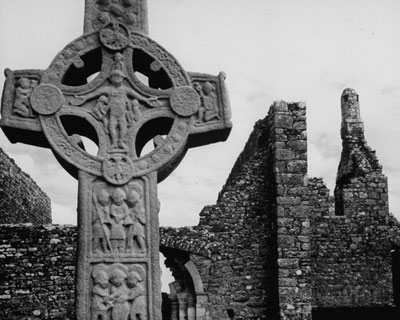
Now. let’s skip back 1400 years, to a time when England was a collection of little Kingdoms, almost 300 years before they would be united under King Alfred the Great and his heirs.
To Christians, the veil of Death, that dark, impenetrable horizon that marks the end of the journey of all of our lives, is not a fearful boundary between the worlds of the living and of the dead. It isn’t the end. Yes, the dead do not return – yet, but there is nothing to fear – as Christians we know that our journey will require us to travel through the valley of the Shadow of Death during our lives, and then beyond – into the realm of death itself. But, Jesus has returned, has shown us that God’s love – the undying and uncompromising love of our Creator, the creator of all that is, including Time itself, is a love that is more than sufficient to pierce the veil that separates these two worlds.
Halloween is a very ancient festival, known as Samhain by the Celts. It was the Festival of the Dead. Cattle were brought back from their summer pastures and livestock slaughtered for the winter. Bonfires and lanterns would be lit; and the spirits had to be propitiated so that the people and their livestock would survive the winter.
Like most major feasts in ancient calendars, Samhain was a day of transition: in this case marking the end of the harvest season and the beginning of the season of darkness: a time of concern. In these ancient communities, which did not have the safety nets or resources we have now, a bad winter, or a bad harvest, or a delayed Spring, could be catastrophic. They knew something had to be done to calm supernatural anger. It was necessary to seek help from friendly spirits and from one’ ancestors who were already in that realm.
Many ancients, not just the Celts, believed that at this time of year the veil between this world and the next was at its thinnest, making it easier for us to communicate with those – the spirits of the dead and supernatural entities – who are part of that realm, but it also made it easier for them to trouble us if we didn’t treat them right! Halloween and All Saints Day both recall these beliefs, which have persisted for thousands of years, or more.
All Saints Day was originally part of a three day Medieval Christian festival that began with All Hallows Eve (which we now know as Halloween); and ended with All Souls Day on Nov 2.
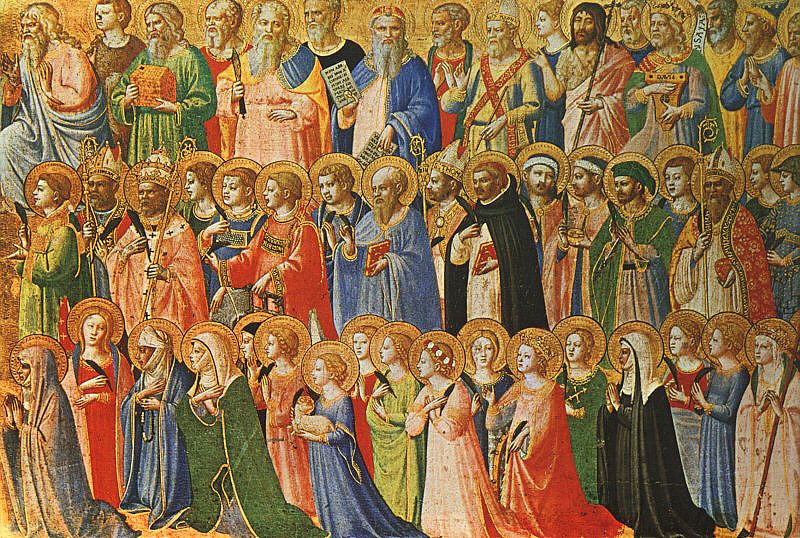
The Forerunners of Christ with Saints and Martyrs (about 1423-24) by Fra Angelico.
All Saints Day was a joint celebration for all the Saints of the Church – since there were far too many to each have their own feast day, and All Souls Day was a day to remember the faithful who died in the previous year.
Most Protestant Churches have either merged these three days into a one day celebration that recognizes all saints of the church – known and unknown (meaning us, when we pass, too); or else they ignore the Festival completely – like the old Calvanists did – disdaining the Holiday, as they did all Holidays, as being too “Popish” in nature.
The tie that links Halloween, All Souls Day and All Saints Day together is the same ancient belief the Celts had, that the veil between this world and the next is thinnest at this time of year. It was a day very appropriate for seeking to calm our fears and uncertainties in this world by reaching out to the next, as the three days in the Medieval Christian Festival each did in their own ways.
I want to reflect for a moment on my last sermon, given on October 4th, where I spoke on the concept of Belief. I pointed out that as Christians, we often think that “believing” is a goal – of having a firm, unshakeable commitment to the absolute truth of God. But, I argued that belief is actually a process – a journey with God, not a journey to God. Belief is not something we achieve, not a goal. Belief is something we do. We don’t know where Belief will take us in our journey through life, but we know where we’re going to end up.
The point of this morning’s reading from The Revelation of John is similar: we’re not certain what road we’ll follow to get to the end, but that we’ll get to the end is certain.
Belief is not dependent upon conformance to the Law. Belief is the process needed to make God’s command to Love a reality in our lives.
Believe!
Believe what? That there are angels? That Jesus died on the Cross for our sins? That all the miracles in the Bible actually happened? That the tribulation is coming? That abortion is a mortal sin? That marriage must be a lifetime commitment between one man and one woman? That only men shall be ordained into the ministry? That God somehow anoints the beliefs or agendas of one person or group over those of another? That our particular understanding of our faith excludes all other understandings, especially those we don’t understand?
Really?
We all are constantly confronted with the choice of what to believe, and how. Do we believe literally all that the Bible says? And, what does “Literal” mean? Literalism presents us with many challenges and contradictions that are impossible to resolve; so, do we instead believe the scriptures through viewing them as metaphor and allegory? Do we ignore the passages that we see as outmoded, focusing on those that seem more relevant? Or, should we go even farther, perhaps picking and choosing what seems nice from the smorgasbord of other beliefs, traditions, and wisdom that we encounter everywhere in today’s world?
I love what the Author of Hebrews has to say about all of this in this morning’s reading. “Long ago God spoke to our ancestors in many and various ways by the prophets.” So, it seems plain that there has never been a single voice deciding what is or is not to be believed as part of our faith. The Author of Hebrews is acknowledging that the prophets don’t all agree with each other, often speaking in ways that seem contradictory, or at least are hard to reconcile with other sacred writings, especially when taken literally. And this is in fact deliberate; since the goal of the prophets was to disrupt conventional wisdom and accepted practice, the very purpose of their words was to challenge our understanding.
Every author of the 66 books in the Protestant Bible see and portray God’s word in different ways, and then there are the 73 books in the Catholic Bible, and the 81 books in the Ethiopian Bible. So, not only is there disagreement between various scriptures within our Protestant Bible, but disagreement between various branches of Christianity as to what scriptures are part of the Bible at all – not to mention the tens of thousands of variations found within the most ancient scriptural texts we have at our disposal. There is no single “right” Bible, and never has been. So, how can there be a single “right” reading of scripture? Therefore, there is no single universal scriptural standard by which we can judge what is “right” to believe, or not.
But that’s OK, because belief is not about believing the right thing! We will not be condemned to hell for believing the wrong thing. Belief is not a certainty that there is a perfect, eternal and unchanging truth upon which all knowledge and all reality depend. (In fact, that belief is a teaching of ancient Greek philosophy, not Judaism.)
The challenge then is not who should be part of our family – that choice is not ours. Nor is the challenge to decide if we are to love them – because the Bible says love all, no exceptions. The challenge is how to love them, because they’re going to be climbing up that same ladder we’re on no matter what we do, Jesus made it so.
The Hunter Family of Waterbury, CT, ca 1900; (c) 2015 Dorothy Vander Meulen
Jesus says “Who is my mother, and who are my brothers? … Here are my mother and my brothers! For whoever does the will of my Father in heaven is my brother and sister and mother.”
How does this relate to us, and why does it matter?
Please join me in prayer…
Lord God, we lift up this morning’s message. May it touch our hearts, may it speak clearly to our souls, that we may come to more fully comprehend your eternal and undying love for us and for all of the Family of God. Amen.
I lived in the Tidewater area of Virginia about 20 years ago. Many of my co-workers, friends and neighbors were part of military families, mostly Navy. One September, a friend who served on board the Aircraft Carrier U.S.S. Enterprise invited me to be his guest for the ship’s “Friends and Family Day Cruise”. Now, how could I refuse such an invitation to see the Enterprise? I accepted!
This was an event where the ship’s officers and crew could invite those close to them to come on board for a short cruise that included tours, a picnic, and some presentations and demonstrations. Towards the end of that afternoon we ran into a co-worker of mine: a wonderful and godly black woman named Veronica. She told us her husband was an officer on the ship.
While there, we really wanted to check out the ship’s control tower, that big “Island” on one side of the flight deck where the bridge is. But, one of the rules was that only officers and their families were allowed up there. Veronica assured us that going up would be no problem…
Wondering how she could do this (since we clearly weren’t family), Sean and I timidly followed her up the ladders. Almost immediately, we were confronted by two very stern guards, holding their rifles at the ready. They said, “Sorry Ma’m, only officers and their families are allowed above Deck O-3.”
A Covenant is not about rules but about relationship, to ensure that the relationship between the parties will be strong and will prosper over time. Any rules or guidelines in the covenant are to provide guidance on how to ensure this happens, and to protect the interests of both parties. But, if the situation changes (and it always does – as change is the only constant in this world) then, in the interest of preserving the relationship, it is understood that the rules will eventually need to be negotiated – and a new (or revised) Covenant agreed-upon.
This is (with some edits to include important points made in the audio) the draft version of the sermon I gave this past Sunday, when we joined together to “Re-Covenant” our ministries for the start of our Congregation’s “Program Year.” I gave the actual sermon without reference to this draft (for the most part) – and, frankly doing so made for a message that was far better and more relevant than you will read here. (That one should listen when the Holy Spirit stirs within you is a lesson I learned long ago.)
If you wish to hear the sermon as given, the audio can be found at the bottom of this page. (I may someday update the draft to match the audio – in my copious spare time!)
Please join me in prayer…
Lord God, we lift up this morning’s lessons. May they touch our hearts, and speak clearly to our souls, that we may come to more fully comprehend your eternal and undying love for us and for all of your Creation. Amen.
The year is 622 BCE.
Zoroaster, founder of the great Zoroastrian faith is a young boy in Persia. Lao Tse – founder of Taoism, and Confucius, and Buddha, all would be born within the next few years. Classical Greek Culture was just beginning its rise to dominance, and Rome was a small city under Etruscan domination.
In Israel young Josiah has been King of Judah for about 18 years. And, for the first time in generations, his Kingdom is not threatened by external aggression or domination. The Assyrian Empire that his Kingdom had long paid tribute to, and which had destroyed Samaria in Northern Israel just a century earlier, was disintegrating. Egypt was also recovering from Assyria’s domination, and Babylon had not yet laid claim to Assyria’s place as the dominant power in that part of the ancient world.
Josiah about 26 years old, and possibly exploiting the opportunities that arose from his Kingdom’s newfound independence, the Bible tells us he directed Hilkiah, the High Priest, to use Tax Money to renovate the long neglected Temple of Yahweh.
And Lo and Behold! As the renovation of the Temple began, Hikiah found a scroll hidden among the stones.
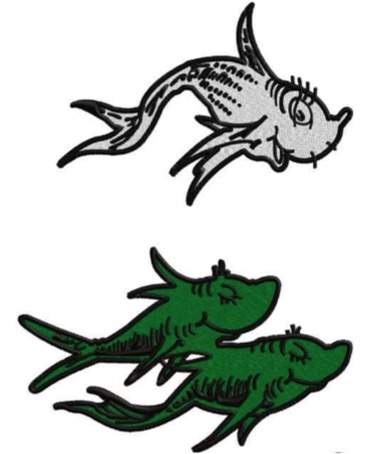
Detail from the cover of “One Fish, Two Fish, Red Fish, Blue Fish” by Dr. Seuss
Two young fish were swimming along and happened to pass by an older fish. The older fish says “Morning, boys. How’s the water?” The two young fish swim on. Eventually, one of them looks over at the other and says “What the heck is water?”
Please join me in prayer…
Lord God, we lift up this morning’s lessons. May they touch our hearts, and speak clearly to our souls, that we may come to more fully comprehend your eternal and undying love for us and for all of your Creation. Amen.
This Sunday we consecrate our Christian Education Ministry’s programs for the year. So, it is fitting that our topic is Wisdom.
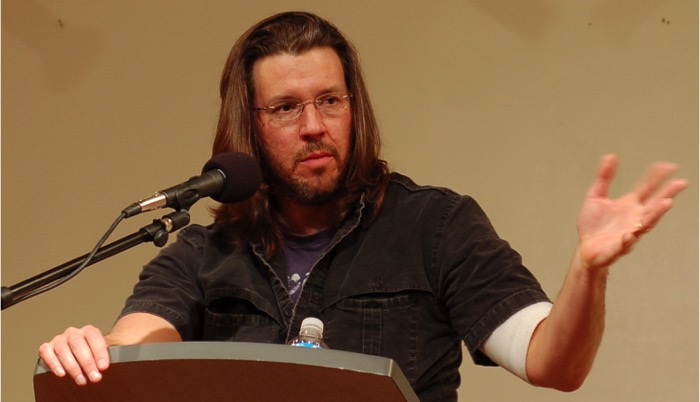
Professor Wallace gave the fish story I related at the beginning of this message and then said its point “is merely that the most obvious, important realities are often the ones that are hardest to see and talk about.”
Dr. David Foster Wallace (1962-2008)
He then related another story:
Two guys are sitting in a bar in Alaska. One guy is religious, the other an Atheist. After a few beers, they begin to argue about the existence of God with great intensity. Finally the Atheist says: “Look, I have reasons for not believing in God. Just last month I got in a terrible blizzard. I was lost and couldn’t see a thing, and it was fifty below. So I fell to my knees and cried out ‘Oh, God, I’m lost in this blizzard, and I’m gonna die if you don’t help me.’”
The religious guy gives the atheist a puzzled look: “Well, you must believe now. After all, here you are, alive.” The atheist rolls his eyes. “Nope, two Eskimos happened to wander by and showed me the way back to camp.”
The lesson here, Wallace points out, is just as obvious as that of the first story: the exact same experience can mean totally different things to different people, because their templates of how the world works are very different.
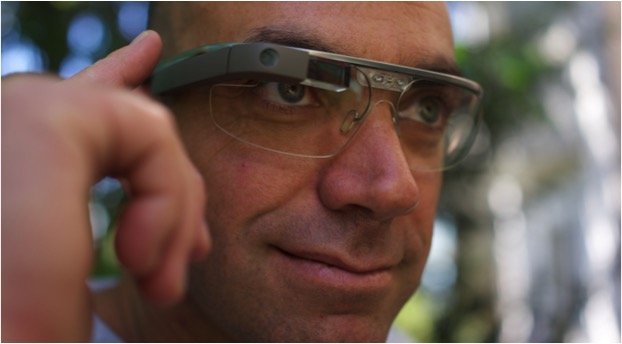
Google Glass
These “templates of meaning” are the maps we carry inside ourselves, the lens through which we see and interpret everything we experience.
This is an important point: all of our meaning-making depends on how we see and interpret what we witness in the world around us. Meaning and understanding are the result of interpretation. The teachings of our faith – teachings of any sort, in fact – are meaningless without interpretation. Interpretation is the process of taking our own observations or knowledge and making them real and relevant to ourselves or others.
There are two kinds of silence present in both of these two passages: the silence which makes space for the inner witness, and the silence of oppression. But, the ways in which the characters in each narrative respond is very different. What can we learn from these two stories?
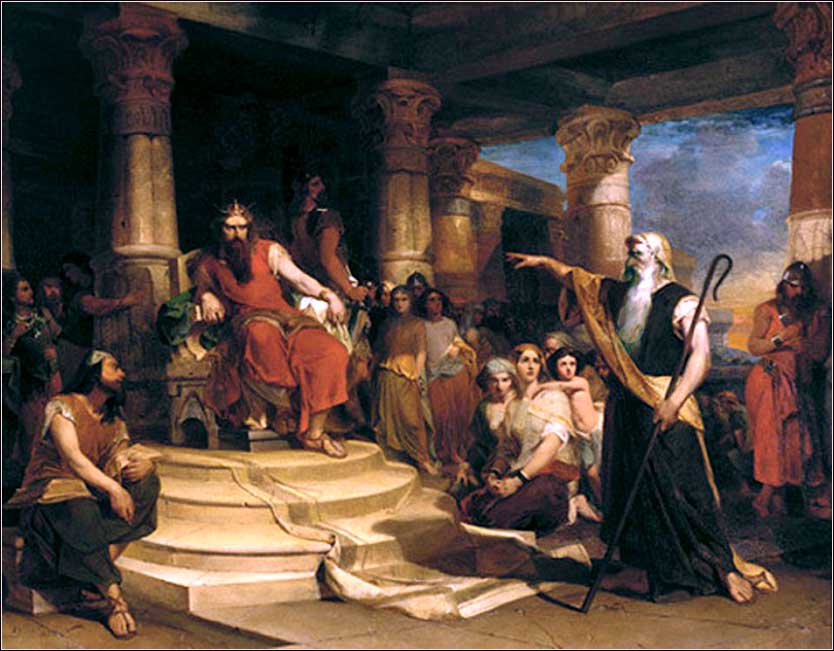
“Thou Art The Man” (1884) by Peter Frederick Rothermel
For all of recorded history, bringing legal disputes to the local ruler or wise man for public airing and judgment was a centerpiece of good government, and still is. And, doing so – among other things – makes all who are there part of the public witness for each case and decision; so, the community as a whole is in effect a party to the success and enforcement of each judgment that is made.
In our reading from 2 Samuel, Nathan makes his case to David in just such a setting; which was a wise move on his part! He knew he needed that public witness for the accusations he was about to make.
Imagine the scene: David is sitting in a chair with his scepter and crown on a platform in front of the crowd. People are standing around, waiting for their turn to be heard, or perhaps hoping for some drama to enliven their day. The King’s advisors are off to one side, waiting to be called upon when needed.
Then, Nathan steps forward, and begins to tell his story. The King listens, his anger rising as he hears the tale; and, when he can’t restrain himself any more, his face red, gripping his chair with both fists, he leans forward and says “As the Lord lives, the man who has done this deserves to die!”
Nathan pauses, then says four simply painful words: “You are the man!” Then, turning his back on his King, he tells the people of all the terrible things David has done: Rape, Deception, Betrayal, Murder.
I imagine David sitting there, mouth open, silent. The sin he’d so carefully hidden from the people, from God and even from himself, is revealed. He has not fooled anyone. He took Uriah’s wife and impregnated her. He engineered the death of one of his greatest and most loyal warriors. He married the grieving widow to make the pregnancy appear legitimate. He tried to deceive everyone, betraying the peoples’ trust and that of the Lord. Yes, he deserved to die: condemned before the people and before God out of his own mouth.
But not one word is said in condemnation of Bathsheba. Nathan does not accuse her, nor does David defend himself through blaming or implicating her. (Unlike Adam’s blaming of Eve and Eve’s blaming of the serpent in the Garden.)
Many have said that Bathsheba enticed David, but doing blames a victim who has lost everything. Nowhere in the Bible is it even hinted that Bathsheba had done anything wrong.
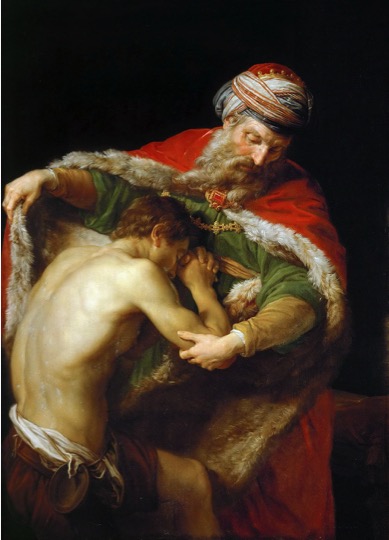
Our God is a God of second chances, a God of Healing not just for us, but also for those who hurt us. We cannot deny the pain they cause, nor should we, but we can receive God’s healing. We begin this process for ourselves, and those who sin against us, through forgiveness. Forgiveness is God’s love in action.
The Return of the Prodigal Son (1773) by Pompeo Batoni
With the recent mass shooting in Charleston and the death sentence for the Boston Marathon Bomber we are once again witnessing the spectacle of one who is a purveyor of hate being confronted by those who have survived their brutality and evil. Some say such monstrosity can never be forgiven. Others say that while justice must be done, it is wrong to answer evil with evil. Both are correct.
Many have used such stories when claiming to know God’s will, and so bull their way ahead towards some predetermined goal. They are full of hubris, not listening – or looking – for any further guidance from anyone, let alone God; confident that they are not mistaken in of their understanding of God’s will. More often than not, they fail, or else their road to success brings such great sacrifices and pain upon others that one rightfully wonders where God is in all of this.
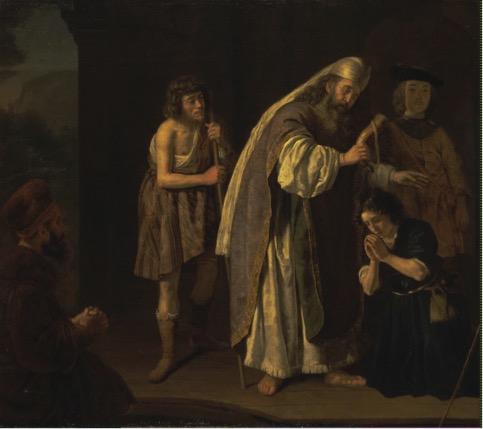
The Anointing of David by Victors Jan, ca 1645
I love reading from the histories in the Old Testament, such as this morning’s text in First Samuel about the anointing of David to replace Saul as King of Israel.
One thread in this story – as with all of our readings today – is about seeing. About what we see vs. what God sees.
This is made very plain at the heart of this passage, where the Lord says to Samuel about Jesse’s son Eliab: “Do not look on his appearance or on the height of his stature, because I have rejected him; for the Lord does not see as mortals see; they look on the outward appearance, but the Lord looks at the heart.” To say this another way, God sees that which we cannot see: the Lord sees the Unseen.
And yet, even after God says this, Samuel keeps on looking at six more of Jesse’s sons, and each time fails to discover what he has been sent to find. Finally, Samuel says “The Lord has not chosen any of these. Are all of your sons here?”
Well, it turns out that one of Jesse’s sons was not seen because he could not be seen, he was not there at all. The eighth and youngest son was up in the hills, tending his father’s sheep. David was the least of Jesse’s sons, and no one even bothered sending for him until Samuel explicitly asked that this last son of Jesse be brought before him. We see that David was unseen in many ways, but the Lord saw him!






 The Here and the Hereafter