The last couple of weeks have been an interesting mix of highs and lows for me.
The certainty of our own mortality has intruded itself forcefully into the lives of many in this part of the country recently, with the tragic deaths of two firemen in Boston the other day (and you can be sure, fire fighters are just as much ministers of God as those of us who wear clerical robes). Also, the first anniversary of the Boston Marathon Bombing is coming soon, during Holy Week in fact.
On a more personal note, old friends have recently made known their own brushes with mortality and how the afflictions of age are becoming more and more difficult to ignore, as has also proven to be too true for myself as well.
Finally, two friends of mine have died this week, one an old and dear friend from childhood, stricken down much too early in life following a very brief and devastating illness, much to the shock and dismay of her young students and the community where she lived. The second was a co-worker whom I’d known as a young man: she was always with a ready laugh and smile, dying after a long battle with a serious illness. Both great people, and both very much loved by the many whom their lives touched over the years.
Mortality does not play favorites, and (as my father has often said) “there is no get out of jail free card” – no exceptions. We will all someday confront the same dark horizon that these wonderful people (and so many others) have already passed beyond: never to return from the darkness that will eventually devour all lives, all nations and all human hope.
Based on the thoughts I surfaced in a recent post (and elsewhere) regarding what I see as God’s call to Unconditional Love, I’ve had several folks ask me questions along the lines of “Does that mean I have to love the person who [abused or hurt or seeks to control] me?”
Let’s answer this one carefully.
Love them? Yes.
Have a relationship with them? Well, that question requires a nuanced answer…
To begin with, let’s make one thing clear: Love and Relationship are not the same thing. We can choose to love another, even if the relationship we have with them is nonexistent (or nearly so). Loving another means building a bridge between another and you, opening a door to a better future, a better relationship. But just because that bridge exists does not mean you have to cross it, or that they will cross it, and you certainly should not cross it all the way to the other side!
Relationship is a two-way street. A relationship will exist in some form – after all, relationship is part of the very fabric of our existence. So, you do have relationships with others, all others. However, the extent and quality of that relationship is attenuated by the limitations we bring to the table. Love makes it possible to have a better quality and more balanced relationship with another, but only if they are willing and able to return that love. Love enables you to get to the midpoint of the bridge, but it is up to the other as to whether they’ll meet you halfway, or not.
We often hear that God loves us unconditionally, and that we are called to love everyone we meet in the same way. Matthew 22:37 & 39 give us the two Great Commandments, which are founded upon this principle: “‘You shall love the Lord your God with all your heart, and with all your soul, and with all your mind.’ and ‘You shall love your neighbor as yourself.’ St. Paul dwells on this topic in the well known “Love Chapter” of First Corinthians (1 Cor 13).
Unconditional Love is central to the Christian Gospel.
But, what is “Unconditional Love”?
Recently, I’ve been reading “Unconditional Parenting: Moving from Rewards and Punishments to Love and Reason” by Alfie Kohn, an interesting and informative book that seeks to apply science and reason to the raising of children. The book is fascinating, and not just because it uses convincing science and logic to throw many cherished myths about raising children right out the window.
What struck me in reading Kohn’s work is his thoughts on what “Unconditional Love” means, and it’s importance in becoming the well rounded, stable and (spiritually) healthy individuals we are meant to be.
For one, he points out that if we demonstrate our love for another only when we meet their expectations, then our love is conditional. Unconditional love “doesn’t hinge on how they act, whether they’re successful or well behaved or anything else.”
He also states that if we love children just as they are, then they learn to “accept themselves as fundamentally good people, even when they screw up or fall short.” This in turn helps them to be freer to accept other people just as they are, and helps them to flourish, instead of being lost in a sea of judgment and rigidity.
Kohn also says that “Conditional parenting is based on the deeply cynical belief that accepting kids for who they are just frees them to be bad because, well, that’s who they are.” This is true of conditional love of any sort. Paul says it best, in Romans 7:22-24: For I delight in the law of God in my inmost self, but I see in my members another law at war with the law of my mind, making me captive to the law of sin that dwells in my members. Wretched man that I am! Who will rescue me from this body of death?”
In other words, we are inherently good (or, at least we yearn to be “good”) says Paul – and Kohn – and Jesus. But, if we do not learn to love unconditionally, if we choose to see the flaws in others before we see what God sees in them, then we are allowing the sin that is in our flesh (as Paul describes it) to obscure the goodness within us, and within others. We then fail to love others unconditionally, as we are called to do, because we have not learned to see beyond what a person does to embrace who they are – a beloved child of God, just like everybody else, including us.
Ultimately, “…The choice between conditional and unconditional parenting is a choice between two radically different views of human nature.” Are we essentially economic robots – our behavior is purely the learning that love is earned in return for correct behavior?
If we are primarily automatons that require incentives to behave well, then how can we be authentic people – authentic in terms of understanding who we are, and authentic in our dealings with others? Our love is conditional if we accept others only when their behavior is acceptable. This also means that we can only accept ourselves if the person we seem to be meets whatever standard we’ve set for ourselves. We will be distancing ourselves from God’s unconditional acceptance of that inner person we try so hard to hide from everyone else, including ourselves.
Why do we need to create a false “self” that others will find acceptable? When we do so, we can never be the person we are meant to be – we will always be a façade, a mask behind which we hide (and often lose) our true selves in the name of finding acceptance.
Kohn goes on to say that “Unconditional parenting insists that the family ought to be a haven, a refuge … [that love] does not have to be paid for in any sense. It is simply and purely a gift …. to which all … are entitled.”
This is echoed throughout the Bible, and especially the New Testament. God is seen as “our Father.” We are called children of God, and members of the “Family of God.” Paul says it in a different way at times, describing us as members of the “Body of Christ.” God’s love is a gift, one that will never be taken away, one that is always there, not given as a result of anything we’ve done.
All of these biblical metaphors reflect an understanding of the importance of accepting and loving others unconditionally; and understanding that they reflect how God loves us. “The other” is part of who we are, and so we must learn to love others unconditionally if we are to learn how to love ourselves in the same way, and learn how to accept the unconditional love of God which is already there, waiting for us.
“Love your neighbor as yourself” is not just about learning to love your neighbor, but also about learning to love yourself.
Love!
– Allen
Copyright (c) 2014, Allen Vander Meulen III, all rights reserved. I’m happy to share my writings with you, as long as you are not seeking (or gaining) financial benefit for doing so, and as long as proper credit for my authorship is given. (e.g., via a credit that gives my full name and/or provides a link back to this site – or just email me and ask!)
My friend, Pedro S. Silva, recently made an interesting point, which is that Science and Faith both begin from the same place. They both start with something that is invisible to the naked eye, approachable only through the functioning of the human mind.
In the case of science, all matter and energy begin with subatomic particles, mixtures of quarks and leptons in various configurations: interacting with each other at the behest of forces like gravity, electromagnetism, the strong force and the weak force. And yet, none of these elementary particles are seen, heard, tasted or touched. Instead, we observe their effects on other things, or throw subatomic particles at each other at ridiculously high speeds to see what flies out when they collide.
And we see invisible things in other ways – using telescopes to see the universe as it was back in time, even up to shortly after the “Big Bang.” Or, assembling myriads of data observations to find patterns that have would otherwise be hidden, patterns which have meaning to us, such as global warming, or economic trends, or opinion polls. (…If you believe that opinion polls have meaning, which I often do not!)
Science is all about seeing the unseen, employing specific tools to help us see and appreciate things that were previously hidden from us. Science is a useful tool, one we cannot ignore (even though some try). Science helps us see clearly where seeing was not possible before.
Faith is no different: like Science, it also makes it possible to find meaning in the unseen.
Like Science, Faith also begins from an invisible place, a place that cannot be directly observed, a place that can be inferred only through its effects upon other things. Those of us who are people of Faith call that place “God.”
Just like Science, Faith employs various tools to better understand the mystery of that which is invisible to our senses. We read scriptures. We pray. We look within ourselves and listen carefully to the unspoken thoughts, feelings and currents we find there. We observe the world around us and find purpose and meaning in it.
Like Science, Faith sees a bigger pattern than can be discerned with the naked eye by beginning with those things that the naked eye cannot discern at all. And yet, Faith differs from Science in one crucial aspect. Science is about finding those patterns. It is about the How and the Where and the When of things. It is not about the Why of things. Faith is about the greater purpose and direction of existence as a whole, and our individual existence. Science focuses on the mechanics of that existence.
Why am I here?
Why am I, at all?
What purpose is there to my life?
What’s the point of life at all?
So, when I see folks dismiss the value Faith for whatever reason, such as because they believe that Science already tells us all about how the universe came to be; I am saddened, for they are not seeing the value of Faith in their lives. They are confusing Fact with Truth…
Science tells us how the Universe started with nothing and came to be what it is.
Faith tells us why.
Science tells us how the Human body functions, and how various aspects of our environment, or our genes, influence our behavior and the quality of our lives.
Faith tells us why life is worth living.
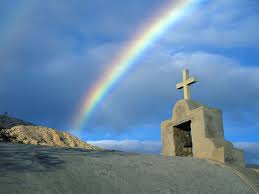
Science tells us of all the wavelengths of light that are to be found in a rainbow, and can even tell us the chemical composition of the source from which that light came.
Faith tells us the Rainbow is beautiful, and how it is a reflection of God’s love for us.
Science helps us understand the World around us.
Faith helps us find hope within it.
Science tells us What we are.
Faith tells us Who we are.
Embrace both.
Copyright (c) 2014, Allen Vander Meulen III, all rights reserved. I’m happy to share my writings with you, as long as you are not seeking (or gaining) financial benefit for doing so, and as long as proper credit for my authorship is given (e.g., via a credit that gives my full name and/or provides a link back to this site).
Thanks to Army Chaplain Jonathan R. Fisher for making this valuable point in his blog.
Being “Open” to others (and their otherness) is simply not enough. “Open” by itself is a passive state. As Christians, whether we are in the pastorate or the laity, we are called to do more than merely be “Open.” Our faith calls us to action, meaning that we must not only be Open, but also Affirming. We cannot simply welcome those who come through our doors, but must also reach out to them beyond the doors of the sanctuaries we’ve defined for ourselves. We must affirm others for who and what they are, right where they are.
Affirmation is not about accepting someone when they come into my territory, but rather about valuing and loving others right where they are even if they never step outside the limits of the space they have set for themselves.
Affirmation is a declaration that everyone is a child of God, and therefore a valuable, wonderful person loved by God for exactly who they are right now; and that we are called to do the same.
Being “Open” AND “Affirming” is not an easy thing to do, because it calls us to accept that we don’t have all the answers, and never will; and that we therefore must be willing to accept and value the presence of God in others, no matter how it is expressed, and no matter how challenging we may find those expressions to be.
I’ll end with this quote from Fred Rogers, from his book “The World According to Mr. Rogers”…
“As human beings, our job in life is to help people realize how rare and valuable each one of us really is, that each of us has something that no one else has–or ever will have–something inside that is unique to all time. It’s our job to encourage each other to discover that uniqueness and to provide ways of developing its expression.”
It would seem that a post about this would be completely unnecessary in the pluralistic world of the Army Chaplain Corps. It would seem that the directive to perform one’s own faith and provide for all the others would make such a statement redundant.
Only it’s not.
Somehow, this needs be said.
So, I am going to say it: I am a chaplain for ALL my Soldiers. All of them. The gay ones. The straight ones. The fat ones. The skinny ones. The conservative ones. The liberal ones. The religious ones. The non religious ones. The connected to church and the far away. The reason driven and the faith-based. The agnostic and the Christian. The pagan, the Muslim, the Hindu, the Buddhist, the whatever-you-happen-to-believe right now. Everyone I can think to mention and everyone else.
All means all.
This last summer, the General Assembly of the Christian Church (Disciples of…
First, as I discussed in that post, “Being Holy” is a process. A process implies that changes are happening as a result of that process. So, when God says “You shall be Holy for I am Holy.” … God is changed by the practice of being Holy, just as we will be changed.
This makes sense from a second point of view, which is that Holiness, based on the commands in Leviticus 19, is about having healthy relationships. In other words, being Holy requires relationship. This makes perfect sense to Christians, since the whole point of Christ walking here on earth as one of us was to bring each and every one of us into closer relationship with God. Christ, after all, was prophesied as being “Emmanuel” – “God with Us” (Matthew 1:23).
Third, relationship is not a one way street. Relationships change both parties. If not, it would be a one way interaction, such as a child might have with a doll – such a relationship might change us, but it sure doesn’t change the doll! Such is not a full relationship, but only a partial or truncated one.
So, when God says “You shall be Holy for I am Holy” in Leviticus 19:2. It means Holiness is a two way thing. We are Holy because we are in relationship with God – You shall be Holy for I am Holy” – and that Holy relationship changes the both of us for the better.
Holiness and relationship both require that God is vulnerable to us, just as we are vulnerable to God – and what could be a greater demonstration of this than Jesus’ death on the cross? Or Jesus as a babe, completely dependent upon his parents for sustenance and support? It would seem, then, that being vulnerable isn’t such a bad thing, it leaves our hearts open for change, and deeper and more meaningful relationships with others.
The Bible asks us to be open to God and God’s movement within our spirits. That movement is a two way street, and that is what is at the heart of being Holy.
Be Holy!
Copyright (c) 2014, Allen Vander Meulen III, all rights reserved. I’m happy to share my writings with you, as long as you are not seeking (or gaining) financial benefit for doing so, and as long as proper credit for my authorship is given (e.g., via a credit that gives my full name and/or provides a link back to this site).
A close friend of mine once lived in a town that was rapidly becoming a mecca for the affluent in his part of the country, ignoring it’s heritage as a community that put significant effort into ministering to those in need.
One afternoon, my friend was crossing the street in a marked crosswalk at a stoplight, when a well-dressed man in his brand new white Cadillac SUV zoomed through the red light as he made a right hand turn. As this driver did so, he hit my friend with his vehicle, knocking him to the ground and leaving him dazed. At that point, the driver stopped, rolled down his window, cussed my friend out for getting in the way, then roared off. (Unfortunately, the driver got away with it; as at that moment my friend was in no condition to read, let alone remember, a license plate number.)
We could say a lot about the injustice of this, highlighting how those with power and position are often arrogant and self-serving, thinking their position and wealth grants them special privileges and consideration; and then contrasting that with the situation of my friend, a man of great talent and a good heart, but who lives on the margins of our economy.
But let’s not go there today; there’s enough of that floating around. Instead, we’ll focus on how this situation is illuminated by the text from Leviticus 19 that is part of the lectionary readings for this coming Sunday.
It seemed appropriate on this, Valentines Day, to reflect on the nature of Love.
In Christian Scripture, the Apostle Paul’s First Epistle to Corinthians (chapter 13) is known as the “Love Chapter.” I quote it in full here…
1If I speak in the tongues of mortals and of angels, but do not have love, I am a noisy gong or a clanging cymbal. 2And if I have prophetic powers, and understand all mysteries and all knowledge, and if I have all faith, so as to remove mountains, but do not have love, I am nothing. 3If I give away all my possessions, and if I hand over my body so that I may boast, but do not have love, I gain nothing.
4Love is patient; love is kind; love is not envious or boastful or arrogant 5or rude. It does not insist on its own way; it is not irritable or resentful; 6it does not rejoice in wrongdoing, but rejoices in the truth. 7It bears all things, believes all things, hopes all things, endures all things.
8Love never ends. But as for prophecies, they will come to an end; as for tongues, they will cease; as for knowledge, it will come to an end. 9For we know only in part, and we prophesy only in part; 10but when the complete comes, the partial will come to an end. 11When I was a child, I spoke like a child, I thought like a child, I reasoned like a child; when I became an adult, I put an end to childish ways. 12For now we see in a mirror, dimly, but then we will see face to face. Now I know only in part; then I will know fully, even as I have been fully known. 13And now faith, hope, and love abide, these three; and the greatest of these is love.
The thing I observe about Paul’s eloquent prose is that it talks about how Love is at the core of the Christian message. Without it, says Paul, Christianity is nothing, and our words meaningless.
In fact, in reflecting upon the Gospels I do not recall a single instance where Jesus limits the ways in which we are encouraged (or allowed) to love others. Instead, like Paul, Jesus focuses us on the importance and centrality of Love, often being an example to us of how to love others, and how our love for the other must be grounded in our Love of God.
I remember the first time I saw a young couple passionately kissing, when I was an early teen, I think. It was a new thing for me – an unfamiliar sight, something I was not comfortable with, something that unnerved me more than a little bit. I remember thinking “Ewwww!” … I’m sure most of us have had similar experiences!
I read an article on CNN a couple of years ago that quoted a social studies teacher who said that each year he asks his students “What is Easter about?” He said they invariably bring up the Easter Bunny but never mention the significance of the holiday to Christianity.
I’ve also noted a tendency among some Churches and Christian leaders in recent years to “circle the wagons” and retreat into Orthodoxy or relatively conservative statements of doctrine. This seems to be a reaction to the declining influence of organized Christianity in American society as a whole, and may also reflect a perception that more conservative, evangelical Christian groups are growing while “mainstream” Protestant denominations (and Catholicism) are on the decline.
I am convinced that by retreating into more orthodox expressions of the Christian faith, progressive Christians are abandoning the greatest advantage they have in the face of an increasingly secular society, which is their ability to engage with others in ways they can easily understand. That Vermont teacher’s observation that young people are not able to identify Easter’s origins in the Christian Tradition (still less the underlying Judaic traditions), means they have no basis for comprehending words like “Christ”, “Jesus” or “Salvation”. Such concepts mean nothing to them. Therefore, using such terminology to try and reach them is fruitless.
Also, the only impression of Christianity many people have nowadays comes from news articles about the hate-filled activism of Westborough Baptist Church, and the anti-intellectualism, racism, misogynistic attitudes and/or homophobia of various religious groups and personalities. So, if we use the same words such people use, even though the message itself is far different, we, as progressive Christians, are being lumped together with them in the public mind. We are therefore perceived as out of touch and irrelevant to modern realities and concerns. (And, as any politician will tell you, perception always trumps truth!)
Most Thursday mornings you can find me at a local shelter for homeless families, working as a volunteer chaplain. I’m not as useful as I’d like to be, since I am male – and many of those needing the services of this facility (and similar shelters) are there because of domestic abuse – meaning that men are to be feared and avoided, not trusted. So, it can take a great deal of time to get past that hurdle before communication (and trust) can grow. And, many of the residents move on to other shelters, or (hopefully) a home, before such a bond can develop.
As a result, I spend a great deal of my time observing those who are there in the shelter, mostly Moms (and some Dads) getting their kids to the school bus, preparing to go to work. Often they are also preparing for a new round in the endless struggle with the Social Services bureaucracy and various other agencies and organizations: a struggle dedicated to providing enough food for their family, finding a new home, a new job, and perhaps medical or other care.
It’s an interesting place. I usually see kids reading schoolbooks, watching TV, talking with their parents and playing with friends. Both parents and kids will be eating from the continental breakfast buffet that the hotel puts out for them. (The State of Massachusetts contracts with a number of hotels around the state, such as the one I work at, to provide shelter for the several thousand homeless families that cannot be housed within state-owned and run homes.)
The kids are dressed just like any kid would be on a school morning – jeans or (for the younger set) some sort of themed clothing – (perhaps a superhero, Barbie, Hello Kitty, and so on…) Backpacks full, sometimes with Mom (as all Mom’s do) doing her best to make their hair and outfits presentable before they have to run out to the school bus.
When I drive up on those mornings, I sometimes see parents running from the hotel to the commuter bus stop nearby with plates of food – perhaps two or three bagels or toast, and (usually) coffee. Moms might be pushing a stroller, or shepherding a young child or two, while the dads might have a backpack or briefcase.
My concerns with Creationism are threefold: one scientific and two theological in nature.
The scientific one is simply that Creationism flies in the face of established science, science with a very deep and well supported history of research behind it. To choose Creationism over Evolution requires rejecting a multitude of well established and well defended facts that are highly supportive of each other, and have shown a massive amount of predictive value in terms of where to look for new revelations of the nature of Creation. Creationism cannot do this, and also (in effect) requires rejecting the majority of scientific theory and research made over the last 500 years or so, along with the advances that have been made as a result of those theories and research.
For me, Faith is of paramount importance (which is probably obvious, given that I am a minister). However, Faith must pass the “sniff test” – meaning that it is relevant and meaningful in this world that we live in and know. Creationism fails that test. This leads to my two theological concerns, where Creationism fails even more egregiously than it does when portrayed as a scientific theory.
I find a recent survey done by the “American Bible Society” quite troubling, not just because of the conclusions the survey’s authors present, but also because of the criteria used in evaluating where people stood on what the ABS termed “Bible Mindedness.”
The authors of this study evaluated “Bible Mindedness” using the following criteria: “Respondents who report reading the bible within the past seven days and who agree strongly in the accuracy of the Bible are classified as ‘Bible Minded…’”
I take strong exception to this, as I find just as many devout and thoughtful Christians here in the Boston area (which was near the bottom of the study’s rankings) as I do anywhere. The criteria used here heavily skew the results towards a very narrow and slanted view of what “Bible Mindedness” means.
For me, reading the Bible on a nearly constant basis should not equate to “Bible Mindedness” because such a practice assumes the Bible can be relevant and useful to us in our daily lives entirely without reference to the world in which we live, an assumption that is deeply flawed.
Reading other works that reflect upon the Bible and our faith, such the writings of various theologians, works of poetry, histories, science, novels, the Talmud, the Koran, etc; all provide new insights about how our faith impacts us and impacts the world around us. Such readings help us gain a greater appreciation of the variety and magnificence of God’s Creation. And, they provide new and deeper revelations of what our faith means to us, and how we can apply that faith to the challenges of life, as well as helping us attain a broader perspective of what it means to be a person of faith.
Since God is infinite, God must encompass an infinitude of perspectives. Therefore, limiting ourselves to a single (and literal) perspective of the Bible limits us in our understanding of Creation and of our relationship with our Creator.
So for me, being a person of faith – being “Bible Minded” – means using the Bible as a starting point – not an end point. A view shared by many who were dismissed (by the criteria used in this survey) as “not engaged with the Bible” and not using the Bible to make sense of [their] life.
Copyright (c) 2014, Allen Vander Meulen III, all rights reserved. I’m happy to share my writings with you, as long as you are not seeking (or gaining) financial benefit for doing so, and as long as proper credit for my authorship is given (e.g., via a credit that gives my full name and/or provides a link back to this site).

 The last couple of weeks have been an interesting mix of highs and lows for me.







 The Here and the Hereafter