The Sadness and Love of Valentines Day

…I ask that you share not just the joys of romantic love, but the sadness that is within all of us, show your love by reaching out to them, helping to share the burden that they carry hidden in their heart, even if only for a little while; because, walking with another through their sadness and hard times is central to what our faith is all about.

tumblr_m4r98e7tDL1r0ou82o1_500On this Valentines Day and the First Sunday of Lent, I ask that we remember not only the importance of Romantic Love; but of Divine Love, the Love of a friend or sibling, LovingKindness, Self Love, and the many other kinds of love out there.
There are many out there who celebrate and remember the romantic aspects of Valentines Day – of marriage proposals and weddings, of building family. But, there are many, many people for whom this day carries a tinge of sadness, such as…

Continue reading “The Sadness and Love of Valentines Day”

Keeping the Christ in Christianity

Those who seek to minimize the Christ in their Christianity do so out of a conviction that we must not offend, and must not intimidate (through “churchy” language and ritual) those who are looking for a touch of the divine in their lives. This is a worthy impulse, but we must be careful to not allow such thinking to seduce us into creating a faith for ourselves that is inoperative and unchallenging.

NotCrossRev. Heath is absolutely right in her recent article in Christian Century entitled “On Throwing the Baby Jesus Out with the Bath Water”: we need to keep the “Christ” in our Christianity.

In my view, the tradition that has been passed down to us, combined with the teachings and example of Christ and others as found in the New Testament and elsewhere, forms a foundation or framework for our faith: denying, minimizing, or casting aside that framework really would leave our faith “rootless” as many Evangelicals often (erroneously) label we who are Progressive Christians.

Christianity is not about supplying all the answers or enforcing a rigid set of doctrines and laws to live by. Jesus preached against exactly that sort of thinking and practice in the First Century, and it doesn’t work any better now than it did then. (And, frankly, doing so has never worked well.)

On the other hand, our faith isn’t just about making us feel good about who and where we are at the moment, either: Yes, we are to love and accept ourselves and each other as we are right now, but we are called to continually seek to do better, not simply accept what is.

Keeping Christ in our faith is challenging, and should always be so: if our faith is not challenged, if it is not continually being refined in the tension of this place we exist that lies between what was and what is to come, then our faith would be fruitless and meaningless. It would simply be a rationale for accepting things as they are, rather than challenging us to become better: to become more just, more thoughtful, and more compassionate.

Continue reading “Keeping the Christ in Christianity”

The Star of Change

The Star shining above that stable in the Gospel of Matthew is leading the wise to the Promise of God. It is a light that is a harbinger of the changes to come, but also the promise that God’s light is within those changes, and that God will never forsake us, nor forget us. Do not fear change, for God’s light and grace are in it – always.

star_of_bethlehemSo, it is close to midnight on December 31 here in the Boston area: New Years Eve.  And, what am I doing?  I am sitting in our living room writing my sermon for this coming Sunday while my wife, son (and cat) sleep peacefully in their beds, not far away.

Some things never seem to change – like the never-ending challenge of finding the time to faithfully serve my small but doughty congregation while balancing my call to the ministry with the duties of father and husband; and the demands of the numerous efforts, activities, and causes I’m involved in.  It is quiet here in the darkened house.  Everything seems stable, solid and at peace.

On the other hand, this Sunday is Epiphany Sunday and the star that shines so bright in Matthew chapter two, guiding the Wise ones who come from afar, is all about change – announcing that change is soon to come, and also confirming that those changes have indeed already begun. And with that change comes the realization that the old rules no longer apply; and that we can no longer expect the world to work as we believe it has always done.  That we cannot proceed with business as usual any more.

Change is coming, and change is already here.

Change can be scary, but instead of fighting it, or pretending it isn’t happening, we – as people of faith – are called to acknowledge it, to see God’s purpose flowing in it, and to understand that while dealing with  change is always a challenge, every change carries within it the promise and grace of of God.

I pray that this past year has been a good one for you – yes there have been many changes in all of our lives – good changes, and bad.  I pray that in this coming year you are blessed with the wisdom and strength and resources you need to deal with the new changes and challenges you will face.  And, I also pray that we all stand together, helping each other rather than fighting each other (as we have done so often in recent years) so that the changes we face as a people, and as creatures of God’s Green earth, are confronted and dealt with compassion, with wisdom, and with God’s grace fully active in our every thought and word and deed.

Remember the Star shining above that stable in the Gospel of Matthew, leading the wise to the Promise of God: a light that was a harbinger of the changes to come, but also the promise that God’s light is within those changes, and that God will never forsake us, nor forget us.

And so I wonder as I write this sermon – is the light of that star merely announcing that change is coming; or is it a light – a light of the Divine – that makes it possible for us to see the change that is already here?

Peace be with you all now, and in the days and weeks and months to come.

Have a Blessed and Happy New Year!

Amen.

Copyright (c) 2015, Allen Vander Meulen III, all rights reserved.  I’m happy to share my writings with you, as long as proper credit for my authorship is given. (e.g., via a credit that gives my full name and/or provides a link back to this site – or just email me and ask!)


A Less Than Perfect Faith

nativity-1024_103941o

In ancient times, the whole purpose of Temple sacrifices, and religion in general, was to make oneself perfect. Sacrifices were meant to cleanse sin from our lives and spirits, atoning for the wrongs and evil we had already done. Devotion to one’s god(s) was supposed to make you would be acceptable in the sight of your God, and therefore worthy of rewards of one sort or another (either in this life or perhaps in the afterlife).

The birth of Jesus flies in the face of all this: a Babe born of an unwed mother – a Bastard, possibly even the product of rape (according to some ancient sources). Born in a stable – a place of poverty and filth – animals, dirt, feces, bad smells. The offspring of Galileans, a people who were not respected or admired even by their fellow Jews. A child raised in obscurity in a remote corner of a poor land under the heel of Roman Domination. How low, how less than perfect, can you go?

But that’s precisely the point: our faith does not require us to become perfect to attain merit or favor from our Creator. Through the teachings of the New Testament, we see that perfection is not a prerequisite for entering into a relationship with God. Instead, perfection is the outcome of our relationship with God. We are perfected by our faith. We do not need to do anything to merit it, other than to believe.

This means you are accepted, and acceptable, just as you are.  You are loved, and lovable, just as you are.  You are valued, and valuable, just as you are.

As a Church, we must come to not only accept this, but embrace it with enthusiasm.  Do we live our faith in ways where this truth, that perfection is not a prerequisite for our relationship with God, is obvious to all?  Do we show, by the way we relate with anyone ad everyone, that we are loving them just as God loves them?

This means every aspect of our life as members of a community of faith must be thoughtfully considered.  Are we welcoming and indeed affirming as people walk through the door?  What about our services, celebrations and outreaches?  What about our bathrooms and our after service coffee hour?  And, most importantly, does the community within which we exist see us as exclusivist or welcoming?  Do we place walls between ourselves and the other, or work hard to tear down any walls that could inhibit our embrace of them as a child of God just as loved by our Creator as we know ourselves to be?

In fact, what if the world were perfect?  It would be a very boring place.  With everything perfect there would be no love.  There would be no relationship, and there would be no grace.  There would be no need for a God.

So, this is not a perfect world.  We are not a perfect people, our churches and our faiths are not perfect either, but our faith is a perfect faith – a faith of less than perfect people who have been perfected by the Love of their Creator.

None whom we encounter in life are any less perfect than we.  Love them where they are, as God does us. Because we need our imperfection, just as God needs our imperfection so that we can be loved for who we are, just as we are.

Amen.

Copyright (c) 2015, Allen Vander Meulen III, all rights reserved.  I’m happy to share my writings with you, as long as proper credit for my authorship is given. (e.g., via a credit that gives my full name and/or provides a link back to this site – or just email me and ask!)

A Holiday Thought

The Holidays are a time of remembrance.  That often means they are a time of regrets over opportunities lost and of what might have been. A time of seeing how our own faults and flaws, and the pain and sadness within our own lives, has affected us and limited us.  We are confronted with how our own frailty has hurt those whom we love.  We are reminded of all that has been lost.


And yet, this season is also a time of hope – of looking towards a future that will be better, of knowing that Light and Love are still there for us, and others, and will always be there.


Let us not bury the sad and bad in this Holiday season: doing so is a rejection of what it is so present – and therefore important – within our own lives as well as within the thoughts and lives of everyone around us.


Instead, let us honor and respect those pains and stains, because they are part of who we are.  And, our faith teaches us that in God’s eyes, what and who we are – including every single one of the bruises and scars we all carry within us  – is wonderful and beautiful.


Peace,


Pastor Allen


Copyright (c) 2015, Allen Vander Meulen III, all rights reserved.  I’m happy to share my writings with you, as long as proper credit for my authorship is given. (e.g., via a credit that gives my full name and/or provides a link back to this site – or just email me and ask!)

Rejection

…Rejection is less about the person being rejected and more about the person who is doing the rejecting. Rejection occurs because you do not fit the mold that another has sought to place upon you. This does not mean they don’t love you, but it does mean they do not know how to love you.

You cannot change how they see you and love you. But, you can continue to love them in some fashion, perhaps distantly, and give them the time and space they need to confront themselves and to learn that they need to grow and change, just as you have grown and changed.

breakupThere was a young woman I recently encountered through an online forum who had “come out” to her parents, only to have them seemingly reject her in some unhealthy and painful ways.  She did not give much detail, but it was clear it was a painful experience for her (as many of my friends and readers have also experienced, or can imagine).

Here is the counsel I gave her (with some minor edits), which I hope may be of help for others who are also experiencing rejection.  (…Though we must also recognize that there are many out there, especially those who are the survivors of abuse, for whom such an approach will only promote or increase the pain they are experiencing, rather than bringing the healing they are looking for.)


…From the tiny bit you’ve said it sounds to me like your parents are going through an identity crisis. They see you as an extension of themselves. (And we are all extensions of our parents in many different ways, aren’t we?)  So, they are confused and distraught because their daughter has suddenly turned out to be someone entirely different (in their minds) from the person they thought she was.

This has shaken their own self image to the core, and they are probably reacting in all sorts of unhealthy ways because of it. I suspect they love you deeply, but are realizing – at some deep and probably unconscious level – that to love this person who is their daughter as deeply as they do means some major readjustments in their own life, with their relationships with you, and even with their relationship with each other and with their God, all of which is scary. They are no longer the parents they thought they were, but something else, some other kind of parent.

Speaking as the parent of an adult child myself, it’s a hard adjustment. Your parents have to learn to accept you as an adult, someone who has their own life to live.  They raised you to be such a person, but didn’t really realize until now that raising you to be a strong and independent person resulted in you becoming a strong and independent person!

In a way, your roles have been reversed: you are now the adult, and they are the ones who need to grow up a bit more.  They’ll need time and space to come to that place of acceptance, so don’t give up on them, but also don’t try to “make” them see and accept the truth of who you are, it is best to let that happen when the time is right.

Show them how to love you as you are, that you are a wonderful person in large part because of who they are – just as they hoped you would be.  And, let the Spirit of the God you share with them give all of you peace as you weather the storms and adjustments that are taking place as they adjust to this new reality in their lives.

My prayers are with you all.


In my experience, rejection is less about the person being rejected and more about the person who is doing the rejecting.  Rejection occurs because you do not fit the mold that another has sought to place upon you.  This does not mean they don’t love you, but it does mean they do not know how to love you.  

You cannot change how they see you and love you.  But, you can continue to love those who reject you in some fashion, perhaps distantly, and give them the time and space they need to confront themselves and to learn that they need to grow and change, just as you have grown and changed.

Peace,

Pastor Allen


Copyright (c) 2015, Allen Vander Meulen III, all rights reserved.  I’m happy to share my writings with you, as long as proper credit for my authorship is given. (e.g., via a credit that gives my full name and/or provides a link back to this site – or just email me and ask!)

Why #MerryChristmasStarbucks is Everything Wrong with American Christianity

Mr. Lake is absolutely right. Even if the point being made had any validity (which it doesn’t), the “Merry Christmas Starbucks” furor is far more a statement of our inability to be welcoming and loving of all of our neighbors than it is a “defense” of our Faith.

And frankly, our God is a pretty big god. I’m certain that our infinite and omnipresent Creator is more than capable of handling any and all insults without our help. In fact, volunteering to defend our faith due to such perceived slights says far more about our own insecurities and our misunderstanding of the teachings of Matthew 22:37-40 than it does about the strength or quality of our faith.

Nate Lake's avatarNATE LAKE

#MerryChristmasStarbucks Blog Photo

A few days ago, former pastor Joshua Feuerstein posted a video announcing a campaign against Starbucks due to their switch from festive holiday cups in previous years to a new plain red look for the 2015 holiday season. In the video, Feuerstein claims that Starbucks wanted to “take Christ and Christmas off of their brand new cups” because, according to the caption on his video, “they hate Jesus.”

Feuerstein goes on to explain that when he visited a Starbucks store, he told the employee making his drink that his name was “Merry Christmas” so that his cup would read “Merry Christmas.” He later says “Guess what, Starbucks? Just to offend you, I made sure to wear my Jesus Christ shirt into your store, and, since you hate the 2nd Amendment, I even carried my gun!” Three days after the initial post of the video, it has over 130,000 likes and 380,000 shares. Feuerstein…

View original post 1,352 more words

The Thermian’s Dilemma, or Galaxy Quest as a Cautionary Tale About Fundamentalism

I agree with the author of this post: Literalism does diminish our faith, reducing its beauty and depth, making it less resilient in the face of adversity, and requiring one to ignore or gloss over anything that is contradictory – turning the faith into a pale and poor parody of itself.

The use of the great movie “Galaxy Quest” to illustrate this point is brilliant.

doylebw's avatarexpressionist coffee

tumblr_nox34umQs01r3oqygo6_1280I loved Galaxy Quest as soon as I saw it. As a fan of Star Trek in all of its incarnations (OK, maybe not Star Trek 5 so much), I recognize almost all of the players in the movie: the geeked-out fans, the trapped actors longing to move beyond their stereotypes, land the viewers of the movie who like science fiction because maybe, just maybe there really is something more out there than just what we know. But I’ve noticed that there is a moral to the tale of Galaxy Quest that lies underneath the trappings of its science fiction.

If you remember the story (and more pertinently if you don’t), the story is this: Galaxy Quest was a 1970’s TV show which is seen by an extraterrestrial race (the Thermians) who have no concept of fiction. As such, when they come under attack from General Sarris they see the…

View original post 1,169 more words

Islam’s Real Face to Me

Yes. I have a number of Muslim friends as well. Once we come to know “The Other”, we often realize that the Evil Caricature we’ve painted of them portrays not the Evil within them, but the Evil within us.

What is a “Respectful Dialog”?

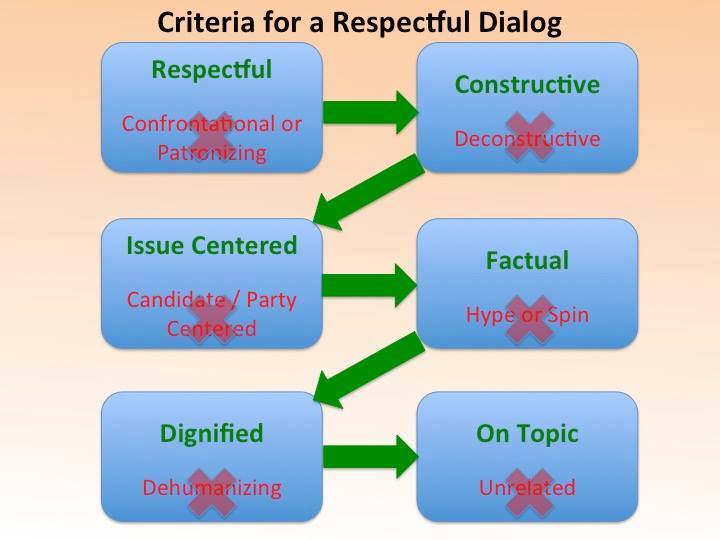
I welcome and enjoy hearing out viewpoints different from my own – and almost always learn something valuable from such discussions. But, abusive speech is never acceptable, and won’t be tolerated. It’s how the views are being communicated that is the issue, not what is being communicated.

11027993_10153228240696773_4766521774461750123_nI spend much of my time writing or posting content on the internet that is intended to educate and inform, and to encourage discussion.  These discussions often manifest themselves in the form of comment-threads with a large number of participants.  (Sadly, most of the more interesting and productive discussions occur on my Facebook page, and so aren’t visible on my WordPress sites.  I wish there were a way to replicate comments between the two!)

Every so often (especially in response to my posts on more controversial topics), I will get a hoard of what I mentally label as “Whacko Conspiracy Theorists” making a rash of comments that have little to do with what is being said, and everything to do with how they feel about what they feel the topic should be: often hijacking what had (or could have) been a productive discussion.

Such comments are a quandary for me: Yes, I want to encourage discussion.  But it is clear that many of these “Whacko Conspiracy Theorists” have no interest whatsoever in learning anything, or in developing a common ground of understanding (and a possible basis for united action on the topic at hand).

So, how does one identify those who are really “Whacko” as opposed to those who merely hold views different from my own?  It is all too easy to label any who disagree with you as “Whacko” and move on – which is what many do on both sides of the fence.  But, this is not productive.  Responding to others’ nutty comments with your own favorite flavor of nuttiness does not help the situation: it does not encourage dialog, and does not do anything to develop a common understanding.  What’s more, when you dig under the covers, you often find significant areas of agreement in terms of identifying what the basic problem is.  The disagreement usually comes with ones’ preferred solution.  We cannot hear what those areas of agreement are if we stay focused only on our disagreements.

Continue reading “What is a “Respectful Dialog”?”

A Matter of Words – Losing a Customer and Opening a Conversation

As this St Louis Bookstore owner says, “Black Lives Matter does not mean White People are Bad. It never did. Saying someone matters does not mean that nobody else matters. It just says to someone who feels invisible, ‘I see you and I value you.'”

Political Correctness

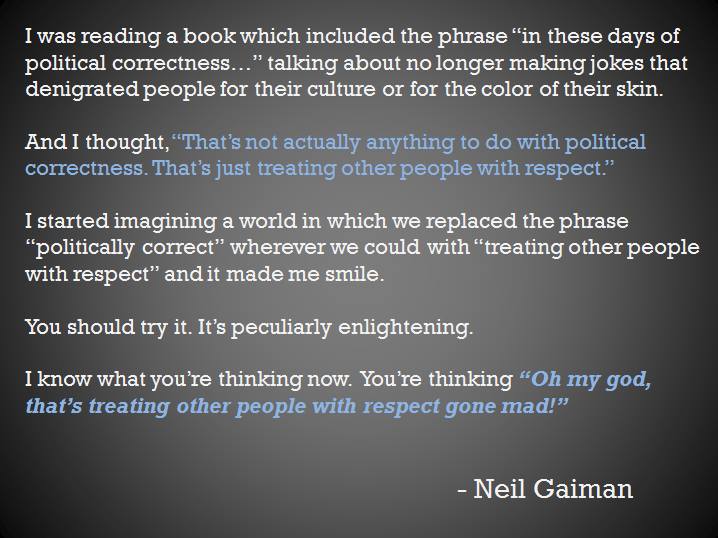
11836927_10153464980125629_6062162762026020487_nAs much as I admire and respect the work and words of Neil Gaiman, this meme that is said to be quoting him (I have not verified that this is the case) is half right.  It is only half right because there are two kinds of political correctness.

The first kind, “treating people with respect,” is a very worthwhile impetus: treating people in ways that demonstrate we truly value and respect them and what they have to say is something we should do all the time, regardless of who they are. I see this kind of “Political Correctness” as one important way of living Christ’s command to “love thy neighbor” in everyday life. So, in this light, Neil Gaiman is absolutely correct.

But then, there’s the second kind of “Political Correctness”…

Continue reading “Political Correctness”