Hell

A meditation written upon hearing of the shootings at the Pulse Nightclub in Orlando, Florida on the morning of June 12, 2016.

O God.

When we demonize others, when we condemn others for simply being who they are: seeing them as less then human, we create Hell here on earth; welcoming the demons of darkness and eternal fire into our own souls.

Hell is not some netherous place in the afterlife. Hell is right here, right now.

In Sandy Hook.

In Boulder.

In Oak Creek.

In Charleston.

In San Diego.

In Chicago.

Paris. Tel Aviv. Deir El Zour.

And now, in Orlando.

Hell takes root when we believe the threat of deadly force is our first defense against the transgressions, or faults, of those around us.

Hell thrives when we encourage violence or injustice against another for simply being “Other” than we.

Hell cannot die if we do not accept that the presence of evil in this world depends upon our own sin, not upon the sins of others.

Hell is in every city and town. Hell is in every one of us.

And yet, our unconditionally loving God forgives the evil we create.

My prayer is that we learn to forgive in return: rejecting and healing ourselves from the Hell we’re creating for ourselves and others here on God’s Earth.

We free ourselves from Hell through embracing love, not hate.

– Pastor Allen


Copyright (c) 2016, Allen Vander Meulen III, all rights reserved. I’m happy to share my writings with you, as long as proper credit for my authorship is given. (e.g., via a credit that gives my full name and/or provides a link back to this site – or just email me and ask!)


Is It Justice When We Do It Too?

Is the use of another’s history of oppression and dispossession as a means of promoting a cause we hold dear, in opposition to the clearly unjust and hurtful stance of those we see as opposing us, just? Do two wrongs make a right?

13177104_1749008605318618_2504027135946281098_n
This meme makes a valid point, but the map itself inflates the facts quite a bit, and is problematic in other ways…
Large portions of the area shown here were never part of Mexico, and most were actually administered remotely with no actual Imperial Spanish (and in some places/times French) presence “on the ground,” and were ceded to the U.S. in the first few decades of the 19th century.
Even so, it is true that the Texas Revolution, the war of 1845, and the Gadsden purchase reduced the land area the nation of Mexico to less than half of the size it had at the time Mexico gained its independence from Spain in 1808.

Continue reading “Is It Justice When We Do It Too?”

When he became a she – walking in love

I just had to share this beautiful post, no additional commentary needed…

The other day, Zac and I went into a retail store and were greeted by an associate. I soon recognized the associate as someone I used to go to church with years ago. Someone close to my age, who I …

Source: When he became a she – walking in love

On Restrooms, Gender, and Fear

I’ve met Rev. Heath only briefly, but her spouse was a classmate of mine in Seminary.  She is far from the only trans or gender non-conforming person I know; and they all relate the same narrative that Emily gives voice to here: “I’m telling you that no trans or gender non-conforming person wants to use the bathroom for any other reason than you do. I’m telling you that this has never been about sexual predators (who don’t need bathrooms to hurt people, and who won’t be discouraged by an anti-trans bathroom law), but about harming trans people. I’m telling you that I’d like to spend a whole lot less time thinking about bathrooms than I do.”

If we are serious about our Christian faith, then we need to ask – FIRST – how our attitudes to others express the love that Christ mandates – MANDATES (via the Second Great Commandment) – that we show in all our dealings them, and that we do so without condition or exception.

And, will they see that love in how we are acting and speaking towards them?  If they don’t, then we are failing to love them as we are required to do by the most basic tenets of our faith.

The anti-LGBTQ laws recently passed in NC and elsewhere do not pass this test.  And so, we must seriously and deeply re-examine our own motivations and faith principles if we believe this was the Christian thing to do.

Source: On Restrooms, Gender, and Fear

Compassion and Leadership

It is clear from his interactions with these students that this is not simply a show for the cameras. The President is involved: asking these young scientists questions, encouraging them, and engaging in extended dialog with them; not allowing other (more “adult”) priorities to distract him.
Whether we agree with his policies and political stances or not; we must admire how, in so many ways, the President is constantly and concretely demonstrating how much he cares for people, all people.
Which of our current crop of Presidential candidates show that they care?
Do we really want our next President to be someone determined to destroy people’s lives through deportations, carpet bombing, or draconian social and economic policies?  If a candidate demonstrates a complete lack of compassion for so many whom we see as “other,” can we reasonably expect them to concern themselves at all for how their leadership will impact us?
Our faith – and in fact every Faith – begins with compassion and love. If these things are not present in the words and deeds of a prospective leader, then they have no business being in the business of caring for this nation.
– Allen
Copyright (c) 2016, Allen Vander Meulen III, all rights reserved.  I’m happy to share my writings with you, as long as proper credit for my authorship is given. (e.g., via a credit that gives my full name and/or provides a link back to this site – or just email me and ask!)

Righting a Wrong

The administrators of Catholic Memorial High School are correct: Corporate Responsibility teaches us that we must all bear responsibility when some in our community commit verbal or physical violence against “The Other.” But, we must also remember that using it as an excuse for violence and oppression of others is an evil lie: you cannot blame an entire population or community or religion or economic class for the (real or imagined) actions of a few.

20160356e4a1fec96cbWith regards to the recent furor in our local (Boston Area) news about how students from Catholic Memorial High School [CM] in West Roxbury, MA chanted “You killed Jesus” at a recent Basketball game against Newton North High School (NNHS, which has a large Jewish student population.  Both schools are within 5 miles of the graduate school were I received my Masters of Divinity, Andover Newton Theological School.)

I understand how many students at CM feel cheated because of the actions of a few dozen of their peers.  And some may feel that the slurs shouted at them by students from NNHS at that game were just cause for the hateful speech that was directed at them in return.

It appears that the school administration has made the hard decision of putting morality and repentance ahead of popularity or convenience. And, they are emphasizing corporate responsibility for what happened (which is also at the heart of the #BlackLivesMatter movement).  “Corporate responsibility” is the moral law that says we can’t escape responsibility for wrongs done against others by those who are part of our own community, even when we are not directly involved. (Sadly, based on the student Tweets quoted in this article, the school will be facing a tough challenge on teaching this to some of their students.)

I will be interested to see how this plays out in the weeks to come: the school administration has pledged to make a determined effort to educate their students more carefully and thoroughly with regards to the evils of anti-Judaism and other forms of exclusion of those who are “Other.” And, in addition to a ban on current students attending the championship game, they have already contacted both NNHS and the Anti Jewish Defamation League to make significant apologies and pledges to reform.

But I wonder, will this determination to right the wrong and to change one’s behavior for the better extend to the teachers and administration as well? The students did not do this in isolation; since, as already stated, the absence of personal responsibility for a wrong does not free anyone in that school from corporate responsibility.  It’s a hard lesson to learn.  I also wonder if the NNHS community, whose students shouted similar (though less incendiary) slurs at the CM students, are in need of learning a similar lesson for themselves.

And, I should add, the very idea that “Jews killed Jesus” is a serious misunderstanding of the Gospels, as Boston’s Cardinal O’Malley made clear in a speech at Temple Emmanuel here in the Boston area just the night before the game.  “Corporate Responsibility” does not lead us to conclude that all Jews must bear responsibility for the faults of a few in leadership positions in Jerusalem two thousand years ago, even if it really was exclusively their fault to begin with (which it wasn’t, if at all).

Corporate Responsibility is an important tool for repentance and healing, not an excuse for violence against “The Other”: using it as an excuse for violence and oppression against others is the evil lie that Donald Trump and others in the current Presidential Campaign are trumpeting every chance they get, but they are wrong: you cannot blame an entire population or community or religion or economic class for the (real or imagined) actions of a few.

Which brings to mind this thought: those who are advocating violence and oppression against others in this political campaign are part of our national “community” – even if we wish it were not so.   So, how do we repent or atone for the damage that is being done by them and those who support them; since they are Americans just like we are, and so we must acknowledge our Corporate Responsibility for their words and actions?


Hateful Speech vs. Hate Speech

U.S. Republican presidential candidate Donald Trump speaks at a campaign rally in Bloomington
Trump speaks at a campaign rally in Bloomington, Illinois, March 13, 2016. REUTERS/Jim Young

There are two things of note in a recent article in the the LA Times about Students successfully rallying to Stop Trump’s recent scheduled appearance at the University of Illinois in Chicago.

The first is regarding the angry assertions of Trump and his supporters that their rights to “Free Speech” were violated because the rally was shut down. (Which, by the way, is despite Trump stating at the time that he agreed the rally had to be cancelled because safety must come first.)

We need to remember that there is a difference between “Hateful Speech” or “Angry Speech” and “Hate Speech.”

I may see someone’s stances on various issues as “hateful”, but that is my own opinion, based on how I see that particular issue. And, it is the Other’s right to have that opinion, a right I will defend on their behalf even though I may strongly disagree with their position. The same goes for “Angry Speech”: Anger is a valid emotion, and must be given space to be expressed. That it is present in a dialog is important: the Other’s anger must be acknowledged and appreciated as real and important.

It is important for such speech to be heard, even if we disagree with it. It is part of the fabric of a healthy Democracy.

Continue reading “Hateful Speech vs. Hate Speech”

Unjust Justice or Just Injustice?

04xp-southcarolina-web-master675
A South Carolina high school teacher who says she was forced to resign after a student took her phone and circulated a nude picture of her has garnered the support of hundreds of students who signed a petition demanding she be reinstated. (NY Times, 3/3/2016)

This New York Times article raises a challenging question.

Absolutely the student did wrong, and should be made to face some sort of consequence for stealing his teacher’s smartphone and then accessing and distributing her personal [nude] photos on it. And, I agree that the school system was way out of line for condemning her, if [as it appears] they rushed to a judgment of her without simultaneously investigating and determining how to address the student’s actions.  (They’ve ducked the issue by saying his fate is being left up to Law Enforcement.)

The deeper question is this: how responsible is the content owner (the teacher) for creating and retaining such content, and then making it accessible – even if inadvertently or illicitly – by others?  Does an expectation of privacy prevail, as she claims?

Continue reading “Unjust Justice or Just Injustice?”

Blaming The Victim

Claiming that our Christian faith is strong is a lie unless we put into action our belief that this nation must embody Christian principles in the governance of its people. Providing subsidies to help those who do not have the resources to begin building a good life for themselves on their own is a good place to start. Likewise, those who claim that this is a “Christian Nation” are deluding themselves if they allow our leaders to ignore and even demonize those in need.

21sun1-superjumboIn a recent Op-Ed piece entitled “The Crisis of Minority Employment,” the New York Times Editors make it clear that  Congress’s abandonment of subsidized work programs for minorities is not only a threat to the economic viability of our cities, but is also shortsighted – sacrificing the long term economic and social wellbeing of a large segments of our population with the excuse that we can’t afford it.  “…Getting jobless young people into the world of work is valuable in itself. Work reduces alienation, gives people a stake in society and allows children in poor communities to absorb the ethic they need to be successful.”

And they are correct: by shutting down such programs, Congress is abandoning its responsibility to provide for the common good – of all, not just for some.

The common complaint we hear from many – both in and out of Congress – who reject the idea of providing help to the poor in any form is that all “they” want is a handout.  The thinking is that somehow (because of the stereotype we have created in our own minds that they are uneducated druggies and street criminals) minority youth do not deserve our help.

Continue reading “Blaming The Victim”

The Fiction of Binary Gender

If we are to treat persons we encounter who are not “fully male” or “fully female” (as we imagine they should be) with compassion and respect, then we must first understand and accept that our belief that anyone is either “fully male” or “fully female” is a mistaken social construct or assumption, not a concrete and unchanging reality.

Recently, Dr. Michelle A. Cretella, MD of the American College of Pediatricians wrote a letter to the organization “District 211 Parents for Privacy” (in Illinois).  That letter was published on the group’s Facebook page, and I include it here (click on the images below to read that letter):

Despite its name, the “American College of Pediatricians” is a small (<200 member) group that broke away from the 60,000 member American Academy of Pediatrics in 2002; and so is far from representative of the opinions of the Pediatric profession as a whole.

A key statement in Dr. Cretella’s letter is this: “No one is born transgender because no human being is born with an awareness of themselves of being male or female.

The latter half of this statement is true: we are not born with such an awareness, but to claim that we are not born transgender because we do not have this awareness is a fallacy – a conclusion drawn without evidence to support it.  One could just as easily say that we are born without a gender identity because we are not aware of it at birth, and we would be equally correct in saying so.

What IS true is that by the time a human being becomes aware of (or develops) a gender identity, let alone a sexual orientation, it is extraordinarily difficult to change, if it can be changed at all: research strongly indicates that it really cannot be changed; and has convincingly demonstrated that attempting to reorient someone in such a situation causes far more harm than good.

Dr. Cretella clearly agrees that we need to be extraordinarily careful in how we care for and raise children who appear to be transgender, which is correct.  However, she also believes that, ultimately, a “mismatch” between a child’s physical gender and their gender identity is a disorder, and that the way to resolve it is to make the gender identity conform to the physical gender – i.e., that physical gender trumps gender identity.

I know children who are transgender, and I see their parents anguishing over how to help their child deal with the many issues that arise because of it, and I see them having to defend their child when they are hurt by the unthinking and judgmental actions or words of others. It is not a path any parent, let alone their child, pursues willingly.  What is clear is that Dr. Cretella’s proposed solutions have done more harm than good in the past, and there is no reason to believe that will change.

What is being wrestled with by school systems and many other groups across this nation is not whether to promote a “gender-fluid ideology” or not, as Dr. Cretella claims.  There is no such ideology, unless one believes that our growing awareness that gender identity is not exclusively either female or male, and not in lockstep with physical gender, is an ideology.  Rather, the challenge is how to respond to this growing awareness that there is a spectrum of gender identity (just as there is a spectrum of physical gender, and a spectrum of sexual orientation) in a compassionate and respectful way.

If we are to treat persons we encounter who are not “fully male” or “fully female” (as we imagine they should be) with compassion and respect, then we must first understand and accept that our belief that anyone is either “fully male” or “fully female” is a mistaken social construct or assumption, not a concrete and unchanging reality.  Changing our own assumptions is where we must begin if we are to come to grips with this difficult and troubling challenge: changing “the other,” especially children who are struggling with their sexuality even before they are fully aware of what it is, is not an option.

Copyright (c) 2016, Allen Vander Meulen III, all rights reserved.  I’m happy to share my writings with you, as long as proper credit for my authorship is given. (e.g., via a credit that gives my full name and/or provides a link back to this site – or just email me and ask!)

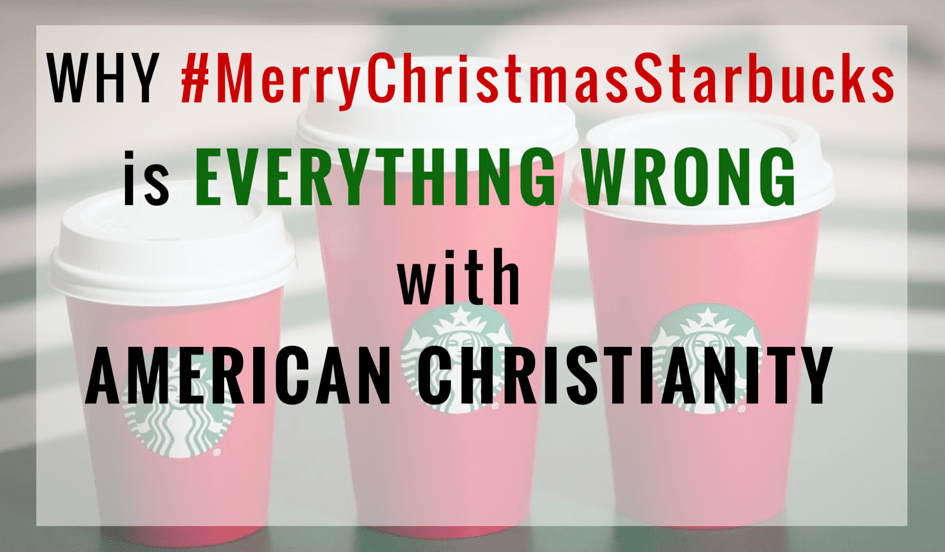
Why #MerryChristmasStarbucks is Everything Wrong with American Christianity

Mr. Lake is absolutely right. Even if the point being made had any validity (which it doesn’t), the “Merry Christmas Starbucks” furor is far more a statement of our inability to be welcoming and loving of all of our neighbors than it is a “defense” of our Faith.

And frankly, our God is a pretty big god. I’m certain that our infinite and omnipresent Creator is more than capable of handling any and all insults without our help. In fact, volunteering to defend our faith due to such perceived slights says far more about our own insecurities and our misunderstanding of the teachings of Matthew 22:37-40 than it does about the strength or quality of our faith.

Nate Lake's avatarNATE LAKE

#MerryChristmasStarbucks Blog Photo

A few days ago, former pastor Joshua Feuerstein posted a video announcing a campaign against Starbucks due to their switch from festive holiday cups in previous years to a new plain red look for the 2015 holiday season. In the video, Feuerstein claims that Starbucks wanted to “take Christ and Christmas off of their brand new cups” because, according to the caption on his video, “they hate Jesus.”

Feuerstein goes on to explain that when he visited a Starbucks store, he told the employee making his drink that his name was “Merry Christmas” so that his cup would read “Merry Christmas.” He later says “Guess what, Starbucks? Just to offend you, I made sure to wear my Jesus Christ shirt into your store, and, since you hate the 2nd Amendment, I even carried my gun!” Three days after the initial post of the video, it has over 130,000 likes and 380,000 shares. Feuerstein…

View original post 1,352 more words

A Progressive Defense of Tax Exempt Status for Churches

Rev. Dwight Welch is right on the money (sic) with this one. Yes, there are some “churches” and religious organizations that take advantage of the tax system to enrich themselves.

But most, even very large and well known conservative organizations (such as the one I once worked for), are sincere in their goals, beliefs and desire to minister to the needs of others, no matter how distressing we may find their theology and public statements to be.

To remove the nonprofit status of religious organizations, as Rev. Welch points out, would be a disaster for most churches in this country.

To try and craft new regulations to weed out bad actors is probably not necessary, and would most likely create an even more difficult regulatory landscape for both the public and for those tasked with enforcing such regulations already.

Such regulations already exist. What is needed is the ability (and will) to enforce them – which may well require rethinking our tax enforcement mechanisms (not the laws themselves) to make them less susceptible to political pressure.

servetus's avatar

outdoorchurch

I’m a person on the left and I’m gay and thanks to marriage equality, I’m married too. I’m also clergy. And so my defense should make various sides of these issues unhappy. But since I see so many articles on the left that call for taxing the churches I thought it would be worth clearing up some misnomers.

A) “What is particularly egregious about the tax benefits going to religious organizations is that they receive these benefits, ostensibly, because they are charities.” No, they are receiving this tax benefit because they are a non profit. But looking at percentages won’t help get a full picture of the charitable support.

I served a church, First Congregational, in Sheridan WY. As a % of it’s budget, it is true that operating expenses took up the bulk of its financial resources. But it also houses the local soup kitchen, the only one…

View original post 1,098 more words