Leaping the Gap

I was sitting at my soundboard one day, running sound checks and preparing for worship, when a young woman, perhaps 16 years old, came in with her friends and sat down right in front me, such that I could plainly see what was printed on the back of her shirt in large white block letters: “I WASN’T EDUCATED IN NO F***ING WHITE MAN’S SCHOOL.” I was a bit shocked, as you might guess…

I’ve always been a strong proponent of equal rights and justice for all, but how that has been expressed changed radically one day in the fall of 1995, as a result of an encounter in an all-black church I was a member of at the time, and where I was the chief sound technician for the church’s worship services. …It was (and still is) a transformative moment for me…

I was sitting at my soundboard that morning, running sound checks and preparing for worship, when a young woman, perhaps 16 years old, came in with her friends and sat down right in front of my position in the church’s sanctuary, such that I could plainly see what was printed on the back of her shirt in large white block letters: “I WASN’T EDUCATED IN NO F***ING WHITE MAN’S SCHOOL.”  (Well, OK – I added the asterisks!)

Continue reading “Leaping the Gap”

Salvation Claimed

Presented at Sudbury Clergy Association’s Ecumenical Good Friday Service at the Martha Mary Chapel at the Historic Wayside Inn, Friday, March 29, 2013.
Scripture reading: John 19:31-42

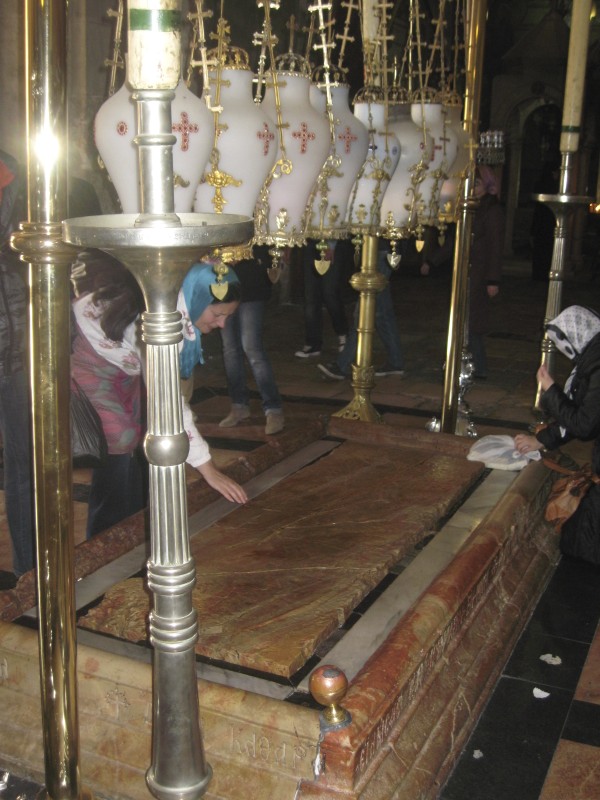
Seeing this Cross laid out here behind me, I am reminded of my visit last year to the Church of the Holy Sepulcher in Jerusalem, the focal point of the events that take place in our reading from the Gospel of John, and the site of the central narrative of our faith, which we remember in this Good Friday service and on Easter: the story of Christ’s death and resurrection.

As you enter that Church, above and to your right, up a flight of stairs, is Calvary, the site of the Crucifixion.  To the left, what would be behind me and deeper into the church, is the tomb.  So, on one side is the place where our sin cost the life of our Savior; and on the other, the spot where he was resurrected by the Grace of God.  Man’s Sin sent him to his death, and God’s grace brought him back, but what ties the two together?  How do we bridge the gulf between man’s sin and God’s grace?

The Stone of Unction: the spot where Jesus' body was laid when first taken down from the Cross.  Church of the Holy Sepulcher, Jerusalem.
The Stone of Unction: the spot where Jesus’ body was laid when first taken down from the Cross. Church of the Holy Sepulcher, Jerusalem.

Continue reading “Salvation Claimed”

The Israeli Palestinian Conflict, A Call for Hope and Healing

Aziz is a warm, thoughtful, energetic man of peace whom I had the pleasure to get to know last year when I had the opportunity to tour Israel and Palestine (through a tourism company he helped establish named MEJDI), and hear the narratives of individuals on both sides of the wall that divides them, a wall not just of concrete and barbed wire, but a wall of shared misperception, mistrust, hate, pain and even greed.  If all that can be shared, why not also share healing and hope?

I urge you to read his words carefully and prayerfully, and hear the heart of a man who, even though a victim of great oppression and injustice in the land of his birth, loves all the peoples in that part of the world and earnestly desires peace and healing for those on both sides of the wall.

The Myth of Legislated Morality

Matthew 22:36-40 (NIV)

36 “Teacher, which is the greatest commandment in the Law?”
37 Jesus replied: “‘Love the Lord your God with all your heart and with all your soul and with all your mind.’ 38 This is the first and greatest commandment. 39 And the second is like it: ‘Love your neighbor as yourself.’ 40 All the Law and the Prophets hang on these two commandments.”

In my ten or so years as a Project Manager and Software Developer at the Mayo Clinic in Rochester, MN, I was frequently involved in discussions with physicians about what limits to incorporate into system designs.

Software development, and any sort of engineering or design for that matter, focuses to a large extent on limits.  We often needed to address questions like:

  • How large a number does this data field need to be able to store?
  • How wide should this column be on this report?
  • How flexible does this screen’s functionality need to be?

At Mayo, the underlying attitude was always “Limit our options and flexibility as little as possible.”  This was because physicians are dealing with people’s lives.  They absolutely do not want anything getting in the way of their ability to provide the best possible care for their patients. Is our “Great Physician,” Jesus, any different?

People constantly come to Doctors with all sorts of symptoms and issues that were well outside of what is expected, and so the tools they use in caring for those patients cannot limit their ability to provide the care that is needed.  Since we cannot accurately predict what situations the future will hold, we must provide tools that “flex” well in unexpected situations, and that do not needlessly place restraints on what can be done.

This same logic applies when talking about moral issues in everyday life, things like abortion, or gay marriage, or adoption across cultural or ethnic boundaries.  In all of these situations, people are involved.  Therefore, each such situation has its own unique circumstances.  Each one involves difficult, sometimes painful choices and adjustments.  Like a physician’s care of a patient, all of these situations involve decisions that these people will have to live with for the rest of their lives.  They are not choices that are made lightly.  Further, they are not choices made in isolation: the choice that is made impacts not only the person making it, but others as well, whether that is an unborn infant, or a same-sex partner, or a child who needs a family.  Their choices also impact and involve the “community” of which they are a part – family, friends, co-workers, and so on.

Continue reading “The Myth of Legislated Morality”

The Third Commandment

I’ve been percolating on the third of the ten commandments [or second, depending on how you count] (Exodus 20:7) for a few weeks now.  Here it is in the King James Version, with which many of us are most familiar…

“Thou shalt not take the name of the Lord thy God in vain…”

And here is the same passage in the New Revised Standard Version, which I think evokes a broader and deeper understanding of the intent of the original text…

“You shall not make wrongful use of the name of the LORD your God…”

What I find interesting about this passage is how we look at it.  Many of us (thanks to how King James presents it) see it as a prohibition against swearing with the name of God.  But really, that’s only a tiny part of it, as the Jews demonstrate with their avoidance of using the name of God at all.  (To the point where, for millennia now, no one has known how to say the Lord’s name in the original ancient Hebrew!)

The NRSV version helps us see some of the reason behind this Jewish interpretation of the third commandment: it’s not just about swearing, but that we are not to make wrongful use of it in any form or context.

Continue reading “The Third Commandment”

The Last Morsel

After service, during fellowship hour this past Sunday, I noted something I often see during any time when we share food and companionship – one last lonely little bite of food, sitting all by itself on a serving tray.

Now, I’m sure we’ve all seen this, often in the workplace: someone brings in some cake, or donuts, or some other treat.  Everyone digs in until there’s just one piece left.  Then eventually, half of that piece disappears, then half of that, then half of that, and this goes on and on until there’s such a tiny piece left that it is indistinguishable from the left over crumbs; or else the microscopic remnant finally turns stale and gets tossed out.

Why do we do this?  Why are we reluctant to take all of the last bit, even when the portion we take is so small that we can hardly taste it, and leave an equally small portion for the next person!?  It’s a very human thing to do, but also really kind of silly when you think about it.  And yet, we all do it.

Continue reading “The Last Morsel”

Remembering My Daughter

My daughter in late 2004

February 12th is both a happy and a sad day for me, happy in that it is the day I celebrate the birth of my daughter, but sad in remembering that our relationship has been sundered for well over 7-1/2 years now.  She has now been lost to me for nearly a third of her life.

Every parent constantly worries about their child – are they healthy, will they succeed in school, can they make the team…  I do too, but sadly, there is no feedback.  I have no way of knowing anything about the state of my daughter – where she is, what she’s doing, whether she’s healthy, happy, sad … anything.  All I know is that for some reason, a couple days after her mother and I split, all communication stopped.

Without communication, there cannot be relationship.  Without communication, there cannot be reconciliation.  Without communication, there cannot be healing.  And, in my case, without communication, I do not even know what caused this break, nor what I can do to resolve it.  It is a position of powerlessness.

Continue reading “Remembering My Daughter”

Spiritual But Not Religious

A fabulous reflection by Eric Hyde…

Eric Hyde's avatarEric Hyde's Blog

“I’m spiritual, not religious”

Spiritual no Religious 2I wish I had a back massage for every time I’ve heard this line. What gets me most is the presupposition it stems from, that “spiritual” is the assumed equivalent of “good” and “religious” is the assumed equivalent of “evil.” Who made up this language game?

Honestly, who decided that “spiritual” was a term that would be used to contradict religion and as evidence of personal enlightenment without further ado? And does anyone using the phrase ever stop to think what they actually mean by it? I think what is usually meant is that religion is man-made tradition, whereas spiritual is a phenomenon that happens on a personal level, free from all “man-madeness” and tradition, and thus… true?

My experience has been exactly the opposite. I spent the first 20 years of my journey in Christianity believing that I was spiritual and not religious, and I…

View original post 433 more words

An Expository Reading of Pilate’s Questioning of Jesus

Presented at Sudbury Memorial UCC Church, November 25, 2012
Scripture: John 18:33-37

Prologue…

Today we celebrate “Christ the King” or “The Reign of Christ” Sunday, the last Sunday of the Liturgical year, a time when we ponder the meaning of Christ’s Lordship here on earth, and in our lives.

In exploring this today, we will focus on the topic of Fact vs. Faith.  For us to allow the Son of God to have Lordship over our lives, then Christ must be real and tangible truth to us in some way.  But, what does that mean?  How do faith, fact and truth intersect?  How does the truth of Christ become reality in our lives?

In 1975, James Cone, a well known African American Theologian, got right to the heart of this issue when he wrote that “Jesus is Black.”  People were shocked by this, as you might imagine.  Many rejected the idea, others tried to understand it as a metaphor.  But Cone insisted, saying that his critics didn’t understand, the TRUTH is that for African Americans, Jesus is Black.  He must be, otherwise, Jesus is not talking to those of us who are African Americans, but only to those who are White.  In order for Jesus to speak to us, to really be what he says he is – God with Us – then, for Cone and many others, Jesus must be Black.  Otherwise, Jesus is not someone that Cone can relate to as a member of a race that has been oppressed and marginalized for centuries because of the color of their skin.

In hearing this, our reaction may be “But, that’s not the truth!”

Really?  How can we be sure?  …Does it matter?

Continue reading “An Expository Reading of Pilate’s Questioning of Jesus”

A Mite in The Emptiness

Presented at Sudbury Memorial Church, UCC, Nov 11, 2012
Scripture: Mark 12:38-13:2

There’s a tiny island about halfway up the western coast of Scotland.  It’s a small, desolate place: bare of trees, covered mostly with scrub and sand.  Ancient rises of eroded granite make up much of the island; covered with a few patches of grass, some flowers and one or two small streams.  Many years ago, I journeyed there, taking a ferry to the Island of Mull, then a long meandering bus ride along a single lane road, passing by empty hills and the occasional farm; and then – finally – a short boat ride to the Island of Iona.

I wandered there for a few hours, strolling out of the village, past the monastery and its ancient graveyard: broken and fallen stones marking the anonymous graves of ancient heroes, kings and saints.  I passed sheep grazing under the bright blue sky, then crossed the narrow island, arriving at an ancient stony hill overlooking a small beach that faced the vastness of the Ocean.

There I sat, meditating for a long while, remembering the monks who came there nearly 1500 years ago, and their long labor to bring the Gospel back to much of Europe.  Their labors ended what we now know as the “Dark Ages” that followed the collapse of the Roman Empire.  I thought of the many Scottish luminaries that history tells us are buried in the graveyard I’d passed, including Duncan and Macbeth.  I remembered reading about the monastery’s destruction by the Vikings; then it’s re-establishment in the 12th century, only to be abandoned again during the Reformation, and finally reborn in the 20th Century as a community dedicated to working for Peace and Justice.

I sat on that windswept hill, enveloped by the sound of the waves breaking on the shore, the smell of sea and flowers, the seabirds calling, the wind whispering among the sand and grass.  A sense of awe and majesty surrounded and filled me as I sat there, alone in that empty place, pondering my own uncertain future.

Continue reading “A Mite in The Emptiness”

The Great Escape

Presented at Sudbury (MA) Memorial Church, UCC on October 14, 2012.
Scriptures: Job 23:1-9, 16-17; Mark 10:17-31

A youtube video of the sermon…

The most painful day of my life was Friday, May 4th, 1991.  In the week leading up to that dark day, everything in my life had exploded – marriage, job, finances – a perfect storm.  I felt the only way out was to escape from it all, I needed peace, I needed help.

So, I bundled myself and my then two year old daughter into my car, to escape for a time to safety in Chicago and figure out what to do. As I drove along, the darkness and turmoil within me was echoed by the magnificent, terrible thunderhead I saw ahead of us as we descended down Minnesota’s bluffs to cross the Mississippi River. It was huge: threatening, dark, turbulent; yet before it was the most beautiful, intense, double rainbow I’d ever seen: brilliant against the angry blackness ahead as the late afternoon sun sank behind us.

We caught up with that storm just after the sun set, and it was the worst storm I’ve ever experienced. Rain was coming down so hard that my windshield wipers were bending under the force of the water. I crept along the highway, my headlights struggling to pierce the stormy darkness, hoping to find refuge, somewhere.  But we were alone: no one else was challenging the storm that night.

Continue reading “The Great Escape”

Unexpected Faith

Presented at First Baptist Church, Belmont, MA; June 17, 2012.

Scriptures:
2nd Corinthians 5:6-17 (We walk by faith, not by sight…)
Mark 4:26-34 (The Parable of the Seed that Grows of Itself and the Parable of the Mustard Seed)

How many of you are familiar with the Garlic Mustard plant?

It’s a common weed in this area.  If you crush its leaves, it smells like garlic; and it has a taste similar to that of mustard, hence it’s name.  In colonial times it was a common herb, since the colonists had no money to buy spices from overseas, such as pepper, even if they had access to them.  It was also very easy to grow.   …Perhaps a bit too easy.

Continue reading “Unexpected Faith”