A would-be historian turned IT Professional who responded to the call to the Ministry, and is deeply involved in community service and social justice for all. He is the proud father of a daughter and son, and enjoys life with his wife near Boston.
You can follow Pastor Allen on Facebook at https://www.facebook.com/PastorAllenV/.
The American Cemetery at Romagne-sous-Montfaucon, where many of the 26,000 Americans who died in the 47 day long Meuse-Argonne Offensive (at the end of WWI) are buried.
This week, 96 years ago, at the 11th hour of the 11th day of the 11th month, the conflict known as WWI ended when the Armistice went into effect – an event we now celebrate as “Veterans Day”.
I probably would not be writing this today if it weren’t for that Armistice.
My Grandfather was a soldier in France, a corporal, in the fall of 1918. Although he’d been in the military for some time (at first ill for several months with what may have been the infamous “Spanish Flu”, then in an artillery unit), his first taste of face to face combat with the enemy was set for a couple of days after that symbolic day that ended the war. He and a team of soldiers were to attack a German fortification (which he termed a “castle”) with the goal of diverting attention from the main attack elsewhere. In military terms, “divert” means “get shot at,” which is why he and his fellows called these teams “Suicide Squads.” The survival rate was typically under 5% – if they were doing their jobs right (and my grandfather never did anything “halfway” in his entire life).
He and his fellow soldiers in that squad survived only because the diplomats agreed to end the war at that symbolic time, and did not drag out negotiations for a couple of more days. If they’d delayed for only a day or two, I might never have existed.
It’s all so easy when no one challenges your views. No arguments, no wasted time or energy in the discussion of technicalities, no need to build consensus, no need to defend what you believe, no need to educate others who have differing opinions. No dissension! You have time to get things get done! And, in today’s world, with things moving so fast, especially when one or more crises are brewing (as always seems to be the case), it’s easy to not even listen for any dissension, and easy to justify squelching those who do question or challenge what we have to say.
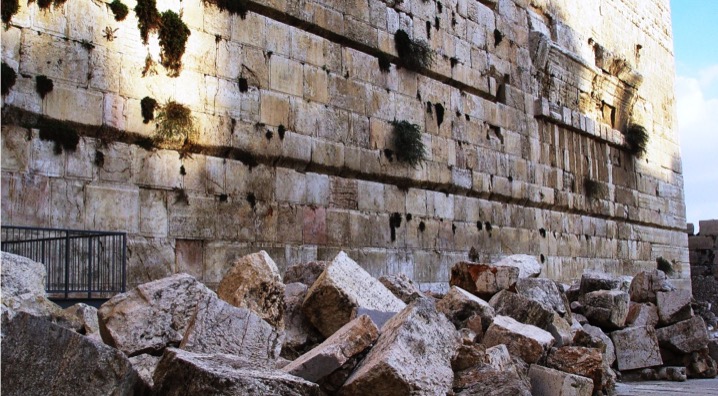
Stones at the base of the Temple Mount in Jerusalem: remnants of the destruction of Herod’s Temple in 70 AD.
In the early 1960’s, Paul T. Fuhrmann was a professor at Columbia Theological Seminary in Decatur, Georgia. He would often present the following list (which I’ve amended slightly) to students in his Church History courses, claiming it was from his grandmother…
Grannie’s Notion of Church History…
The ancient world was a desert, such a wilderness that not even a chicken could be found there.
In the year 1, a King James Bible in English, bound & printed in New York (by the American Bible Society) and sold at $1.00, falls to the ground in that desert.
The Apostles Peter, John, and Paul run to grab that Bible & organize the Primitive church, which was exactly like our church. Things were marvelous because the Apostles did things exactly as we do.
In the year 100 the Devil came in and upset and corrupted everything, then went on to set up the Pope and later (much later) the Tea Party. The Pope plays all sorts of dirty tricks to make money. The Tea Party spends all sorts of money to play dirty tricks.
In 1520, Martin Luther finds a Bible in chains, translates it, and the Bible spreads like butter on bread. In his barn in Rome, the Pope gets mad and swears to get even.
In 1536, John Calvin comes in and organizes the UCC. Since he was intelligent, he must have thought exactly as we do in everything, and so did everything just as we do. The evidence of this is found in his two volumes of Institutes.
Please join me in prayer…
Lord, let it be your voice that speaks through my mouth, and let our hearts and minds be open and receptive to hearing the Word you have for us here, today. Amen.
It’s all so easy when no one challenges your views. No arguments, no wasted time or energy in the discussion of technicalities, no need to build consensus, no need to defend what you believe, no need to educate others who have differing opinions. No dissension! You have time to get things get done! And, in today’s world, with things moving so fast, especially when one or more crises are brewing (as always seems to be the case), it’s easy to not even listen for any dissension, and easy to justify squelching those who do question or challenge what we have to say.
Unlike the King James Version, the New Revised Standard Version of the Bible, which is less archaic and takes advantage of recent scholarship and knowledge of the best ancient texts we have, presents the second commandment as follows:
“You shall not make wrongful use of the name of the LORD your God…”
Like the King James, the NRSV still presents this commandment as a prohibition against swearing with the name of God. But the term “wrongful use” implies that there is more to this commandment than the common interpretation…
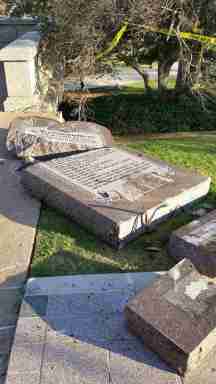
This morning, as I was eating breakfast and preparing leave for my drive here, I noticed an item in this morning’s news about a man who destroyed a controversial “Ten Commandments” memorial that was on public land in Oklahoma City. He smashed the memorial with his car, left the car there, walked into the nearby Federal Courthouse and surrendered himself, saying “The Devil made me do it.” The irony is wonderful, and dovetails so well with this morning’s message that I had to tell you about it and show you the photo of the destroyed monument. Notice that the break near the top of the stone runs right through the second commandment itself.
We have all learned to set and achieve goals for ourselves, and to own them. We learn to say “I did that” or “I own that” or “I am that.” We want to be (or have) the biggest, the best, or the fastest, and know how to achieve such things; and there is nothing wrong with this: it is part of our identity, one of the ways we define who we are to ourselves and to others.
But sometimes, we come to want something because in some way we think it will magnify or justify our identity, rather than just defining it. When that subtle line is crossed, a line we are rarely (if ever) aware of, we have begun making an idol of ourselves.
Scriptures: Exodus 32:7-14 (The Message): The Golden Calf Acts 16:11-15 (NRSV): Paul Establishes the Philippian Church Philippians 4:1-9 (NRSV): Paul Advises the Philippian Church
Podcast:
Note: This sermon was presented at the church where I serve is Minister. It is derived from last week’s sermon, which was given at my boyhood church, where I am from time to time invited to preach as a Pulpit Supply Minister: Centre Church in Brattleboro, VT. Both sermons in turn have their genesis in a sermon given while I was a Seminarian at First Congregational Church (UCC) in West Boylston, MA.” While this sermon is almost identical to last week’s sermon (and similar to the original from three years ago) there are some significant differences, partly due to my tailoring each message to address where each congregation was “at” at the time; and partly due to the evolution of my thinking and insights regarding the relevance and implications of the First Commandment for us in the modern world.
I’ve noticed that when young children play, it’s often about the process – or journey, if you will – not the goal. For instance, when my son builds a tower with blocks and it gets too high, he knocks it down and starts over, and over, and over.
Such play is not about being the biggest, nor the best, nor the tallest, nor any other measure of success. It’s about playing – about stacking blocks. That’s where the fun is, that’s what makes it valuable. What’s more, as parents, our judgment of the quality of the results is not important. …Well, at least not yet! – But our participation is.
A couple of years ago, we invited some of our friends and their toddlers over for dinner. Once everyone arrived, we all went into the room where the kids were playing, and … guess what … … … The Dads saw the kids playing with my son’s big cardboard blocks!
Well, as good fathers, we had to participate, didn’t we?
But our play was very different. We didn’t build towers just for the fun of building. Noooo… We had to build the BIGGEST tower. And, so we built a HUGE tower, nearly touching the ceiling, which in that room is quite high.
The Moms held the kids back from participating while we worked, saying they didn’t want them to topple the tower; but I think they were more afraid that someone would get trampled in all that furious activity.
When the tower was done, we took a few pictures, congratulated ourselves, and then the Moms let the kids go. … … A few seconds later, we had to act as human umbrellas to prevent our little ones from getting seriously bonked as that tower came tumbling down. Continue reading “The First Commandment”
One thing I’ve noticed about my son, like most young children, is that when he plays, it’s about the process – or journey, if you will – not the goal. For instance, when he’s building a tower with his blocks and it gets too high, he knocks them down and starts over again.
His play is not about being the biggest, nor the best, nor the tallest, nor any other human measure of success. It’s about playing – about stacking blocks. That’s where his fun is, that’s what makes it meaningful and valuable to him. What’s more, his parents’ judgment of the value of his work is not important. …Well, at least not yet! – But our participation in his play is important.
A couple of years ago we had a dinner for some of our friends and their toddlers at our home. Once everyone arrived, we all went into the room where the kids were playing, and … guess what … … … The Dads saw the kids playing with AJ’s big cardboard blocks!
Well, as good fathers, we had to participate, didn’t we?
Being Holy is not a goal, but a process, founded upon the unconditional and undying love we share with each other and with God. Being Holy is a gift freely given to all of us, together. It is not a prize for good behavior presented only to a select few.
The Labyrinth Floor of Amiens Cathedral
Sermon: “Being Holy”
Delivered at ARK Community Church, Dalton MA 13th Sunday after Pentecost: September 7, 2014.
Lord, let it be your voice that speaks through my mouth, and let our hearts be open and receptive to the Word you have for us here, today. Amen.
One afternoon, a few years ago, a good friend of mine was crossing the street on a marked crosswalk at a stoplight, when a well-dressed man in his brand new white Cadillac SUV zoomed through the red light without stopping as he made a right hand turn. He hit my friend, knocking him to the ground and leaving him dazed. The driver stopped, rolled down his window, cussed my friend out for getting in the way, and roared off, never to be seen again.
We could use this incident to launch into a discussion about social justice, highlighting how those with power and position are often arrogant and believe their position entitles them to special privileges and consideration. We could then contrast this with my friend’s situation: a man of great talent and a good heart, but who, through no fault of his own, has long lived in the margins of our economy. Then asking whether he is any less deserving of consideration or respect than the driver?
But Jesus teaches us to be more concerned with our own hearts than with the hearts of others, even the hearts of those who seem to be self centered, wealthy and reeking of a sense of entitlement. So let’s look instead at how this situation is illuminated by this morning’s readings.
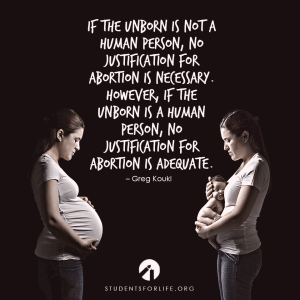
This poster featuring Mr. Kouki’s statement is extremely misleading: it assumes that the fetus is a being for whom all choices can be made independently of the mother, and ignores the fact that it is actually totally dependent upon its mother while still in the womb. It is another round in the effort to create a law that prohibits certain activities (abortion, in this case) as a way of settling a moral debate, even though history proves that such prohibitions are almost always ineffective, and often cause far more harm than good.
While I agree that abortion is not a step to be taken lightly (and hopefully, only extremely rarely); viewpoints such as that expressed in this poster are also a form of abortion, since they separate the child from its mother in another way – by declaring that the mother must be responsible for their child, but only as long as their decisions with regard to the child conform to the dictates of others. Think about it: this poster declares that it is absolutely acceptable to abort the mother’s life in favor of the child’s. Or, to put it another way, instead of the mother being allowed to decide whether to remove a fetus from within her body; the state feels it is justifiable to remove that same fetus from the control of the mother – while it is still in her body. (I’d also note that this notion, which is part of the the Tea Party’s stance on abortion is completely at odds with one of its most basic principles, which is that the government already intrudes too deeply into the lives of American citizens.)
Lord, let it be your voice that speaks through my mouth, and let our hearts be open and receptive to the Word you have for us here, today. Amen.
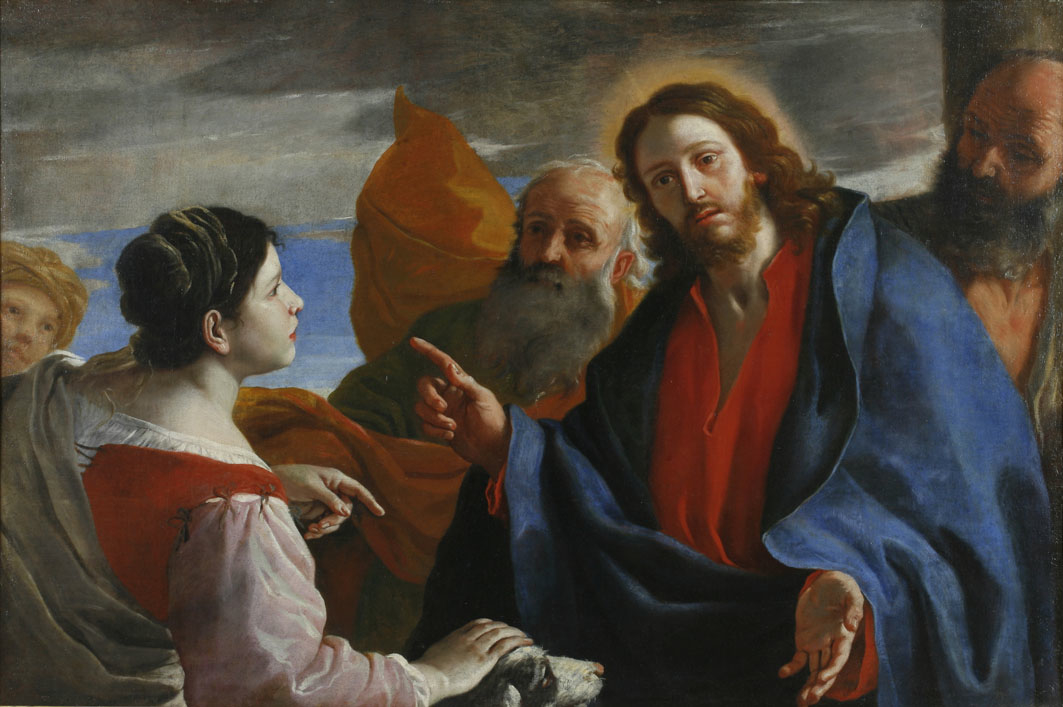
The story of the “Canaanite Woman” in this morning’s reading from Matthew 15, and also in Mark 7, is a narrative that crosses all sorts of boundaries.
To begin with, the setting isn’t located near any of our other stories about Jesus. Matthew tells us that Jesus has journeyed with his disciples to “Tyre and Sidon.” Doing so means he has left behind the familiar comforts and safety of his native land, moving across Israel’s frontier into the Gentile lands to the North. He’s in a new and strange place. But, is it strange for him, or strange for us?
I’ve long promised that I would eventually post here on the issue of suicide, and this seems to be the moment, as much as I dread doing so: it is a difficult challenge, one that must be approached with great care and compassion.
What impelled me to do so at this time is the death of Robin Williams, and my feelings with regards to a post about Williams’ suicide by Matt Walsh – another screed of his that I once again (almost) agree with.
In his post, Walsh discusses at length how painful suicide is, in so many ways, for those we leave behind: whether we realize it or not. As he and I both know all too well, there are always those who love you dearly, and who will always be haunted and who will always carry a deep, hidden hurt from the suicide of someone they love. He calls suicide a “selfish choice” and again – he is right, to some extent.
Frankly, there are far more survivors than you can possibly suspect of their own suicide attempt(s) or the suicide of someone close to them. I am certain that there are many people you know who carry this hidden pain, and who will move heaven and earth to keep another from experiencing what they’ve gone through – which means they will do everything they can to help you, once they know that you see your own death as the only way out of the deep pain and darkness that you feel you cannot escape.
But, Walsh is also wrong – suicide seems like a choice to those looking on from outside, but for those mired in making that choice, it is not a choice: it is an escape when one becomes convinced there are no other choices. It is a disease that deludes one into thinking that the only way out is to choose oblivion. It leads you to believe that no one else cares, or that no one else can help you.
Walsh’s thesis is – as he puts it – that in teaching kids about safe sex, “…we have taken the honesty, love, passion, beauty, and creative power out of the act, and replaced it with something sterile, guarded, frivolous, and disinterested.”
For Walsh, “safe sex” teaches kids that they must protect themselves as much as possible from the potential harm and dangers that can arise as a result of sexual contact. He feels this misses the entire point of sex, and turns it from a beautiful expression of vulnerability and mutuality into a sterile act that is little more than shared masturbation, as well as providing a false guarantee that it is possible to have sex safely. Continue reading “Safe Sex?”
We are those who followed Jesus and the Disciples out into that Wilderness: a wilderness in a country of Gentiles, a place where people have not yet heard or embraced the Gospel; and, a place where we will experience that renewal and that deepening of relationship with God we all need to fulfill the call upon our lives. So, why feed us bread and fish?
“The Miracle of the Bread and Fish” by Giovanni Lanfranco, 1620-23
Sermon: “Fish in the Wilderness” Delivered at ARK Community Church, Dalton MA 7th Sunday after Pentecost: August 3, 2014.
The “Feeding of the Five Thousand” is the only miraculous sign found in all four Gospels. What’s more, Mark and Matthew each have two variations, for a total of 6 versions in the Four Gospels.
Clearly, the early church saw this story as central to their faith, and therefore it is central to ours. Many ask “How did this Miracle come about?” And there are a number of explanations as to the “How” of this story. Some claim it is a true miracle, others say it isn’t, many say it doesn’t really matter whether it was a miracle or not.
But for me, the central question is not how (or if) this miracle happened, but “Why is it important?”
The marriage ceremony is a “passing of the torch” (through this ritual of vowing to love, honor and cherish) from one generation to the next. It reaffirms the importance of preserving those things that make our relationships with our spouses healthy, strong, and supportive. Marriage is a statement of our hope and determination to continue that chain of sharing, and the hope it represents, into the future – so that our spiritual (or physical) descendants will someday have their own opportunity to join with us in making the same affirmations. That said, it is important to recognize that as our culture changes, so too must our traditions. Therefore, no marriage tradition is so sacred that it can’t be rethought or even entirely omitted.
As a minister, I am (obviously) called on from time to time to officiate at weddings. In helping a couple plan their wedding and begin their new life together it is important to help them recognize that as our culture changes, so too must our traditions, if they are to remain relevant and meaningful. Therefore, no tradition is so sacred that it can’t be rethought or even entirely omitted.
Along these lines, the New York Times recently published an article entitled “What Wedding Traditions Should Be Tossed?” Which brought together the thoughts of a number of experts on various aspects of marriage and relationship. These authors’ suggestions are all worth considering when helping a couple work through their plans to marry – and for the ceremony itself. I thought I’d highlight some of the suggestions that I find most helpful in my role as the officiant and spiritual guide, and I’ve added a couple of additional suggestions of my own…









 The Here and the Hereafter