A would-be historian turned IT Professional who responded to the call to the Ministry, and is deeply involved in community service and social justice for all. He is the proud father of a daughter and son, and enjoys life with his wife near Boston.
You can follow Pastor Allen on Facebook at https://www.facebook.com/PastorAllenV/.
…when we walk out of this church, the question of whether we are going to face the issue of racism and race-based injustice is a choice we can make, because we are all white. And, unlike our black brethren, we can choose to forget about it. … King said “the time is always ripe to do right.” And so I say “yes, the time is always ripe; but are we willing to do right all the time?”
My self-image as a strong supporter of Civil Rights crashed in ruin one Sunday morning, in the Spring of 1996. At the time, I was a member of an African American church in Virginia, and their sound technician. (…But please don’t tell our worship team that!) That morning, as I was setting up, a young woman, maybe 16 years of age, came in with her friends, and sat down in front of me and my sound board. She then leaned forward in her chair, so that I could not miss what was printed on the back of her orange t-shirt in big block letters: “I WASN’T EDUCATED IN NO F***ING WHITE MAN’S SCHOOL”.
I must apologize for even hinting at such language here. But it is important for this morning’s message to give you a good sense of what that moment was like.
Obviously, this is not one of my lighter sermons. So, let’s take a moment to pray…
…the landscape is not as dark or cold or empty as we thought, because The Light is already here. We carry it with us wherever we go, and so it continues to beckon to all those who are wandering in the darkness – a beacon guiding the nations to a place of light and warmth, and the promise of an Epiphany of their own.
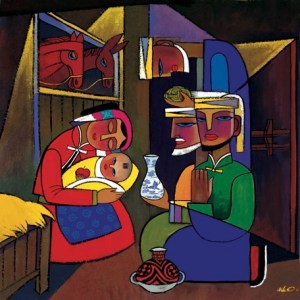
“The Magi” by Chinese Artist He Qi
When I was 12, my family moved from Vermont to Wyoming. As you might guess, it was quite a transition. Here I was: a New England boy used to rolling hills, abundant trees, air that was humid, and lots of little towns sharing borders with other little towns; but we were relocating to a sparsely inhabited desert plateau a mile and a half above sea level and surrounded by mountains – real mountains – not the green bumps we have here in New England.
I remember as we drove out, constantly quizzing my Father:
So Dad, we’re moving to Laramie, right?
Yes, son.
So, what other towns are around it?
There aren’t any. Rawlins is the next town up on the highway, on the other side of the Snowy Range, about 100 miles away.
Huh, but … what’s in between? There must be towns in between!
Nope, none.
Really? Well, but what’s in-between Rawlins and Laramie, then? There’s got to be something!
…The fact that every acre of land in the country wasn’t within some town’s boundaries, as is true here in New England, just did not compute for me. There was no such thing in my experience as a town that bordered on … nothing!
Lord, Advent and Christmas are a dark time for many, a time when the pain of past and present injuries and losses become almost unbearable. A time we’d rather not face all over again.
And yet, the purpose of Advent is to remind us of our brokenness and sin, of our need for the grace and healing touch of a God who loves us fiercely and compassionately. Further, Christmas teaches us that God knows our pain because God has lived it: walking among us as one of us, as a human being. Jesus experienced birth, the love of a devoted mother, the pain of losing those dear to him. He knew rejection, hunger, despair and fear. He was betrayed by those he loved, and he experienced a painful and humiliating death. God knows what it means to be human. God knows our deepest, greatest, most deeply hidden fears, failures and weaknesses.
And so, our faith tells us, Jesus is Emmanuel – the God who walks with us. God and the Kingdom of Heaven are near us at the hardest of moments, and for every moment of our lives, including now.
At the heart of the Annunciation is the declaration that God isn’t here just in the extraordinary times. God isn’t here just when we need divine providence. God loves us, and calls us, right here, right now, right where we’re at in our ordinary, everyday lives.
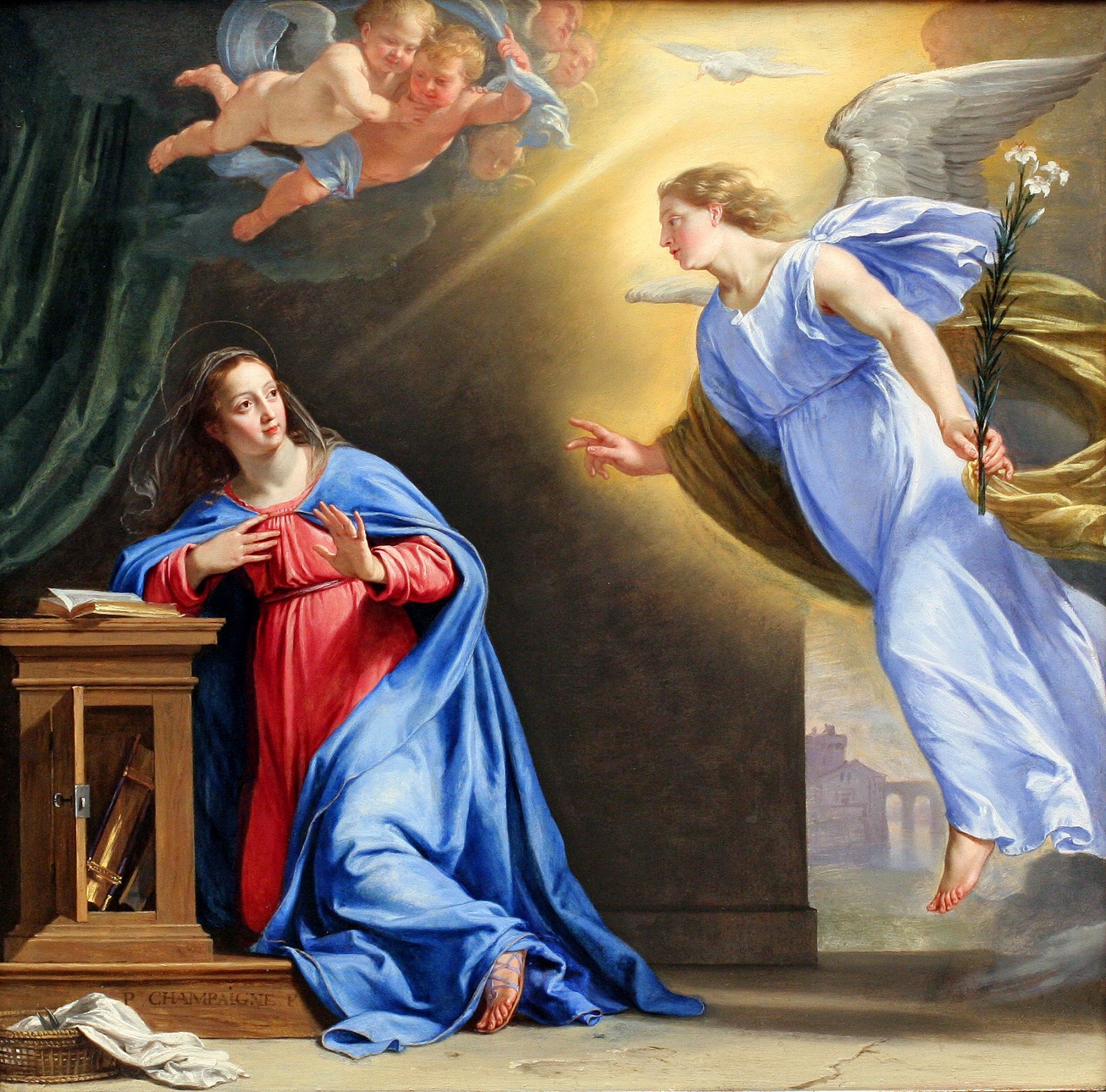
L’_Annonciation, Philippe de Champaigne (1644)
Sermon: “How Can This Be?”
Delivered at ARK Community Church, Dalton MA, December 21, 2014; (Fourth Sunday in Advent).
I’ve been considering Mary’s question in this morning’s reading from Luke, where Gabriel tells her that she will soon have a child, a son; that he’ll be a great King, and that he will sit on the throne of his ancestor, David.
Mary responds by asking “How can this be?”
As Christians, this is a question we often ask ourselves, or perhaps others ask of us: How can this be? It’s a question we ask about the birth of Christ, about why we believe, about why we find ourselves in various situations. And, as we read this passage in Luke, we see that a lot is wrapped up in this simple little question of Mary’s: How can a baby be born of a virgin? Why is God doing this? Why does it matter?
I begin by asking myself “what was Mary thinking when she asked this?” What I do know is that the common assumption, that she’s wondering how a virgin can give birth, is not what she is perplexed about.
This Christmas Eve, I thought it would be useful to share a simple thought: that God trusts us.
Orthodox Christianity is very explicit about this – God became incarnate and accessible to us through the birth of an infant human child.
Newborns can do nothing for themselves: they are vulnerable and rely totally upon those who love them for protection, for sustenance, and for life itself.
Jesus and the entire plan and hope represented by the Virgin Birth would never have come to fruition if his parents had not cared for him, fed him, educated him and loved him. If they had failed to do so, nothing else would have saved him, or us.
So, God became vulnerable to us through the birth of Christ. God trusted us to take care of the babe and so ensure the fulfillment of God’s plan.
In other words, God trusts humanity – for all its flaws and failings – to do the right thing, and to accomplish the mission. Even more importantly, God believes that you are ultimately good – because a creature that is inherently evil would never be entrusted with God’s child.
Therefore, God knows you are lovable. God values you. God believes in you, and is willing to risk everything based on that belief.
God trusts you…
Have a Blessed Christmas.
… And as my fellow North Central College Alum, Bruce Nesmith, said in response to these thoughts: “Maybe in 2015 we can trust our best selves more.”
Copyright (c) 2014, Allen Vander Meulen III, all rights reserved. I’m happy to share my writings with you, as long as proper credit for my authorship is given. (e.g., via a credit that gives my full name and/or provides a link back to this site – or just email me and ask!)
Third Isaiah is a text that deals with disappointment, of a restoration gone wrong, of a reality that does not match up with the image that hope had inspired in the minds of the people. They thought the future was here, but now realize it will take much longer to realize the vision. So, we are forced to admit, with disappointment and frustration, that the future is still not here, yet! We are also facing doubt and division over the way forward, and finding that our vision for the future does not match that of others. The future is much cloudier than we thought. Things are not going well, and we are struggling to figure out who is responsible for failing to implement the dream. We are coming to realize that bringing the dream into reality is far harder than we we ever imagined.
This week we will be celebrating the Third Sunday of Advent, known as Gaudete Sunday. Tradition tells us it is “…a day to be joyful even in the midst of long waiting and keen awareness of suffering.”
Advent begins with a focus on the future: “The reign of God is coming. Prepare!” And ends a little over a week from now with a focus on the past: “The Messiah is about to be born in Bethlehem. Rejoice!” Gaudete Sunday, the Third Sunday of Advent, is named using a Latin word meaning “to rejoice” in the imperative – meaning we are commanded to rejoice.
Last week’s reading from Isaiah 40:1-11 was the Second Isaiah’s comforting of Jerusalem because the restoration from exile of both God and the people was at hand. That morning’s sermon focused on the need to prepare in anticipation of that return, to reflect upon our own failings and sin, and admit to ourselves that we needed God to heal (or fill) the gaps and holes in our own lives.
This coming Sunday’s lectionary reading from the Hebrew Scriptures is from the third set of prophesies in the Hebrew Testament’s book of Isaiah: prophesies that mainly concern themselves with the situation in Jerusalem after the exiles have returned from the Babylonian exile. Just as the second set (chapters 40-54) are referred to as “Second Isaiah,” scholars refer to these writings (chapters 55 through 66) as “Third Isaiah.” Like the second set, those who compiled the Book of Isaiah felt it important to include the prophesies of “Third Isaiah,” along with those of “Second Isaiah” to follow the complete (three generation long) narrative arc of exile of Judah to Babylon: from the First Isaiah’s prophesies of future doom and destruction for Judah’s distancing itself from God; to Second Isaiah’s call for compassion and redemption in the present as the seemingly impossible dream of restoration comes to pass; to Third Isaiah’s focus on the disappointment, discord and disillusionment that followed the return of the exiles to Jerusalem a generation earlier.
The story of Advent follows a similar arc: our emphasis on the future declines as our emphasis on the past increases. Our readings for Advent begin with a mature Jesus teaching us about the reign of God, and they close with the unborn Christ Child in Mary’s womb.
This movement reflects our Christian understanding that the sacred story, to be understood fully and correctly, has to be told backwards. The birth and ministry of Jesus are incomprehensible until we know of his death and resurrection. To put it another way, our understanding of the past is muddled and incomplete until we grasp the nature of the future and purpose of History. Christianity sees History as having a definite start, a definite end, and that it reflects the plan and purpose of God, reaching its crescendo in Christ. In other words, while we have (incomplete) knowledge of the past and present, we cannot make sense of what we know of them until we know the whole story, including the end.
Advent encourages us to choose God BECAUSE of the facts, not in spite of them; and to remember that it is God who writes our story, a story that always ends in the embrace of God’s eternal, fierce, and unrelenting love for us.
Sermon: “Just the Facts”
Delivered at ARK Community Church, Dalton MA, December 7, 2014; (Second Sunday in Advent).
The year is about 540 BC. The place is Babylon, capitol of the Babylonian Empire.
Only a generation ago, in the year 587 BC, Nebuchadnezzar’s army destroyed the Nation of Judah, the City of Jerusalem, and Solomon’s Temple. Much of the surviving population, including most of the upper classes of Judah – priests, nobility, scholars and their families – are imprisoned and then exiled here, in an alien land totally unlike the isolated mountaintop fortress of Jerusalem. Their new home is perhaps the greatest city on earth, containing people of many cultures, languages and faiths. Strange people, strange ideas, and strange gods are all around them, challenging the Jews and their faith in ways they never imagined.
They are strangers in that strange land. The fact is, they have lost everything – friends, family, home, possessions, status, and even – or so they think – their God. And even if God is not lost, what good is God, since the strange gods of this strange land are clearly more powerful? And besides, how can they hear from God, even if God still lives? God’s home among them was destroyed, too.
The news from back home is just as troubling: the prophet Obadiah tells us that marauders and armies from nearby lands, such as Edom, are sweeping through the ruined land, murdering those left behind, and plundering what little of value remains.
The People of God see themselves as the walking dead, soon to forever vanish and be forgotten. All is darkness. All is lost. They are lost: whether they are scrabbling to survive among the ruins of Judah, or living in exile in the all too alluring and exciting materialism and corruption of cosmopolitan Babylon.
The facts are indisputable: the future holds no hope at all for them, nor for their faith.
In some ways (and perhaps oddly, for a Progressive Christian like me), I admire Joel Osteen. I like his preaching, even though I often disagree with his Theology, because he presents a clear and simple message that is grounded in God’s love.
This particular tweet of his is, however, a little bit problematic for me: mostly but not entirely because of Osteen’s main point, “choose faith over facts.” Even though this is, in fact, a theme that often appears in my own preaching and teaching, including my recent sermon entitled “Risky Business.”
But with regards to this tweet, the heart of my concern lies in how that statement is modified by the statements that precede it: “The facts may tell you one thing” and “God is not limited by facts.”
Back in the mid 1990’s I worked for a well known conservative Christian organization. All employees of that organization were periodically required to spend a day ministering to those in need, in various ways. My role in one of those efforts was to be part of a crew that distributed food to those in need.
One of the people that I encountered that day, a very slightly built black woman, lived several blocks away from the place where we were handing out our boxes of food. The box I gave her was very heavy, so I offered to help her carry it back to her home. She gratefully accepted. She said it was only a block or two, so I didn’t worry about telling anyone what I was doing, since I figured I’d be back in just a few minutes.
We chatted as we walked along, she was quite an interesting person – but as we went on, I steadily became more and more nervous, Here I was, getting further and further away from my team, several blocks, in fact, in the middle of a one of the worst neighborhoods in the Tidewater region of Virginia. I was the only white anywhere in sight, and a red head at that! I knew that no one would be looking out for me when it was time to pack up and head back. So, I was likely to be stranded if I didn’t get back soon. I felt conspicuous, I felt alone, and I was afraid.
I find the perspective of the author of the following article (that I’m reposting below) interesting and useful. It conforms to my own experience and observations during the two decades or so I spent in more conservative churches, including some very “Fundamentalist” congregations. Which is that yes: there is comfort and value in “knowing God” and coming to know the great Love God has for us, which many if not most such churches espouse.
But, if God is present and speaking in the present world, then God cannot be a static or unchanging God. Nothing else is – the very core of the nature of Creation is constant change and variety, an infinity of possibilities and realizations, each reflecting their own instantiation of some aspect of the nature of God.
So, if we claim that the Bible is in fact an inerrant, and direct (read: unchanging) revelation of God’s word that is without contradiction, then we must be careful to not assume that our own finite minds are capable of fully comprehending even a tiny portion of the infinitude of God that is the source of that document.
Many of us make this mistake, concluding that our current understanding is the only valid understanding of what our faith (or “The Truth,” whatever that means), and the Bible, is attempting to tell us.
When we do that, then we’ve set up our own perspective as an inerrant and unchanging standard for our faith. The result is that any possibility of coming closer to God is actually lost. What we believe now becomes the standard, and an idol. And, God’s voice becomes hard to discern, if not entirely silent – lost in the noise of our own selfishness and egocentricity.
God is still speaking. We are called to listen for God’s voice and be open to the power of change and growth that is always an inherent part of God’s Word., God is not only speaking to us directly, but also through everything, and everyone around us. No one has a monopoly on comprehension of God, and no one understands more than a tiny fraction of all that God is, or all that God says, to us.
In this article I am going to argue that Christian fundamentalism is not a faith position. The former Bishop of Edinburgh, Richard Holloway, declared, “the opposite of faith is not doubt, it is certainty.” As their language and actions show, fundamentalists are absolutely certain.
We have a risen Christ, unquestionable proofs, and, as if we needed it, God has thrown in a host of unarguable evidences all around us!
(Accelerated Christian Education Science 1096, p. 31)
Scriptures: Matthew 25:14-30The Parable of the Talents (The Voice Bible)
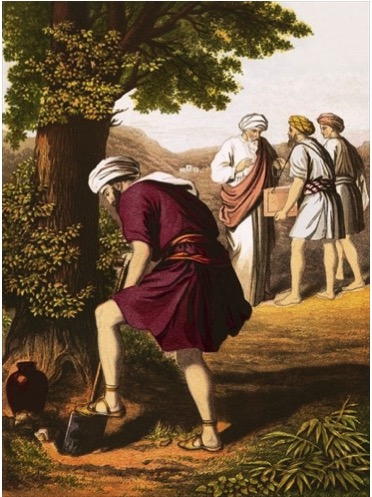
The Parable of the Talents in Matthew 25 has always left me a little uneasy. For one thing, parables, by intent, are meant to end with a question mark: leaving their audience with an anxious and counterintuitive decision that they would rather not face and can’t quite pin down. And yet, in this parable, the answer seems pretty clear – “Put our God-given talents to use.” In fact, this is so widely accepted that the word “Talent” itself came to be used in the English language as a reference to our God-given gifts because of this parable; transformed from its ancient use as a word for a standard measure of great wealth.
So, from that point alone, I am curious as to whether the traditional interpretation that we’ve probably all heard in many sermons is actually in line with the intent of Matthew’s Gospel, or Jesus’ intent, for that matter.
Increasing my unease is this: Jesus is the Social Revolutionary, constantly campaigning against the evils of privilege and position and power. And yet, in this story, the person who already holds position and power seems to be eager to acquire even more through the efforts of others, and engages with his servants in ways that would have been perceived by the original audience as unfair and dishonest.
But first, let’s look at the setting for this parable… It is part of a very clear and intentional sequence of events and teachings in Matthew’s narrative, all of which focus on the issue of the return of Christ.
The American Cemetery at Romagne-sous-Montfaucon, where many of the 26,000 Americans who died in the 47 day long Meuse-Argonne Offensive (at the end of WWI) are buried.
This week, 96 years ago, at the 11th hour of the 11th day of the 11th month, the conflict known as WWI ended when the Armistice went into effect – an event we now celebrate as “Veterans Day”.
I probably would not be writing this today if it weren’t for that Armistice.
My Grandfather was a soldier in France, a corporal, in the fall of 1918. Although he’d been in the military for some time (at first ill for several months with what may have been the infamous “Spanish Flu”, then in an artillery unit), his first taste of face to face combat with the enemy was set for a couple of days after that symbolic day that ended the war. He and a team of soldiers were to attack a German fortification (which he termed a “castle”) with the goal of diverting attention from the main attack elsewhere. In military terms, “divert” means “get shot at,” which is why he and his fellows called these teams “Suicide Squads.” The survival rate was typically under 5% – if they were doing their jobs right (and my grandfather never did anything “halfway” in his entire life).
He and his fellow soldiers in that squad survived only because the diplomats agreed to end the war at that symbolic time, and did not drag out negotiations for a couple of more days. If they’d delayed for only a day or two, I might never have existed.