Goodbye Mr. Boehner

We will always need a viable, strong and thoughtful opposition in Congress, one that acts as a counterbalance to the excesses that will inevitably come if the majority party feels no need to seek consensus with others as it implements its own agenda. Sadly, the GOP is a sycophantic caricature of the great institution it once was, and is unable to be such a voice; and it may never be again if it continues on its present path.

John BoehnerYou know, while I am sure it is no surprise to my readers that I don’t agree with the Conservative Agenda (as presently conceived), and have never felt that Rep. John Boehner was a very effective Speaker of the House, I also recognize that Boehner was in an extremely difficult position: trying to hold together an increasingly fractious, extremist, and polarized GOP while simultaneously trying to make some sort of progress on many important issues. Not an enviable position; and he did far better in that thankless situation than most anyone else would have.

So, rather than “piling on” and mocking or ridiculing him as he resigns from office and leaves Congress, I think it best to wish him well, and thank him for his dedication.

I do worry, though – Boehner is the latest casualty in the GOP’s race to marginalize itself ever further from the American mainstream, alienating itself from most groups within the electorate in ways that will take decades to recover from, if they ever do.

We will always need a viable, strong and thoughtful opposition in Congress, one that acts as a counterbalance to the excesses that will inevitably come if the majority party feels no need to seek consensus with others as it implements its own agenda. Sadly, the GOP is a sycophantic caricature of the great institution it once was, and is unable to be such a voice; and it may never be again if it continues on its present path.

With Boehner gone, the Republican Party may well descend into chaos for a time.  But whether it does or not, I worry about what the future will hold if they continue to reject the centrality of consensus-building within the political process.

Copyright (c) 2015, Allen Vander Meulen III, all rights reserved.  I’m happy to share my writings with you, as long as proper credit for my authorship is given. (e.g., via a credit that gives my full name and/or provides a link back to this site – or just email me and ask!)

Sermon: Covenant

A Covenant is not about rules but about relationship, to ensure that the relationship between the parties will be strong and will prosper over time. Any rules or guidelines in the covenant are to provide guidance on how to ensure this happens, and to protect the interests of both parties. But, if the situation changes (and it always does – as change is the only constant in this world) then, in the interest of preserving the relationship, it is understood that the rules will eventually need to be negotiated – and a new (or revised) Covenant agreed-upon.

This is (with some edits to include important points made in the audio) the draft version of the sermon I gave this past Sunday, when we joined together to “Re-Covenant” our ministries for the start of our Congregation’s “Program Year.”   I gave the actual sermon without reference to this draft (for the most part) – and, frankly doing so made for a message that was far better and more relevant than you will read here.  (That one should listen when the Holy Spirit stirs within you is a lesson I learned long ago.)

If you wish to hear the sermon as given, the audio can be found at the bottom of this page.  (I may someday update the draft to match the audio – in my copious spare time!)


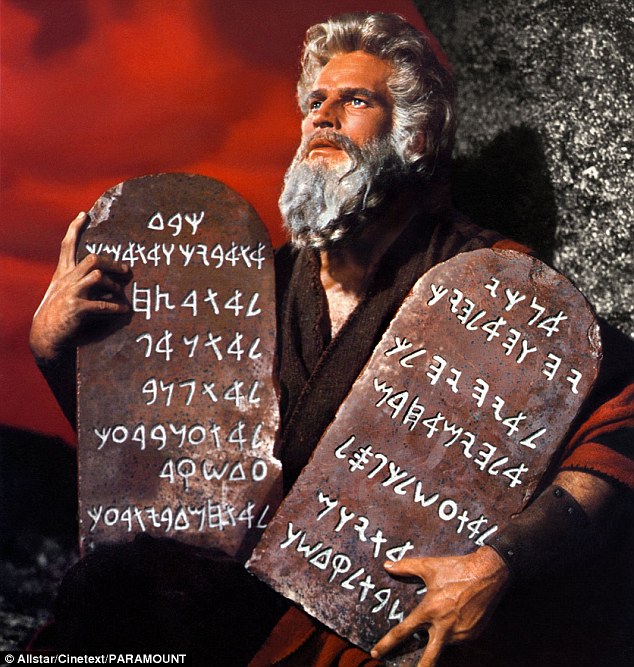
article-2544061-140565F4000005DC-472_634x667

Please join me in prayer…

Lord God, we lift up this morning’s lessons.  May they touch our hearts, and speak clearly to our souls, that we may come to more fully comprehend your eternal and undying love for us and for all of your Creation. Amen.

The year is 622 BCE.

Zoroaster, founder of the great Zoroastrian faith is a young boy in Persia. Lao Tse – founder of Taoism, and Confucius, and Buddha, all would be born within the next few years. Classical Greek Culture was just beginning its rise to dominance, and Rome was a small city under Etruscan domination.

In Israel young Josiah has been King of Judah for about 18 years. And, for the first time in generations, his Kingdom is not threatened by external aggression or domination. The Assyrian Empire that his Kingdom had long paid tribute to, and which had destroyed Samaria in Northern Israel just a century earlier, was disintegrating. Egypt was also recovering from Assyria’s domination, and Babylon had not yet laid claim to Assyria’s place as the dominant power in that part of the ancient world.

Josiah about 26 years old, and possibly exploiting the opportunities that arose from his Kingdom’s newfound independence, the Bible tells us he directed Hilkiah, the High Priest, to use Tax Money to renovate the long neglected Temple of Yahweh.

And Lo and Behold! As the renovation of the Temple began, Hikiah found a scroll hidden among the stones.

Continue reading “Sermon: Covenant”

The Thermian’s Dilemma, or Galaxy Quest as a Cautionary Tale About Fundamentalism

I agree with the author of this post: Literalism does diminish our faith, reducing its beauty and depth, making it less resilient in the face of adversity, and requiring one to ignore or gloss over anything that is contradictory – turning the faith into a pale and poor parody of itself.

The use of the great movie “Galaxy Quest” to illustrate this point is brilliant.

doylebw's avatarexpressionist coffee

tumblr_nox34umQs01r3oqygo6_1280I loved Galaxy Quest as soon as I saw it. As a fan of Star Trek in all of its incarnations (OK, maybe not Star Trek 5 so much), I recognize almost all of the players in the movie: the geeked-out fans, the trapped actors longing to move beyond their stereotypes, land the viewers of the movie who like science fiction because maybe, just maybe there really is something more out there than just what we know. But I’ve noticed that there is a moral to the tale of Galaxy Quest that lies underneath the trappings of its science fiction.

If you remember the story (and more pertinently if you don’t), the story is this: Galaxy Quest was a 1970’s TV show which is seen by an extraterrestrial race (the Thermians) who have no concept of fiction. As such, when they come under attack from General Sarris they see the…

View original post 1,169 more words

Sermon: Wisdom

Detail from the cover of “One Fish, Two Fish, Red Fish, Blue Fish” by Dr. Seuss

Two young fish were swimming along and happened to pass by an older fish. The older fish says “Morning, boys. How’s the water?” The two young fish swim on. Eventually, one of them looks over at the other and says “What the heck is water?”

Please join me in prayer… 

Lord God, we lift up this morning’s lessons.  May they touch our hearts, and speak clearly to our souls, that we may come to more fully comprehend your eternal and undying love for us and for all of your Creation. Amen.

This Sunday we consecrate our Christian Education Ministry’s programs for the year. So, it is fitting that our topic is Wisdom.

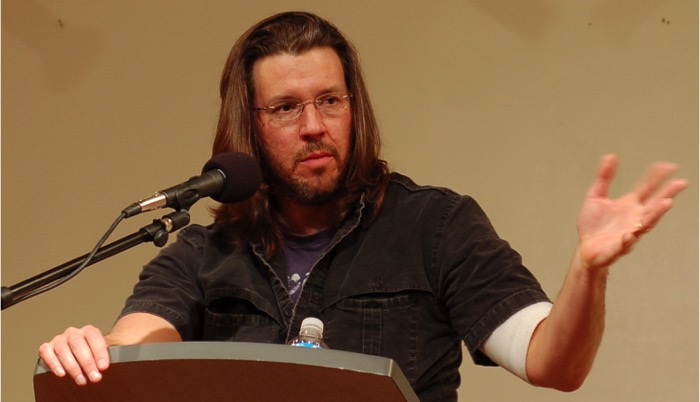
As I was preparing this message, I came across a Commencement Address by the late David Foster Wallace, given at Kenyon College in May of 2005.

Professor Wallace gave the fish story I related at the beginning of this message and then said its point “is merely that the most obvious, important realities are often the ones that are hardest to see and talk about.”

Dr. David Foster Wallace (1962-2008)

He then related another story:

Two guys are sitting in a bar in Alaska. One guy is religious, the other an Atheist. After a few beers, they begin to argue about the existence of God with great intensity. Finally the Atheist says: “Look, I have reasons for not believing in God. Just last month I got in a terrible blizzard. I was lost and couldn’t see a thing, and it was fifty below. So I fell to my knees and cried out ‘Oh, God, I’m lost in this blizzard, and I’m gonna die if you don’t help me.’”  

The religious guy gives the atheist a puzzled look: “Well, you must believe now. After all, here you are, alive.” The atheist rolls his eyes. “Nope, two Eskimos happened to wander by and showed me the way back to camp.”

The lesson here, Wallace points out, is just as obvious as that of the first story: the exact same experience can mean totally different things to different people, because their templates of how the world works are very different.

Google Glass
Google Glass

These “templates of meaning” are the maps we carry inside ourselves, the lens through which we see and interpret everything we experience.

This is an important point: all of our meaning-making depends on how we see and interpret what we witness in the world around us. Meaning and understanding are the result of interpretation. The teachings of our faith – teachings of any sort, in fact – are meaningless without interpretation. Interpretation is the process of taking our own observations or knowledge and making them real and relevant to ourselves or others.

Continue reading “Sermon: Wisdom”

Kim Davis and George Wallace

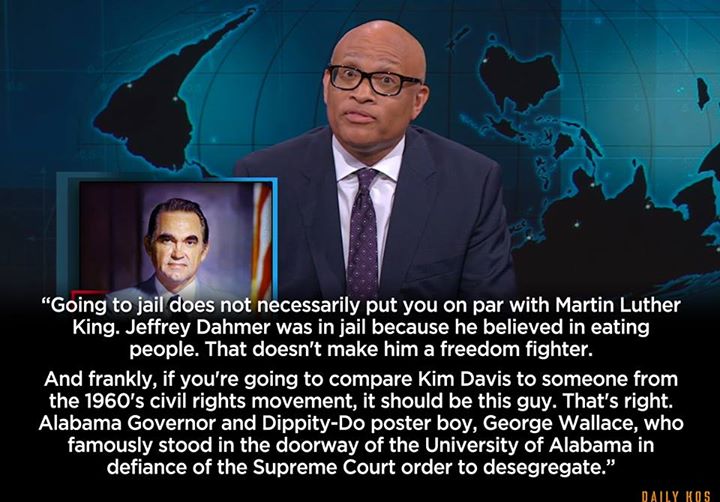
12002911_10153667860574255_5030704171055636376_nThe comparison made here to Jeffrey Dahmer is inappropriate and inflammatory in my mind, but one commenter on The Daily KOS’s Facebook post of this meme suggests that Davis is more like James Blake: the man who refused to drive the bus if Rosa Parks did not move- and who said of that event years later: “I wasn’t trying to do anything to that Parks woman except do my job. She was in violation of the city codes, so what was I supposed to do? That damn bus was full and she wouldn’t move back. I had my orders.”  He never repented, apparently.

According to the Wikipedia Bio of Gov. Wallace, what’s really interesting is that years later Wallace apologized to the Black Community, saying he was wrong to stand in that doorway to fight for segregation – that it had been born out of his lust for political power and influence, and that because of his conversion to Born Again Christianity later on (in the late 70’s), he now saw how wrong segregation is.

Continue reading “Kim Davis and George Wallace”

Kim Davis and the Storm of Hypocrisy that Surrounds Her

There is no need to sling mud at Ms. Davis – she’s no more flawed than any of us. There is no need to parade her in front of the cameras as a paragon of Christian Virtue – she isn’t, any more than we are. … We need to stop making her into something she is not. Instead, as Christians, we are called to hope and pray that she will come out of this experience without wrecking her life, and with a deeper and fuller appreciation of what her faith means to her, and how better to live her faith in compassion and love.

Kim-DavisBy now we’ve all heard about the Clerk of Rowan Country Kentucky, Kim Davis, who has refused to issue marriage licenses because she cannot in good conscience sign her name to a marriage license that, in her mind, violates God’s command that marriage is to be a heterosexual union between a man and a woman.

There has been a whole lot of very personal and nasty invective spewed in Ms. Davis’ direction because of this. Factually, most of it is true: she herself admits that her life was a mess until she began attending church about 4 and a half years ago. But does the fact that she has a checkered past matter?  No.  What matters is that she is a faithful person, trying to live out her faith as best she can. That needs to be respected.  We need to remember that digging up such old dirt to throw at another runs contrary to Jesus’ words in Matthew 7:3-5: “Why do you see the speck in your neighbour’s eye, but do not notice the log in your own eye? Or how can you say to your neighbour, ‘Let me take the speck out of your eye’, while the log is in your own eye? You hypocrite, first take the log out of your own eye, and then you will see clearly to take the speck out of your neighbour’s eye.”

Continue reading “Kim Davis and the Storm of Hypocrisy that Surrounds Her”

Making Guns our God

The discussion on gun control needs to be on where to draw the line – on what is in the best interests of society as a whole. Claiming that it is a matter of “personal rights guaranteed by the constitution” is a profound misunderstanding of the nature and purpose of a document that was intended from the start “to create a more perfect union” by delineating the boundaries between the responsibilities and rights of the State vs. those of the individual.

IOF-32-REV-1[Just a reminder to all: I make an effort to approve all comments regardless of the writer’s perspective.  But when it comes to contentious issues like this (where passions are strong), I recommend reviewing my comments policy before writing your response.]

I agree with the basic premise of author Mark Lockhard’s recent post on the Sojourners website entitled “Making Guns our God”:  Claiming that the best response to “the other’s” (real or imagined) possibility for violence is to have an equal or greater capacity for violence of your own is not in line with any flavor of Christian thought (thoughtless Christianity exempted). It is also futile and never ends well, as both history and recent news headlines have repeatedly shown.

But, I tend to be a bit more of a pragmatist, I think.  We will not and cannot eliminate guns from society, and while I will never own a gun myself, I realize that we as a society have to make room for those who like having and using guns for sport and personal enjoyment; as well as for those who hunt.

The gun debate is about where to draw the line when it comes to owning tools of violence. We don’t allow people to own all the atomic bombs, fighter jets, tanks, or grenade launchers they want to have – i.e., our laws already make it clear that people cannot arm themselves with whatever weapons they want. So, the claim that gun ownership must have no limits [whether based on a questionable reading of the 2nd amendment or not] is unreasonable, just as a complete ban on all gun ownership is equally unreasonable. The line is somewhere in between.

Continue reading “Making Guns our God”

Women Going Topless In Public???

I admire those who are pushing for equality in this area. It does make me feel uncomfortable, but that’s OK: change tends to make all of us uncomfortable. But we’ll survive, and we’ll adapt. Things will be just fine, and our society will once again prove itself to be much more resilient and adaptable and compassionate than we imagined.

topless_300This issue (as well as occasional pushes to legalize going entirely naked in public) has been in the news off and on for quite a while.

Now, intellectually, I recognize that going topless should not be an issue, regardless of gender, gender orientation or gender expression – and frankly, treating two groups of people differently because of something they have no control over always disturbs me: it just isn’t right.

On the other hand, this is a society that sexualizes women’s breasts; and – from an emotional perspective – the prudish old fogey in me recoils at the idea of actually seeing a woman’s bared breasts in public.

Continue reading “Women Going Topless In Public???”

Raising the Age of Social Security Eligibility?

We’re paying our Congressional Reps and Senators a handsome wage and even better health and retirement benefits to look out for us; so, it’s about time they got serious about doing the job we’re paying them to do, and fix this mess – so that we can have some modest assurance of financial stability in our retirements, too.

11885164_10154157348992908_2115962267242637017_nI agree with Bernie on most issues. Not quite so sure about this one.

There are really two gaps that need to be addressed:

First, Social Security in general is underfunded and additional revenues absolutely must be found if it is to remain solvent. The solution is clear and incontestable: raise the limits on how much of one’s income is subject to the Social Security tax; and perhaps even raise the rates, especially on those who have large incomes.

Second (and as is at the heart of this proposal) it has always been assumed that the taxes paid by workers retiring in the future would fund the Social Security benefits of those retiring now.  (Which further assumes that there will always be a significantly larger pool of those still working compared to those who are currently retired.)

Continue reading “Raising the Age of Social Security Eligibility?”

Islam’s Real Face to Me

Yes. I have a number of Muslim friends as well. Once we come to know “The Other”, we often realize that the Evil Caricature we’ve painted of them portrays not the Evil within them, but the Evil within us.

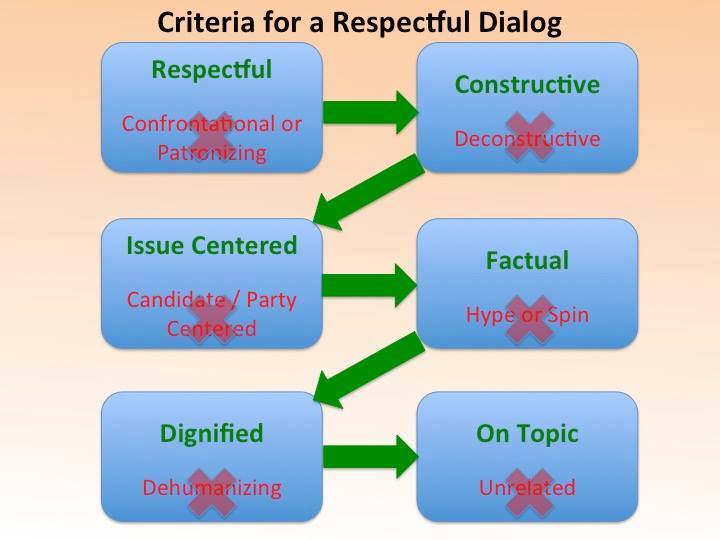
What is a “Respectful Dialog”?

I welcome and enjoy hearing out viewpoints different from my own – and almost always learn something valuable from such discussions. But, abusive speech is never acceptable, and won’t be tolerated. It’s how the views are being communicated that is the issue, not what is being communicated.

11027993_10153228240696773_4766521774461750123_nI spend much of my time writing or posting content on the internet that is intended to educate and inform, and to encourage discussion.  These discussions often manifest themselves in the form of comment-threads with a large number of participants.  (Sadly, most of the more interesting and productive discussions occur on my Facebook page, and so aren’t visible on my WordPress sites.  I wish there were a way to replicate comments between the two!)

Every so often (especially in response to my posts on more controversial topics), I will get a hoard of what I mentally label as “Whacko Conspiracy Theorists” making a rash of comments that have little to do with what is being said, and everything to do with how they feel about what they feel the topic should be: often hijacking what had (or could have) been a productive discussion.

Such comments are a quandary for me: Yes, I want to encourage discussion.  But it is clear that many of these “Whacko Conspiracy Theorists” have no interest whatsoever in learning anything, or in developing a common ground of understanding (and a possible basis for united action on the topic at hand).

So, how does one identify those who are really “Whacko” as opposed to those who merely hold views different from my own?  It is all too easy to label any who disagree with you as “Whacko” and move on – which is what many do on both sides of the fence.  But, this is not productive.  Responding to others’ nutty comments with your own favorite flavor of nuttiness does not help the situation: it does not encourage dialog, and does not do anything to develop a common understanding.  What’s more, when you dig under the covers, you often find significant areas of agreement in terms of identifying what the basic problem is.  The disagreement usually comes with ones’ preferred solution.  We cannot hear what those areas of agreement are if we stay focused only on our disagreements.

Continue reading “What is a “Respectful Dialog”?”

#BlackLivesMatter and The Legacy of Slavery

Much of what the “Black Lives Matter” movement is doing makes us uncomfortable, particularly those of us who are white. This is as it should be. If we’re comfortable where we are “at”, we won’t move, we won’t improve, we won’t change. If the injustices that exist are to be righted, we must be made uncomfortable. We must be made to see those things which are invisible to us because they’ve “always been that way” – working well for us, and so we ignore them or are unaware that they operate in our favor: that’s the very definition of “structural racism.” Yet, these same structural prejudices that are so deeply intertwined within our society and legal system do not work so favorably for others.

The first slaves arrive in Massachusetts on board the Desire, December 12, 1638.

We often forget that slavery was everywhere in the US until the early 1800’s, and it was no prettier in Massachusetts, New York, or New Hampshire than it was in Texas, Delaware, or Virginia.

Some of the best known Blacks in U.S. History – such as Sojourner Truth, William Still, and Lucy Terry Prince – were born into slavery in the North, or were transported here as slaves from Africa.  Many of our most famous native sons here in New England (such as John Winthrop, founder of the Massachusetts Bay Colony) sanctioned slavery.  Many of the wealthiest families of New England and New York in the 17th, 18th and 19th centuries built their fortunes upon the slave trade.  And, we forget that slavery was very much present in places like Massachusetts for over 150 years.  In fact, with the sole exception of Vermont, slavery was not abolished in any Northern State until after the American Revolution, and was not fully abolished from all Northern States until 1865.

Another aspect of oppressive systems, such as slavery – and like any institution or behavior deeply embedded in any society or organization – is that its effects persist long after people even remember that it was there. You see this in how some churches keep on “chewing up” new Ministers, in how corruption keeps on toppling one political figure after another in certain communities, or in why we here in America drive on the right hand side of the road, or why we set the table with the fork on the left.

Continue reading “#BlackLivesMatter and The Legacy of Slavery”