When he became a she – walking in love

I just had to share this beautiful post, no additional commentary needed…

The other day, Zac and I went into a retail store and were greeted by an associate. I soon recognized the associate as someone I used to go to church with years ago. Someone close to my age, who I …

Source: When he became a she – walking in love

On Restrooms, Gender, and Fear

I’ve met Rev. Heath only briefly, but her spouse was a classmate of mine in Seminary.  She is far from the only trans or gender non-conforming person I know; and they all relate the same narrative that Emily gives voice to here: “I’m telling you that no trans or gender non-conforming person wants to use the bathroom for any other reason than you do. I’m telling you that this has never been about sexual predators (who don’t need bathrooms to hurt people, and who won’t be discouraged by an anti-trans bathroom law), but about harming trans people. I’m telling you that I’d like to spend a whole lot less time thinking about bathrooms than I do.”

If we are serious about our Christian faith, then we need to ask – FIRST – how our attitudes to others express the love that Christ mandates – MANDATES (via the Second Great Commandment) – that we show in all our dealings them, and that we do so without condition or exception.

And, will they see that love in how we are acting and speaking towards them?  If they don’t, then we are failing to love them as we are required to do by the most basic tenets of our faith.

The anti-LGBTQ laws recently passed in NC and elsewhere do not pass this test.  And so, we must seriously and deeply re-examine our own motivations and faith principles if we believe this was the Christian thing to do.

Source: On Restrooms, Gender, and Fear

A Message for All Ages: “Glass of Water”

The challenges of life are like this glass of water. Carry them by yourself for only a short while and it’s not too bad. Worry about them a bit longer and they begin to hurt. And if we carry them all day long, or longer, we will get to the point where we think of nothing but the pain of holding them.

HoldingWaterGlass

Prop: a half full tumbler of water (needs to be clear glass – not a plastic or paper cup).  

If a younger child might be your volunteer, you may want to take steps in anticipation of a spill or the glass being dropped – such as a towel on the floor underneath to use in mopping up spills, and to serve as a soft landing spot.

You can begin the lesson by pointing out – in a humorous way – that this is not a lesson about “Is the glass half full, or half empty?”

Ask for a volunteer to come and hold the cup. Have them hold it at arm’s length, sideways to the audience if possible, so that the water level and any dip of the arm are plainly visible to the congregation.

Ask “How heavy is this glass of water?”

Continue reading “A Message for All Ages: “Glass of Water””

Our Many Judases

Christ gave us a new command: “Love each other deeply and fully. Remember the ways that I have loved you, and demonstrate your love for others in those same ways.” …In so doing we shall find that we are helping others to be healed as well, for that love is in them too; and even in our many Judases.

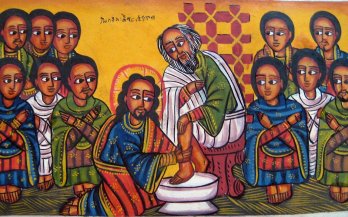
JesusWashingDisciplesFeet-EthiopianIcon
Ethiopian Icon of Jesus washing the disciple’s feet (artist & date unknown)

Monday (April 18th) was the 120th running of the Boston Marathon. And again we remember that moment during that race, three years ago, when the hate and anger that had been fanned to life within two young men exploded; forever altering or destroying the lives of many innocent and wonderful human beings.

We’ve seen people coming together in many ways to minister to those wounded, whether visibly or not, by this and so many other acts of inhumanity, both before and since that day. And, we’ve all seen those who were victims of such violence coming forward with their own stories, sharing them in many different ways, so that others who have suffered similar losses might find healing.

These outpourings of love, compassion and care reflect how Jesus calls upon us to love one another and minister to each other, especially in times if crisis, as we see in this morning’s scripture.  But, here in John 13, the disciples have not yet endured the tragedy that we know so well.

Continue reading “Our Many Judases”

Being “Family”

Alex, a UCC Minister (and onetime fellow student at Andover Newton Theological School), recently gave voice in his blog to some really excellent and cogent thoughts on the nature and ramifications of seeing our congregation(s) as “family.”  (That blog entry, entitled “The trouble with Being a ‘Church Family’ can be found here.)

And he is absolutely right: conceiving of our church as a family can exclude or intimidate many who are looking for (and need) acceptance and affirmation.  Acceptance into membership within a family can be difficult, it usually takes a long period of courtship or else birth (into the family) to achieve it.  Churches are no different, as we all know.  So, if Church is a family, says Alex, then it is a very different kind of family, one that is not insular, one that is not a closed system.

Now, I do envision church as a family, but a very different sort of family.  I see my congregation as being one local expression of the “Family of God” – which is a very large family, indeed!  …A family consisting of all of God’s people, and even of all creatures in God’s Creation- past, present and future.

In that light, the challenge in being a member of a “Church Family” is to recognize that anyone who walks through the door already is part of our family.  So, the challenge is not for the newcomer or outsider, but for us: one of how we are to affirm and embrace everyone as family from the moment we first encounter them. We certainly don’t want to overwhelm people the moment they walk through our doors, but we also don’t want to raise barriers that would frustrate them in their search for fellowship, or healing, or nourishment of their faith.

Ultimately, we are constantly always involved with one sort of family or another, usually more than one.  A Church can be one of those families.  As such, it is best to remember that in a healthy family, each member is celebrated and supported for who they are, not condemned for who they are not.  God loves each of us without exception or limitation;  and so we are called to love everyone else in turn, and without exception or limitation.

In the end, Alex and I both agree: we are all part of the same family, but it is a very different sort of family: one without boundaries or barriers to membership within it.

Amen.

Copyright (c) 2016, Allen Vander Meulen III, all rights reserved.  I’m happy to share my writings with you, as long as proper credit for my authorship is given. (e.g., via a credit that gives my full name and/or provides a link back to this site – or just email me and ask!)

Compassion and Leadership

It is clear from his interactions with these students that this is not simply a show for the cameras. The President is involved: asking these young scientists questions, encouraging them, and engaging in extended dialog with them; not allowing other (more “adult”) priorities to distract him.
Whether we agree with his policies and political stances or not; we must admire how, in so many ways, the President is constantly and concretely demonstrating how much he cares for people, all people.
Which of our current crop of Presidential candidates show that they care?
Do we really want our next President to be someone determined to destroy people’s lives through deportations, carpet bombing, or draconian social and economic policies?  If a candidate demonstrates a complete lack of compassion for so many whom we see as “other,” can we reasonably expect them to concern themselves at all for how their leadership will impact us?
Our faith – and in fact every Faith – begins with compassion and love. If these things are not present in the words and deeds of a prospective leader, then they have no business being in the business of caring for this nation.
– Allen
Copyright (c) 2016, Allen Vander Meulen III, all rights reserved.  I’m happy to share my writings with you, as long as proper credit for my authorship is given. (e.g., via a credit that gives my full name and/or provides a link back to this site – or just email me and ask!)

A Message for All Ages: “Blue”

In this message, I showed this two minute video: “Blue” by Tech Insider.

The video shows us that a word for the color “Blue” usually develops much later in most languages than do words for “Black,” “White,” “Red,” “Green” or “Yellow.”  So, the question is “Can people without a word for ‘Blue’ in their language actually see the color we know as ‘Blue’?”  The video answers this question by presenting convincing evidence that people have great difficulty in distinguishing Blue from other colors when they have no word for Blue in their language.

This suggests several things – any one of which would be sufficient for a brief “Message for All Ages” – pick the one that suits your situation best…

Continue reading “A Message for All Ages: “Blue””

Sermon: Feed My Sheep

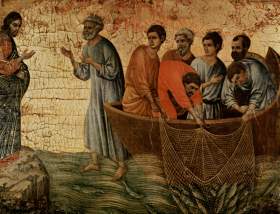
Duccio_di_Buoninsegna_015
“Appearance on Lake Tiberius” by Duccio di Buoninsegna, ca. 1308

The last chapter in the last of the four Gospels, the Gospel of John, is the final statement in the narratives of Jesus’ walk among us here on earth.  And as such, we can imagine that it has much to tell as we voyage forth into the world, leaving behind the physical presence of Jesus, just as a child ventures forth from home, eagerly heading to school on their own for the first time.

John is unique among the four Gospels.  It was written a few decades after the others and has a great deal of material not shared with the other three.  And unlike the so-called Synoptic Gospels of Matthew, Mark and Luke, John is very much focused on the future of the community of believers.

The 21st chapter focuses on our role as believers living and working in the world: Are we to be active or passive agents of the Body of Christ?  How will Christ be present in us in this role?  How will our own strength and faith be sustained as we do so?

Continue reading “Sermon: Feed My Sheep”

An Easter Sermon: A Sissified Jesus?

No, we (who are seen by some as “Liberal” Christians) do not believe in a sissified Jesus. We follow a Jesus who died for us. A Jesus who will never let us go, and a Jesus who loves us no matter what. That kind of love, that walks through any fire, endures any cross, is an uncompromising and fierce love. This is a Jesus who’s Gospel – in whatever form it may take – is for all, not just for some.

Kneeling at The CrossYou know, loving others is hard.

Loving those lost in grief or pain, loving those who have turned away from the world out of their illness or fear or abuse, is hard.

Loving those who are different from us; who’s ways are alien to us; who’s politics or faith, or piercings and tattoos, are offensive to us; is hard.

Loving people when they shout at you, when they refuse to hear what you have to say, when they call you ugly names, when they slander you and despise you and shut you down, is hard.

Loving those who abuse or oppress you, loving those who cannot or will not love you in return, loving others when you are in such pain yourself, loving those who are nailing you to a cross, is hard.

Continue reading “An Easter Sermon: A Sissified Jesus?”

Sermon: The Magic Messiah

Lent teaches us that the Kingdom of God is not a magical solution to all of the bad things we’ve had to endure. It will not take away our pains or erase our scars. The Kingdom of God is about Love, not hate. It is about healing, not magic; it is about conquering fear, not eliminating what spawned that fear within us. The Kingdom of God comes about after the death of all of our hope, and all of our fear. The Kingdom of God is realized only through our openness, brokenness, and repentance.

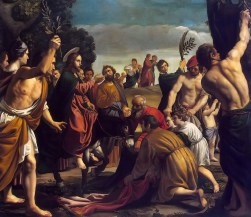
Entry Into Jerusalem by Pedro Orrente c. 1620

On Palm Sunday, we remember Jesus’ dramatic entry into Jerusalem: The Crowds celebrate his arrival, believing it heralds a new era for the people of Israel.   The Messiah has come, and will set everything right: the occupiers and their Empire will vanish; the evils and oppression they brought with them will be cleansed from the land. The incompetence and greed of Israel’s own leaders will be made as if it had never been, once David’s descendant, anointed by God himself, takes his rightful place on the throne.

Israel will regain its long lost greatness, and will indeed become greater than ever: a new Empire of God, with the Son of God himself as their King. The glory of the Temple and God’s renewed presence within it will shine forth to every nation and people in all the world, forevermore.  It’s all so beautiful, so wonderful, so magical: what a great thing to witness. What a great time to be alive.

But then it all comes crashing down. Now, just a few days later, Jesus and his disciples are hunted by the authorities: they know it is only a matter of time before Jesus, and maybe all of them, are arrested and maybe even executed.

The crowds are turning against this latest in a long string of disappointing Messiahs. They now see that the magic they’d seen in him has no substance or reality at all.   In the eyes of the people and their leaders, he is a fraud.

The magic is gone. The people feel that Jesus has betrayed them; and the disciples feel that God has betrayed them, and it seems like everyone has betrayed Jesus.

Continue reading “Sermon: The Magic Messiah”

Righting a Wrong

The administrators of Catholic Memorial High School are correct: Corporate Responsibility teaches us that we must all bear responsibility when some in our community commit verbal or physical violence against “The Other.” But, we must also remember that using it as an excuse for violence and oppression of others is an evil lie: you cannot blame an entire population or community or religion or economic class for the (real or imagined) actions of a few.

20160356e4a1fec96cbWith regards to the recent furor in our local (Boston Area) news about how students from Catholic Memorial High School [CM] in West Roxbury, MA chanted “You killed Jesus” at a recent Basketball game against Newton North High School (NNHS, which has a large Jewish student population.  Both schools are within 5 miles of the graduate school were I received my Masters of Divinity, Andover Newton Theological School.)

I understand how many students at CM feel cheated because of the actions of a few dozen of their peers.  And some may feel that the slurs shouted at them by students from NNHS at that game were just cause for the hateful speech that was directed at them in return.

It appears that the school administration has made the hard decision of putting morality and repentance ahead of popularity or convenience. And, they are emphasizing corporate responsibility for what happened (which is also at the heart of the #BlackLivesMatter movement).  “Corporate responsibility” is the moral law that says we can’t escape responsibility for wrongs done against others by those who are part of our own community, even when we are not directly involved. (Sadly, based on the student Tweets quoted in this article, the school will be facing a tough challenge on teaching this to some of their students.)

I will be interested to see how this plays out in the weeks to come: the school administration has pledged to make a determined effort to educate their students more carefully and thoroughly with regards to the evils of anti-Judaism and other forms of exclusion of those who are “Other.” And, in addition to a ban on current students attending the championship game, they have already contacted both NNHS and the Anti Jewish Defamation League to make significant apologies and pledges to reform.

But I wonder, will this determination to right the wrong and to change one’s behavior for the better extend to the teachers and administration as well? The students did not do this in isolation; since, as already stated, the absence of personal responsibility for a wrong does not free anyone in that school from corporate responsibility.  It’s a hard lesson to learn.  I also wonder if the NNHS community, whose students shouted similar (though less incendiary) slurs at the CM students, are in need of learning a similar lesson for themselves.

And, I should add, the very idea that “Jews killed Jesus” is a serious misunderstanding of the Gospels, as Boston’s Cardinal O’Malley made clear in a speech at Temple Emmanuel here in the Boston area just the night before the game.  “Corporate Responsibility” does not lead us to conclude that all Jews must bear responsibility for the faults of a few in leadership positions in Jerusalem two thousand years ago, even if it really was exclusively their fault to begin with (which it wasn’t, if at all).

Corporate Responsibility is an important tool for repentance and healing, not an excuse for violence against “The Other”: using it as an excuse for violence and oppression against others is the evil lie that Donald Trump and others in the current Presidential Campaign are trumpeting every chance they get, but they are wrong: you cannot blame an entire population or community or religion or economic class for the (real or imagined) actions of a few.

Which brings to mind this thought: those who are advocating violence and oppression against others in this political campaign are part of our national “community” – even if we wish it were not so.   So, how do we repent or atone for the damage that is being done by them and those who support them; since they are Americans just like we are, and so we must acknowledge our Corporate Responsibility for their words and actions?


Hateful Speech vs. Hate Speech

U.S. Republican presidential candidate Donald Trump speaks at a campaign rally in Bloomington
Trump speaks at a campaign rally in Bloomington, Illinois, March 13, 2016. REUTERS/Jim Young

There are two things of note in a recent article in the the LA Times about Students successfully rallying to Stop Trump’s recent scheduled appearance at the University of Illinois in Chicago.

The first is regarding the angry assertions of Trump and his supporters that their rights to “Free Speech” were violated because the rally was shut down. (Which, by the way, is despite Trump stating at the time that he agreed the rally had to be cancelled because safety must come first.)

We need to remember that there is a difference between “Hateful Speech” or “Angry Speech” and “Hate Speech.”

I may see someone’s stances on various issues as “hateful”, but that is my own opinion, based on how I see that particular issue. And, it is the Other’s right to have that opinion, a right I will defend on their behalf even though I may strongly disagree with their position. The same goes for “Angry Speech”: Anger is a valid emotion, and must be given space to be expressed. That it is present in a dialog is important: the Other’s anger must be acknowledged and appreciated as real and important.

It is important for such speech to be heard, even if we disagree with it. It is part of the fabric of a healthy Democracy.

Continue reading “Hateful Speech vs. Hate Speech”