
Please join me in prayer…
Lord God, may your peace and Holy Spirit fill this place. Open your scriptures to us, and may I clearly communicate that which you intend us to receive. May your Word take root and flourish within each and every one of us. Through it may we be strengthened and transformed by your unconditional, living, and limitless love for all of your Creation.
In Jesus Name, Amen.
Our journey through the Christian year often seems like a rush from one major event to the next, skipping over the smaller stories in-between. But then again, that’s the point of this summer’s series of sermons; such as this morning’s meditation on the story of Joseph of Arimathea.
Like Joseph and the others we’ve studied, there’s a whole chorus of us here at MCC – seen and unseen – whether officially members of this congregation or not – who make this service, this congregation, this community of Faith, and its many ministries and outreaches, part of our own stories. We are all part of that community. All of us make the Body of Christ a living reality. It works because of all of us.
There are no heroes here, nor in the stories we’ve studied. There is no one waving a magic wand to make it all happen. They and we are just one of a bunch of people working together to help all of us move along on our journeys of faith. And in that light, our subject this morning fascinates and inspires me for three reasons.
First, Joseph of Arimathea’s story, although brief, is unusual in that the Gospels all agree on the main points, and tell them in roughly the same order. That all four Gospels are so consistent in their telling of this story means it was a well-established and important tradition among the earliest Christians.
Second, even though every one of the Gospels mention him by name and describe him as a man of some influence, Joseph is not mentioned anywhere else in scripture. From our perspective, he does a deed often overlooked on our journey from the Cross to the Tomb, and then vanishes into the mists of history.
Joseph was a “secret” disciple at first; but his faith was no longer a secret afterwards. He gave up his anonymity, and risked his social and political status, to do what he was certain he had to do.
Finally, – well, I’ll get to that! I don’t want to give away the whole point of this sermon just yet!
Let’s take a moment to step back and look at the spot where this story takes place, in what is now Jerusalem’s Church of the in Holy Sepulcher.
As you enter, right there in front of you is a flat stone: big enough to hold a human body. Known as the Stone of Unction, the Stone of Anointing, it is said to be the spot where Joseph laid the body of Jesus to wash and anoint after he’d taken it down from the Cross.
The stone’s placement is very intentional. After encountering it, you go up the stairs to your right, to Golgotha, the site of the Crucifixion. Afterwards, coming down another staircase, you pass this stone – again – on your way to the tomb, off to the left. In following this path, we re-enact Jesus’ final journey, the last three of the Fourteen Stations of the Cross.
So, why? Why is this stone right in our face as we enter the church? Why do we and thousands of others each day pass it twice as we retrace Jesus’ final journey in life?
In other words, why is this stone, and Joseph of Arimathea’s kindness on behalf of a dead man, so important to our Faith?
Jesus’ ministry was brought to a harsh and bloody end by the Romans (with the collusion of Joseph’s fellow Council members). His body now hangs up there on the Cross: pierced, covered in bruises and blood. Dead. He’s beyond help, beyond saving, beyond caring for this world. His life and ministry are at an end.
Now, the Romans aren’t exactly known for their tenderness and compassion. But they had learned to take the Jews’ religious beliefs seriously. The Gospel of John says, “the Jews (probably meaning the Council) did not want the bodies [of Jesus and the two crucified with him] left on the cross during the Sabbath.” Where the bodies went wasn’t a concern. The demand was just to get them out of sight, there is no mention of a proper burial. Unseen meant problem solved.
The Gospels tell us the task to make sure they were dead and their bodies gone was assigned to Roman soldiers who – unsurprisingly – cared little for Jews, or for the task at hand. At best, they would have dumped the bodies in an unmarked grave. More likely they would have thrown them into a garbage pit a few yards away, in the Valley of Gehenna. The valley filled with trash and smoke that Jewish tradition equates with the Gates of Hell.
But as the sun sank towards the horizon that evening, a miracle happened. A miracle that occurred through the hands of Joseph of Arimathea. He wasn’t a hero. He didn’t intend to change the world. He just knew that Jesus, a man he loved and followed in secret, needed a proper burial. Joseph’s deed made it possible for all of us to become part of the miracle, too.
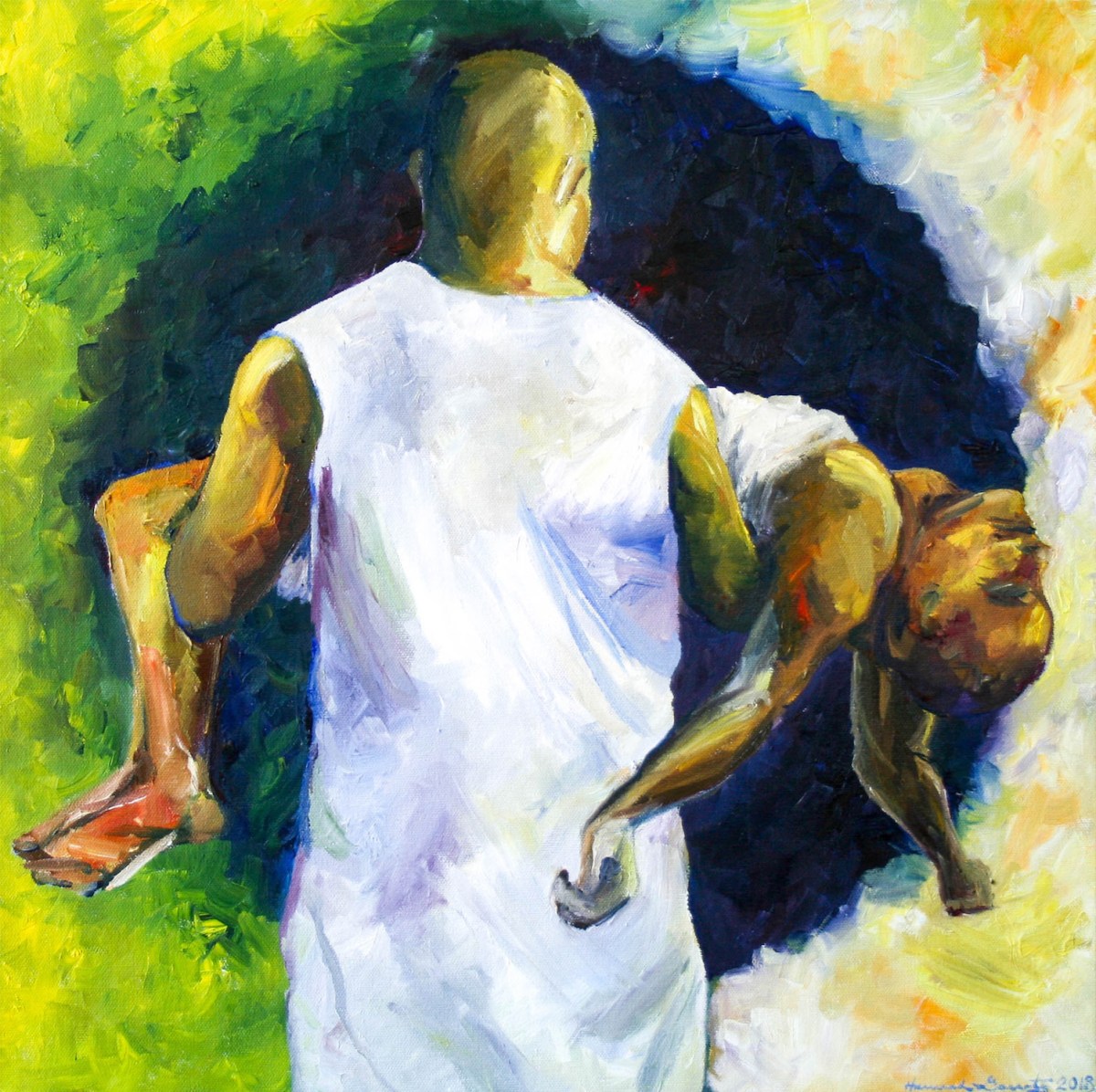
We celebrate the Cross and the Empty Tomb. But we forget that without living, loving human hands doing the work, Jesus couldn’t have journeyed past that stone a second time. He wouldn’t have had a tomb. The empty tomb is meaningless if Jesus was not placed there to begin with. We celebrate the empty tomb only because Joseph physically climbed up on that cross to remove that broken and lifeless body, care for it, and put him there – as this image shows him doing.
It wasn’t a Herculean task, but it was an unpleasant one, and probably a bit risky. Someone with the stature to gain an audience with the Roman Governor that same afternoon had to be willing to risk their reputation and status by asking for the body. They had to be willing to sacrifice, willing to place the needs of another ahead of their own. Joseph had to take Jesus’ teachings and make them a living reality for himself, and for Jesus, and for us. That was the miracle.
And that’s the third reason for why Joseph inspires me. His deed is a lesson for us all on what it means to have a living faith. He was the first. Like Joseph, we are called to see what others can’t see, or don’t want to see, and do what we can to help.
We aren’t called to change the world on our own. We aren’t heroes. But, we can provide food and shelter for those who have none. We can listen and be there for our neighbors when they are overwhelmed with fear or loss or loneliness. We can work with others to make a difference, however small. We can bring healing into broken hearts and minds with a kind word or an offer to help. We can’t change the world for everyone, but we can change the world for our neighbor. That’s all we’re called to do. The rest is in God’s hands.
It’s not easy. Joseph made the empty tomb possible, but he was also one of those who killed Jesus in the first place. He was a member of the council that convinced the Romans to murder Jesus on their behalf. He did not petition Pilate before Jesus was executed. Willing or not, he had blood on his hands even before he climbed up on that Cross. We all share the blame, the sin, for that failure: alongside Joseph.
But Jesus wasn’t a hero either, and he knew it. His disciples tried to make him into one, many still do. People like heroes. Heroes do mighty deeds that change the world. They rescue us from ourselves, or from what we call Acts of God. A hero makes for a good story, or marvelous movie. But having a hero means we are passive observers, sitting there in comfort, eating popcorn, and reaping the benefit of another’s efforts – at no cost to ourselves. A hero means that the responsibility for our salvation is on someone else’s shoulders. A hero means that there’s no point to our Faith. It would be a faith of fantasy, not reality. A faith that calls us to sit there, not challenging us to grow or to love.
Joseph knew this, and Jesus made it very clear. The time of simply hearing the Word ended with Jesus’ passing. It is now time to act. Joseph demonstrates what Jesus taught, that change and hope for change require our active participation.
We don’t know the outcome in advance – Joseph sure didn’t, but that doesn’t matter. What matters is having the willingness to do our bit. Jesus himself said the Way was narrow and steep, not an easy one to follow. Salvation is available to all, but is not a reward we get without effort or cost.
I see Joseph as the first to take that path – and risk. The first to publicly demonstrate that he was determined to continue to follow Jesus’ teachings, and no longer secretly. He didn’t make a big deal about what he’d done. He didn’t need to promote himself as a hero of humility and faith. He saw a need, and did what he could to meet it.
We aren’t called to do what we are incapable of doing. We aren’t called to ignore, or unsee, the needs of others. We aren’t called to give more than we can. But we are called to see the unseen. To share out of what we have in service to the needs of others. And through that, the Ministry of Christ continues because we are His Body now. Here, in the present, doing what he can no longer physically do himself.
In the closing verses of John, Christ asks three times whether Peter loves him. Each time, Peter responds, saying, “Yes Lord, you know I do.” But each time he said that, Jesus responded by telling – not asking – him to do something: “Feed my lambs. … Tend my Sheep. … Feed my sheep.”
The passage closes with Jesus saying “Follow Me.”
Following Christ requires action, not words. We are called to do as Joseph of Arimathea did: to see the need, and to do what we can to help our neighbor. It’s our job now.
Amen.
Scripture Readings:
John 19:39-42 The Burial of Jesus
John 21:15b-17, 19b Jesus questions Peter
Matthew 7:7-13 The Narrow Gate
Delivered at Memorial Congregational Church UCC in Sudbury MA, August 25th, 2024: (14th Sunday after Pentecost)
Copyright 2024, Allen Vander Meulen III, all rights reserved.
This work is licensed under a Creative Commons Attribution-NonCommercial 4.0 International License.

 The Here and the Hereafter