
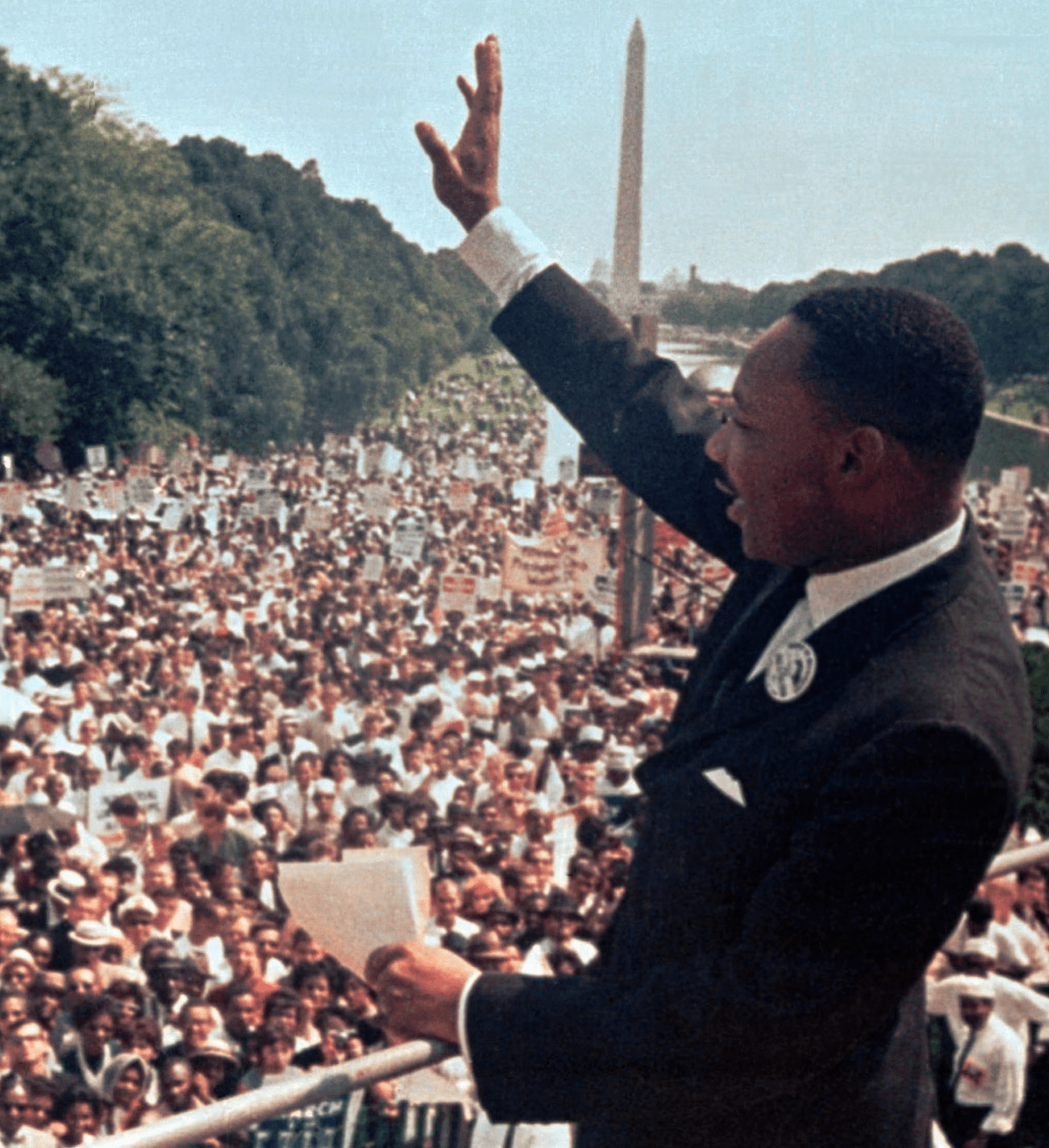
A Meditation on the “Great March on Washington” of August 28, 1963
Sermon Video:
Before I begin, I must thank Rev Gail Wright and her son, Peter Wright, for stepping in at the last minute once they knew of my need to isolate due to COVID exposure.
I particularly wish to thank the Rev. Sarah Hubbell: Last week, while describing my struggles and thoughts as I prepared for this service, I mentioned that I’d found the materials my Father had saved from his witnessing of Dr. Martin Luther King’s “I Have a Dream” speech at the finale of the Great March on Washington DC on August 28, 1963.
She pointed out that this month is the 60th Anniversary of that event. So, now you know how the theme of today’s service came about. The music, hymns, scripture readings, and sermon are all connected with the events of that day.

Please join me in prayer… … Lord God, may your peace and Holy Spirit fill this place. Open your scriptures to us, and may I clearly communicate that which you intend us to receive. May your Word take root and flourish within each and every one of us, and through it may we be strengthened and transformed by your unconditional, living, and limitless love for each and every one of your children. In Jesus Name, Amen.
My father was one of the 60,000 or so Whites who stood in solidarity with about 200,000 of our Black siblings that day.
Inspired by Sarah’s words, I thought I’d paint a picture of what this time meant to my family. I asked my mother for her 1963 Diary, so I could learn how this watershed event in American History impacted my parents. What she recorded for that week is that her in-laws were visiting, and my grandfather was quite grumpy the whole time.

40 years later, my father showed me the spot where he’d stood that hot, sunny, afternoon: 2/3rds of the way back on the left side of the reflecting pool, about where Dr. King’s coat-cuff touches the tree line in this photo. (When I mentioned this to Gail yesterday, she replied that being under Dr. King’s hand is a good place to be.)
In my father’s papers were several mementos of that day:

The first is a badge handed out to many of those who attended. Dr. King wore the same badge that day (minus the UCC ribbon). You can see it pinned to his lapel in many of the photos of him that day.
I also have the official brochure he received, which included the day’s program, instructions, and a set of images.

This cover letter is signed by the leaders of the March, including John Lewis and Dr. King. It describes the purpose of the images and the themes seen in each. Each of those themes is found in the excerpt from Dr. King’s speech that I read earlier [found at the bottom of this post]. I’ll run through them now.
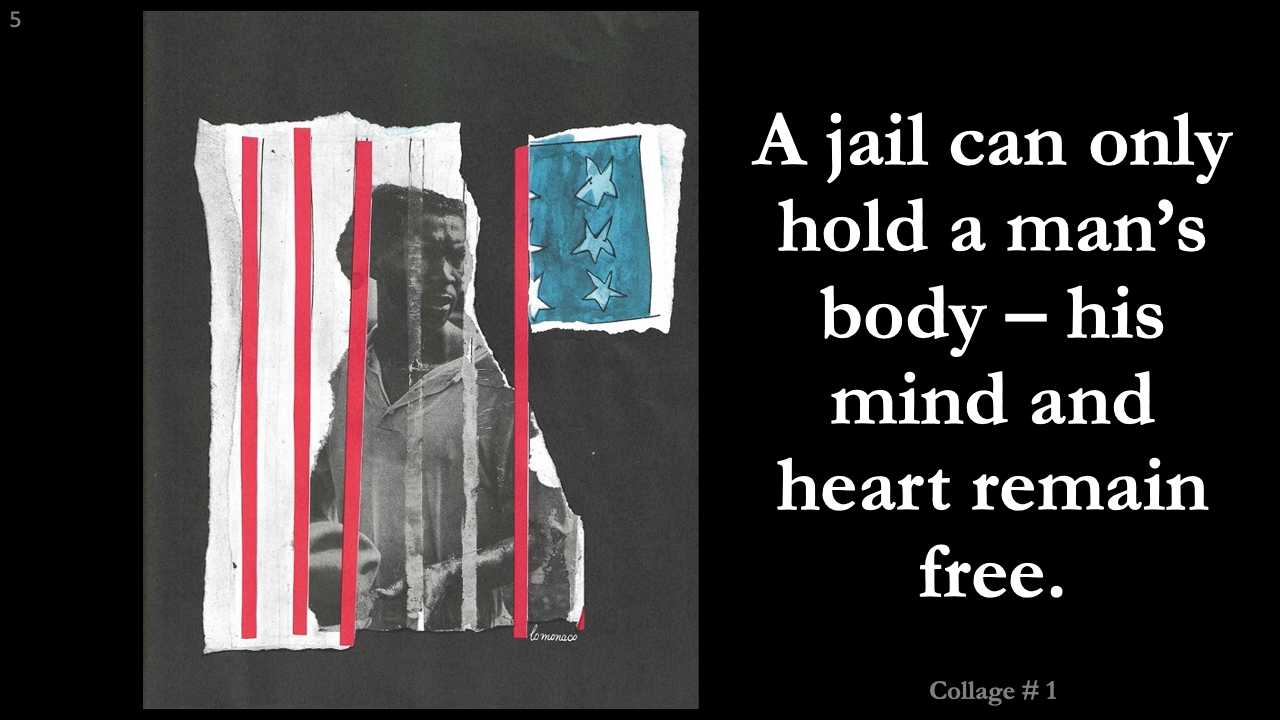
This first collage image is entitled “A jail can only hold a man’s body – his mind and heart remain free.” It testifies to those arrested and jailed for demanding their right to equal opportunity and equal treatment before the law. Even today, every – and I really mean every – man of color I know well has shared stories of being stopped and harassed, and sometimes arrested, simply because of their skin color. Guilty only of their black skin.
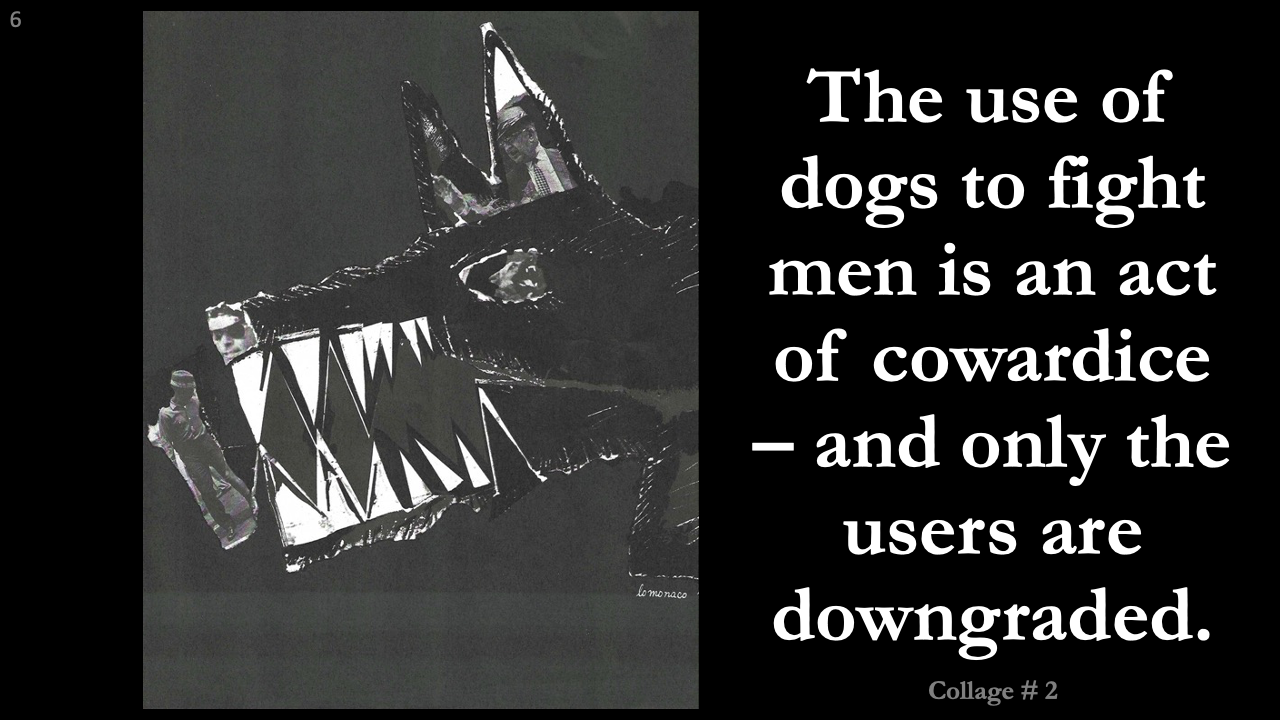
The second image refers to the police dogs used to attack Civil Rights protestors, proving the brutality and inhumanity, and cowardice, of those who use force to twist the law to serve their own interests.
You’ve heard that Black Parents teach their children, especially their sons, to be super-cooperative with the authorities. Can you imagine always worrying that your child will wind up in jail, or a hospital, or a morgue, when just going down to the corner store to get a package of gum? That’s what happened to Travyon Martin.
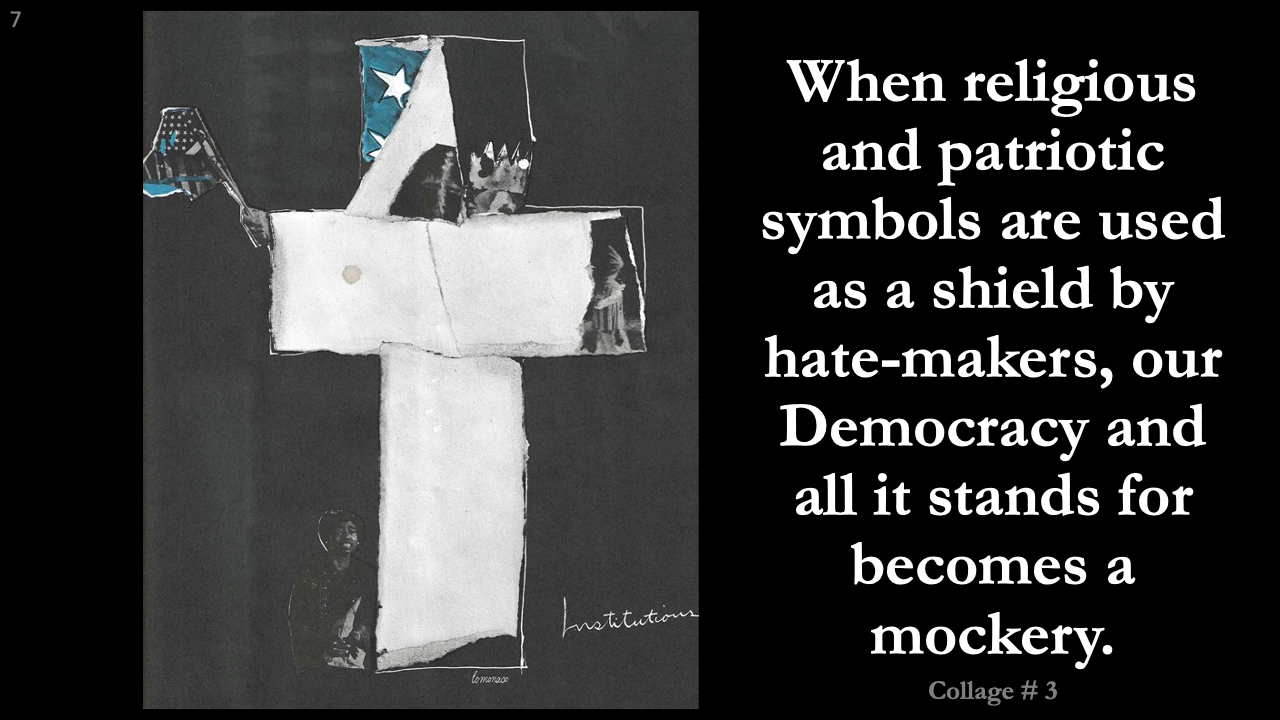
The third image references how racism was promoted – and is still promoted – as free speech, wrapped in the trappings of faith and country: the burning of crosses, the waving of the US or Confederate flags; the erection of monuments to racist heroes.
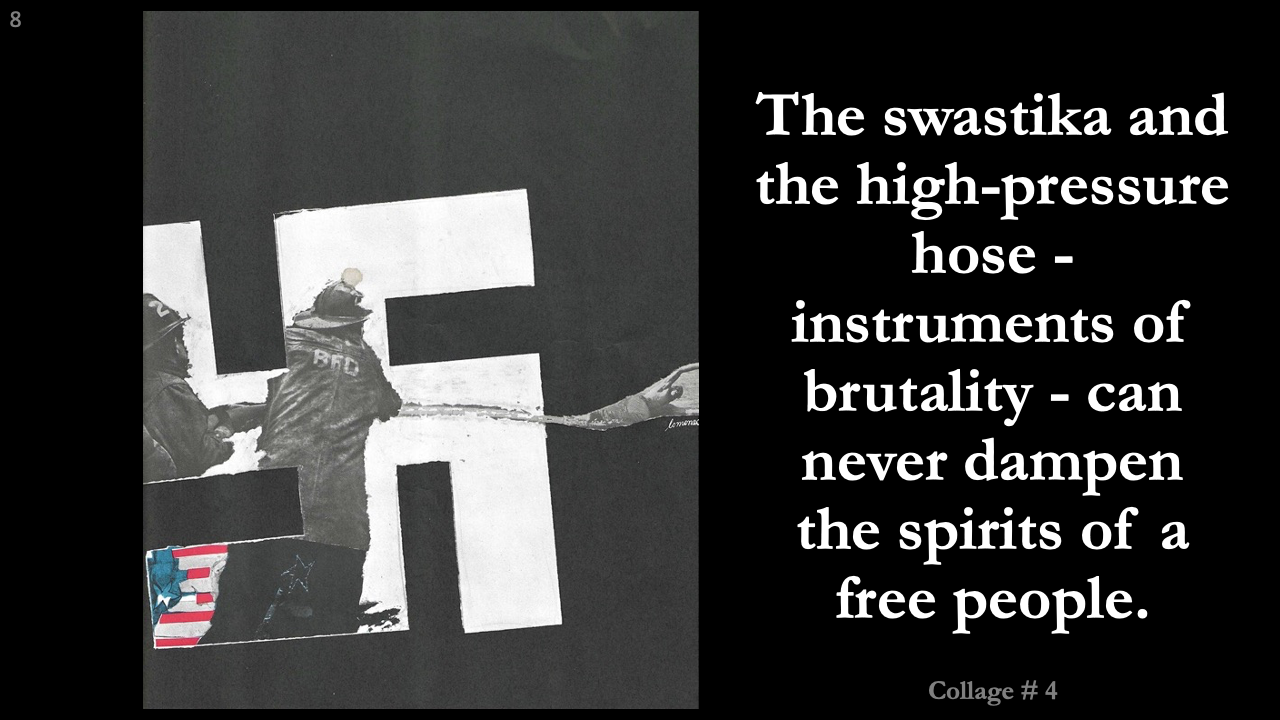
The fourth collage superimposes a swastika over a demonstrator being hit with a high pressure firehose. Similar to the first image, the message here is that those with power can and will inflict harm upon the bodies of those who challenge them, but in the end that will not matter. African Americans have survived four centuries of unimaginable and unending terror and abuse and oppression. And yet, their minds and their spirits remain free.
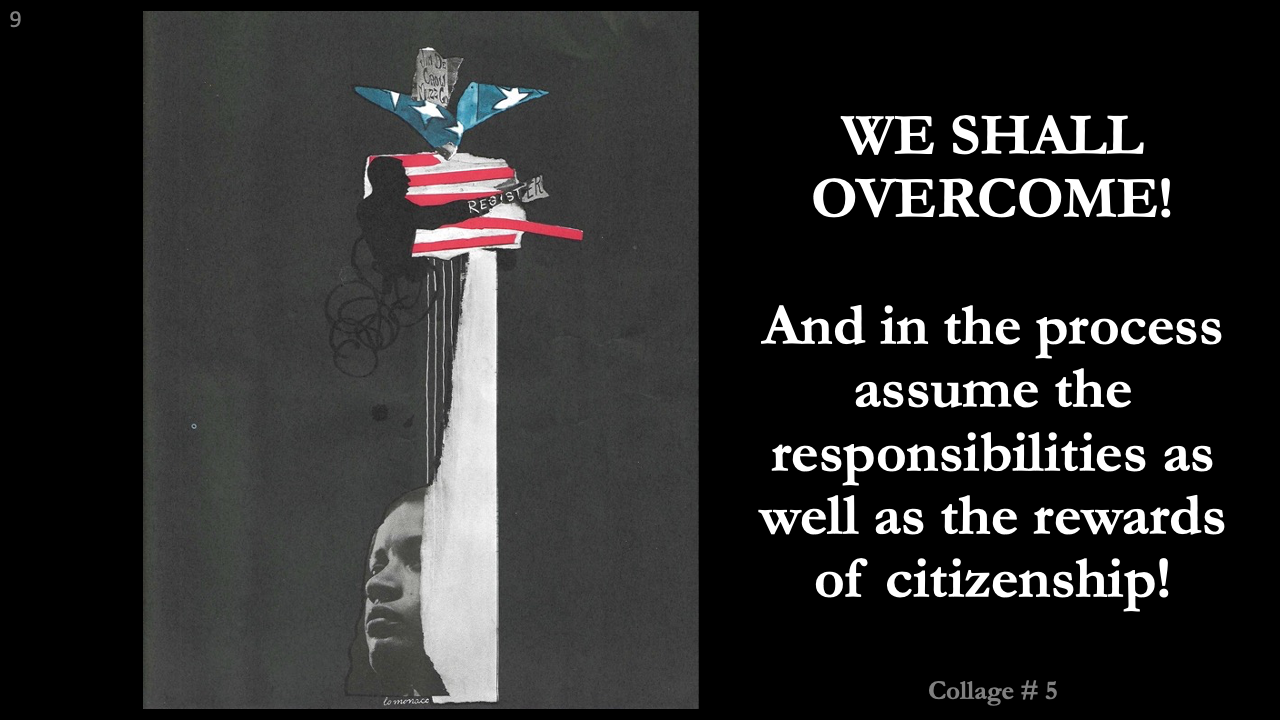
And finally, They Shall Overcome. They will continue to endure what must be endured, even unto death. King specifically said so in his last speech before his assassination.
We understand how and why our black sisters and brothers are not and can not be satisfied with half measures. Bandaids and delays over addressing the deep wounds and injustices that threaten to destroy America’s Democracy, and ultimately us all, cannot be tolerated any more. They Shall Overcome. We shall overcome. It is inevitable; and our faith compels us to stand in solidarity, and as witnesses on behalf of all who struggle to be free and equal citizens of this country.
The March on Washington and Dr. King’s speech was a high point in an exciting, painful, inspiring, and difficult era. The challenges were great and the foes powerful, but the cause is mighty and just. The people there that day, and those they represented, were united in their determination to create a more perfect world: the New Jerusalem, the Kingdom of God here on Earth that is prophesied in Scripture. They were, and are, determined to march to that mountaintop.
That day the Preacher said, “One hundred years later, the Negro lives on a lonely island of poverty in the midst of a vast ocean of material prosperity. One hundred years later the Negro still languishes in the corners of American society and finds himself in exile in his own land. And so we’ve come here today to dramatize a shameful condition. In a sense we’ve come to our nation’s capital to cash a check.”
My father reflected on his experiences in a sermon a few weeks later. He began with the same reading from Exodus we have this morning; and then said, and I quote, “Washington finally opened my eyes to the Book of Exodus through the eyes of the Negro Spiritual, ‘Go Down Moses.’ I caught a sense of the vision and hope that enables people to stand up against fire hoses, endure abuse and insult and prison, and lead their children to school through sullen crowds.”
Here we are, 60 years later, still fighting the same battles, over the same ground and same ideals, some springing back to life long after we thought they had been permanently resolved. People of Color are still oppressed, still denied basic human rights because of their skin, a skin they cannot escape.
The pilgrimage to Washington helped my father understand that he would never fully grasp what it is like to be a person of color living under the legacy of centuries of oppression and abuse. We will never fully understand, either. But, he now understood their urgent need for action, and realized that pushing back for patience, for a more measured pace of change, while reasonable, placed him on the seat of Pharoah.
Pharoah, he said, is not just a person of power in the story of Exodus, but a person afraid of losing power. Those at the top are always concerned about things that affect the systems that keep them in power. Pharoah was afraid of the Jews, afraid of the disorder and instability their demands created. Afraid of losing them as slaves.
Pharoah looks a little different nowadays, but the same issues are at the heart of our modern conflicts. Our leaders in the 1960’s, and today, are no different in that regard. We delude ourselves into thinking we have the right to manage and lead our brothers and sisters on the path to equality and dignity. But do we? We are part of the system, we benefit from it. The changes needed will threaten our positions. So, it is easy to see – and portray – change as a threat to who we are, as many did then, and many do still.
But, the Preacher said, “…many of our white brothers, as evidenced by their presence here today, have come to realize that their destiny is tied up with our destiny. And they have come to realize that their freedom is inextricably bound to our freedom. We cannot walk alone.”
This, I believe, is the heart of the challenge and the invitation that we have been given: will we embrace and affirm our brethren, regardless of color, regardless of creed, regardless of gender, regardless of who they love, regardless of faith, regardless of position, regardless of power. Will we love them without reservation, without prerequisite, and without judgment, as our faith demands we do?
In his last speech before his assassination in 1968, King closed with these words, echoing God’s prophesy to Moses in Exodus: “I just want to do God’s will. And He’s allowed me to go up to the mountain. And I’ve looked over. And I’ve seen the promised land. I may not get there with you. But I want you to know tonight, that we, as a people, will get to the promised land. And I’m happy tonight. I’m not worried about anything. I’m not fearing any man. Mine eyes have seen the glory of the coming of the Lord.”
King knew his work would eventually be completed, that little boys and little girls of every race would someday play and grow up together in peace, in happiness, and in prosperity. But he never saw that time, and neither have we.
Change is never easy, and if it is to last, the deep-seated change required to root out centuries of injustice and oppression will not happen quickly, nor will doing so be comfortable or safe. Yet, it is a challenge we cannot avoid or delay.
The bill due is a mighty one. It was presented to us at the conclusion of the Civil War. The passing of the 13th, 14th, and 15th Amendments promised payment on that debt. Our brothers and sisters endured another century of suffering and oppression, and then – as King said – asked for the check. A partial payment was made, and incremental and uncertain progress has been made in the decades since. But when will we finally pay up on the rest of that bill? When and how will we finally honor that check?
It’s significant how the passage in Exodus ends. God said to Moses, “I will be with you; and this shall be the sign for you that it is I who sent you: when you have brought the people out of Egypt, you shall worship God on this mountain.”
No miracle brought the people to that mountain without cost. The miracle was the journey out of Egypt that got them there, the journey they made with their own feet across a hot, dry desert. The sign occurred because they undertook the challenge, and persisted until they succeeded. Their work fulfilled God’s promise to Moses.
Our role is one of support, not leadership. We are not here to solve the problem, but to help make sure it issolved; not set aside, weakened, or forgotten. We are not the light that chases away the shadows within which injustice thrives. We are a lens others use to focus and strengthen that light. We are here to be take part in the journey, not lead it.
Our Sisters and Brothers demand a consequential voice in the politics and economy of our nation. We are called to help make sure that happens: supporting and walking with those who are working to fulfill Dr. King’s vision.
This congregation has always shown itself to be generous in its support and affirmation of those who are Other. We are in it for the long term, dedicated to achieving our faith’s vision of Heaven here on earth: a Kingdom for all, not just for us. We understand that our destiny is tied up with the destiny of our neighbors. We know, and demonstrate, that our freedom is meaningless unless they are also free.
We shall overcome. We may not see The Preacher’s vision realized in our lifetime, but every bit we do to support the cause brings the Kingdom of God closer, and brings us closer to God.
Amen.
Scripture Readings…
7Then the Lord said, “I have observed the misery of my people who are in Egypt; I have heard their cry on account of their taskmasters. Indeed, I know their sufferings, 8and I have come down to deliver them from the Egyptians, and to bring them up out of that land to a good and broad land, a land flowing with milk and honey, to the country of the Canaanites, the Hittites, the Amorites, the Perizzites, the Hivites, and the Jebusites. 9The cry of the Israelites has now come to me; I have also seen how the Egyptians oppress them. 10So come, I will send you to Pharaoh to bring my people, the Israelites, out of Egypt.” 11But Moses said to God, “Who am I that I should go to Pharaoh, and bring the Israelites out of Egypt?” 12He said, “I will be with you; and this shall be the sign for you that it is I who sent you: when you have brought the people out of Egypt, you shall worship God on this mountain.”
Exodus 3:7-12 (NRSV)
“…many of our white brothers, as evidenced by their presence here today, have come to realize that their destiny is tied up with our destiny. And they have come to realize that their freedom is inextricably bound to our freedom. We cannot walk alone. And as we walk, we must make the pledge that we shall always march ahead. We cannot turn back. There are those who are asking the devotees of civil rights, when will you be satisfied? We can never be satisfied as long as the Negro is the victim of the unspeakable horrors of police brutality. We can never be satisfied as long as our bodies, heavy with the fatigue of travel, cannot gain lodging in the motels of the highways and the hotels of the cities. We cannot be satisfied as long as the Negro’s basic mobility is from a smaller ghetto to a larger one. We can never be satisfied as long as our children are stripped of their selfhood and robbed of their dignity by signs stating “for whites only.” We cannot be satisfied as long as a Negro in Mississippi cannot vote and a Negro in New York believes he has nothing for which to vote. No, no, we are not satisfied, and we will not be satisfied until justice rolls down like waters, and righteousness like a mighty stream.”
Excerpt from Dr. Martin Luther King Jr’s “I Have a Dream” Speech, August 28, 1963
Delivered at Memorial Congregational Church UCC in Sudbury MA, August 13, 2023: (11th Sunday after Pentecost)
Copyright 2023, Allen Vander Meulen III, all rights reserved.
This work is licensed under a Creative Commons Attribution-NonCommercial 4.0 International License.

 The Here and the Hereafter