
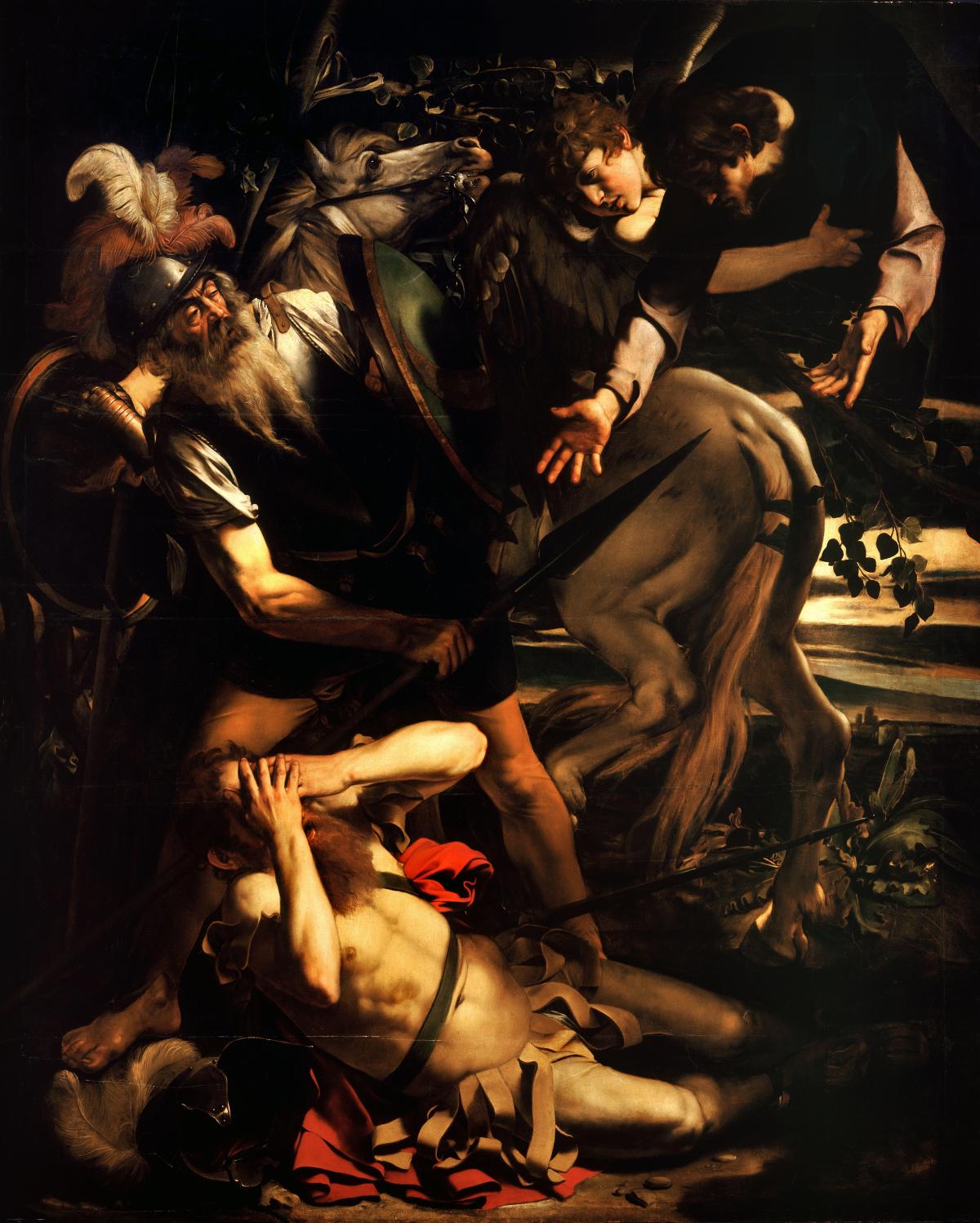
Paul’s Epistle to the Romans is a dense and complex text. We will examine just one thread of the many he surfaces in this morning’s reading…
Please join me in prayer… … Lord God, may your peace and Holy Spirit fill this place. Open your scriptures to us, and may I clearly communicate what you intend us to receive. May your Word take root and flourish within each and every one of us, and through it may we be strengthened and transformed by your unconditional, living, and limitless love for each and every one of your children. In Jesus Name, Amen.
The world is a dismal, frightening, imperfect place; and we’re tired. It isn’t like it was in the “Good Old Days.” (On the other hand, even the good old days were not like the Good Old Days.)
But seriously, we’re tired. Tired of one crisis after another. Tired of existential problems that never go away. Tired of our own endlessly repeating kaleidoscope of challenges and problems. We’re even tired of being tired.
And in this perpetual exhaustion, we find that we don’t always demonstrate that we are the caring and loving individuals we know ourselves to be. We promise ourselves we’ll be a good friend, or a great leader, or an inspiring example to others. We aspire to going above and beyond just doing the minimum needed to survive. But we don’t always follow through, or we … just … fail. Fulfilling such promises to ourselves and others is just too much. Life is too much.
Even so, I’m sure we all remain calm when things don’t go as planned. We never give in to anger and despair when we don’t measure up – again – to our own expectations. (Let alone the expectations of others.) We never pick some other target of convenience to blame. We never lash out. (Ahem…)
Honestly though, we admit to enjoying replying to that idiotic post with a really nasty and to the point meme. (That’ll show ‘em!) We’ve all cut off other drivers in traffic – because they deserve it, of course. We never yell obscenities at Siri. And even if we did, she can take it! [Hey Siri, can you take it?]
Dumping our internal negative energy upon others is a way to cope. We are applying it to a proxy that we can then annihilate or ignore – externalizing our pain and frustration so it can be a target. This is a very human response. We use it to relieve the self-recrimination and pressure caused by our constant failure to achieve the image we have of ourselves.
But it doesn’t work. All of that distress just continues to ferment within us. Projecting it on others harms and inflames them. And, perpetuates the cycle: ultimately hurting us, too. Blaming others for that which is within us leaves the root cause untouched. It stays there, smoldering; always ready to ignite another inferno. In our hearts we despise ourselves for what we’ve done. We know it’s wrong, whether deliberate or not. And, we know it only allows that inner turmoil to fester even more. But, we still do it.
Blaming the other helps us avoid confronting the source of it all. We are masking our own frailty and failures from others, and from ourselves. It is a futile attempt to hide from the inevitable consequences of being human.
How do we deal with this? That one lesson I take from this morning’s reading. Paul says we can’t escape the imperfection within us, this thing that makes us do that which we do not want to do, but do anyway. We can’t eliminate this sin, this evil nature that is within all of us, because it is an essential part of who we are. …Wretched people are we. Who can rescue us from these bodies of death?
I understand this inner imperfection as what we call “Original Sin.” The idea that we all have a flaw within us that has always been there, and always will be. We can’t fix it, and we can’t ignore it. But, we still try: over and over and over again. …Aren’t you tired of that? I am, and Paul was too.
And this that is within us causes so much harm – whether we will it or not. The world is an imperfect place. And, we contribute just as much to that imperfection, that evil, as anyone else. We are all complicit in creating and perpetuating the pain and failure that we all endure together throughout our lives. And, we can’t stop doing it.
Kind of depressing, don’t you think?
We don’t want to be lost, anymore. We don’t want to be alone, anymore. We don’t want to live in this world of uncertainty, and hopelessness, and despair, any more. We don’t want problems. We want peace. We want to do what’s right. But, to be perfectly honest with ourselves, we always seem to get in the way of what we really want to be, or to do. Being lost or alone or depressed or angry aren’t the problems. They’re the symptoms: we are our own worst enemy.
The misery and despair and anger and hopelessness we all experience is real, and present. To address that means we must also be real and present. Easy platitudes, inspiring sermons, and breezy assurances that Jesus heals all, aren’t enough. Nor should they be. Such empty promises only deepen the dark pit that our neighbors, our loved ones, and we, find ourselves in.
We’ve run out of answers. We have no solutions. We realize that we can’t solve the basic problem, the problem of ourselves. We can never be the strong, independent, self-sufficient icon of American Goodness and Values, that we imagine ourselves to be.
Paul knew all this, and was shown a better way.
He knew bad stuff is going to happen, and that we can’t stop it. Even if we could make the world a perfect place: no more shootings, no more global warming, no COVID, and especially no more politics; it would not, and could not, stay that way. That’s because human beings live here. We live here. And, we always fall short.
We will always be confronting new problems, new disasters, new darkness, and new wannabee saviors with simple and compassionless answers to complicated problems. We know that our inadequacies always make things worse. All that changes is how the challenges look to us. The root cause never changes because it is an inescapable part of us.
Paul’s answer is to accept that we are all sinners; even trumpet that fact, as he did. He gloried in his weakness and failure throughout his ministry. He knew there is no one else to blame. There is no scapegoat. We are the problem.
There’s nothing we can do about it. Yelling, stomping on the ground, or blaming others won’t solve our problems. Denying we’re imperfect won’t work: things will just get worse!
And you know, one thing we all learn with time is that you can’t rescue someone who doesn’t think they’re in trouble. Think of all the cranks on Twitter, or on Tik Tok, or YouTube, and elsewhere. What about that “Angry Uncle” we all seem to have?
They “know” they have the answers. We “know” they don’t. We try to rescue them from their ignorance. But, they keep on prancing along as they always have. They are oblivious if not outright dismissive of our good intentions and superior knowledge. They see us as a bunch of obstructive, dense “know-it-alls” who really know nothing. They’re right.
That’s how we see them, and that’s how they see us. We think we’re better informed. And yes, we may well be, but that’s not the point, nor the problem. Such judgments ignore the common frailty and failure – the humanity – that we all share. Such judgments refuse to acknowledge that root cause that is within all of us. Our “Angry Uncles” are fighting the very same internal war we all fight. Like us, they are looking for hope, for a path to salvation, and for inner peace.
And until they, and we, admit to ourselves that we are lost, we literally cannot and will not hear anything The Other has to say. It won’t matter how well-intentioned, or well-informed, or caring, we think we are.
Our faith teaches that judging others is not our job, but God’s. We’re only called to love, without condition, without prerequisite, and without judgment. That can be really hard to do. We are not called to correct our Angry Uncle, but to love him.
As a young man, Paul was just as frustrated and bitter and tired as any of us. His world was not working the way it is supposed to. He was sure Jesus was a fraud. No Messiah would dare look and act and die like Jesus did! The Jews needed a living hero, not an executed criminal. And besides, his death had changed nothing. The Jews were still oppressed. Israel was still not free. And injustice and oppression were still everywhere.
And yet, these crazy Christians challenged all that he knew to be right. They rejected how he saw the world. So, he knew they must be the ones responsible for all of his problems.
He projected all this upon those clueless Christians; and, his solution to make it all go away was to eliminate them. But then, he was shown that the real challenge was entirely within himself. You can’t solve a problem if you don’t know there is one. You can’t be helped or healed if no one knows you are hurting. You can’t solve a problem by dumping your pain on others.
Acts Chapter 9 tells us the scales then fell from Paul’s eyes. He saw he could not solve the problems around him, because he was part of the problem. No human agency could force him to realize any of this. That revelation came only through the power and grace of God.
Just like Paul, once we admit we need to change, then God has room to work within us. After all, why would we need God – or Jesus – if we are perfect? We wouldn’t.
So, this lesson from today’s reading seems simple and obvious, but it is very hard to achieve. Healing can’t be done on our own, or on our terms. Walls built to shut out the bad stuff always fail. Smashing that which we see as standing between us and inner peace only creates more havoc and hate and despair for everyone, including ourselves.
Paul said “he went out on a limb, trusting me.” God trusted Paul, the murderer. Paul, was a man who had proved himself unworthy of any sort of grace or redemption. Paul, knew how to hate, but not how to Love. And yet, God trusted him. God trusts us. To achieve perfection, we must love those who are imperfect, including ourselves. We must open ourselves to the risk of embracing and affirming and loving The Other and Ourselves just as we are. This is what being an “Open and Affirming Church” is all about. And so, guided by the Love of Christ, the followers of Jesus came to love Paul despite all he had done. They recognized he was just as flawed, beautiful, worthy and wonderful in the eyes of God as they.
Glory to God.
Amen.
Scripture Readings:
Romans 7:15-25a [NRSV] – Paul’s Discourse on how sin prevents him from doing what is right.
Acts 9: “The Conversion of Saul on the Road to Damascus”.
Delivered at Memorial Congregational Church UCC in Sudbury MA, July 9, 2023: (6th Sunday after Pentecost)
Copyright 2023, Allen Vander Meulen III, all rights reserved.
This work is licensed under a Creative Commons Attribution-NonCommercial 4.0 International License.

 The Here and the Hereafter